


- Products
- Catalogs
- News & Trends
- Exhibitions
How to Choose & Use Vibratory Feeders and Conveyors

How to Choose & Use Vibratory Feeders and Conveyors
The document offers guidance on selecting and using vibratory feeders and conveyors for moving raw and unfinished goods in process applications, excluding belt conveyors and equipment for finished goods.
Conveying refers to transporting materials, while feeding maintains material flow. Feeders control material flow into subsequent process stages.
Vibratory equipment moves materials through rapid back-and-forth motion. Key variables include amplitude, frequency, and angle of deflection, which control the feed rate.
Single-mass systems transfer vibration directly to the tray, while two-mass systems use springs for efficiency advantages.
Components include a drive system, tray or trough, and springs. Drive systems can be electromagnetic or mechanical, each with specific benefits.
Electromagnetic drives are energy-efficient and precise, with AC models being more efficient. Mechanical drives include brute force, eccentric shaft, and direct drive systems.
Springs convert drive vibration into motion, made from materials like fiberglass, rubber, and steel, each suited for different applications.
Trays and troughs must be balanced and are made from materials like mild or stainless steel, with various coatings available.
Equipment choice depends on material size, moisture content, and other factors. Fine, midsize, and coarse materials have different feeder requirements.
Understanding material and process needs is crucial for selecting appropriate vibratory equipment for efficient operation.
The document details vibratory feeders and conveyors, their specifications, applications, and operational considerations, including contact information for Eriez Magnetics.
Bulk density affects feeding characteristics. Light materials feed slower than heavier ones. High deflection feeders are recommended for lightweight products.
Rigid products suit electromagnetic feeders, while flexible products are better with high deflection feeders. Fragile materials should use high deflection units to minimize damage.
Feeder capacity to handle head load is crucial, especially under a hopper, requiring operation at full amplitude.
Electromagnetic feeders are ideal for cycling applications due to their design without belts or moving components. Service type and length should be considered when selecting equipment.
- Electromagnetic Feeders: Include small A & C models, high-speed, high deflection, inertial feeders, and B feeders for specific applications and capacities.
- Mechanical Feeders: Include Ultra Force, HV, and Brute Force feeders, each with unique designs and capacities for different materials and applications.
Discusses various conveyors like VMC, SM, TM, HV, and Horizontal Motion Conveyors, each for specific applications and materials.
Provides contact details for Eriez Magnetics' global offices, highlighting their capability to provide custom solutions.
Catalog excerpts

The need to move, convey and feed product exists in virtually all industries. Whether asophisticated food processing plant or a simple packaging line, product needs to move from one area to the next. This book, How to Choose and Use Vibratory Feeders and Conveyors will focus on selecting vibratory equipment to move raw and unfinished goods in process applications meaning, it will not discuss belt conveyors, forklift trucks, gravity flow storage systems or pick and pack modules moving finished goods. It is written to help users select the correct vibratory feeder, conveyor or screener for theirparticular...
Open the catalog to page 3
HOW VIBRATORY EQUIPMENT WORKS The Vibratory Movement Vibrating, again by definition, means to move back and forth rapidly.Ӕ The equipment and process solutions described in this guide all use this rapid back and forthӔ motion to move or convey product. On a vibratory feeder, material is thrownӔ up and forward so that it drops to the surface at a point further down the tray. This is the feeders amplitude. The number of times per minute that this repeats is the frequency. A third variable is the angle of deflection҅ meaning how high the product is thrown as compared to its horizontal movement....
Open the catalog to page 4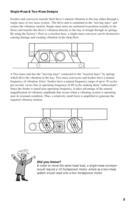
Single-Mass & Two-Mass Designs Feeders and conveyors transfer their drives natural vibration to the tray either through asingle mass or two mass system. The drive unit is contained in the ғmoving mass and creates the vibratory motion. Single-mass units are anchored in position (usually to the floor) and transfer the driveԒs vibration directly to the tray or trough through its springs. By using the factorys floor as a reaction base, a single-mass conveyor can be destructive causing damage and creating vibration in the shop floor. A Two-mass unit has the ғmoving mass connected to the ԓreaction...
Open the catalog to page 5
Dense Rubber Springs are typically used on heavy-duty feeders and conveys to providestability and motion control between the drive and the tray. However, rubber springs are limited to use in environments below to 120 F. Steel Coil Springs are commonly used in heavy duty and high temperature applications.These coils are effective in ambient temperatures up to 300 Fiberglass Springs (or boards) are the most popular springconfiguration for light and medium duty applications. Fiber- glass springs of varying lengths, widths and thickness are mounted on the moving mass of the drive and are attached...
Open the catalog to page 8
Product Size One of the most obvious considerations when selecting vibratory equipment is the size ofthe material to be processed. There are many factors involved in choosing the proper vibratory feeder, conveyor orscreener. The material being processed is the most important element in selecting equipment. Many standard models of feeders and conveyors can be fine tuned to improve the product flow. Selecting the proper equipment for the type of application can ensure years of trouble free service. Below are some of the key considerations. Material Considerations Coarse Material Midsize Material...
Open the catalog to page 9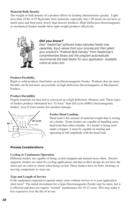
Material Bulk Density The weight or bulk density of a product effects its feeding characteristics greatly. Light (less than 10 lbs (4.53 Kg)/cubic feet) materials, especially fine (-50 mesh) do not have as much mass and feed more slowly than heavier products. High Deflection electromagnetic or mechanical feeders handle these light weight products effectively. Did you know? Eriez FeederCap > Ү software helps calculate feeder traycapacities. Input values from your process and then selectyour products ғMaterial Bulk Density from FeederCapԒs comprehensive library and the program automaticallyrecommends...
Open the catalog to page 10
B Feeders Eriez B Feeders are heavy dutyElectromagnetic Feeders designed for the glass, steel, chemical, fastener, coal, and aggregate markets where high capacity is required with the best linearity. B Feeders are virtually maintenance free. They can be provided with abrasion resistant replaceable liners and with capacities of 400-1700 cubic feet (11.32 - 48.13 cubic meters)/hour. 11 Inertial Feeders ֖ The I-36 and I-56 Inertial Feedersare special light-duty Electromagnetic Feeders designed to replace multiple side-by-side drives. This type of feeder has application in feeding small amounts of...
Open the catalog to page 11
Feeders, Mechanical Ultra Force Feeders The Ultra Force Mechanical Feeder is a two-mass coil springdesign using a motor driven eccentric shaft. It uses standard off-the-shelf motors and bearings and will feed capacities of 2,000-25,000 cubic feet (56.63 to 707.92 cubic meters)/hour of aggregates, glass, steel, and coal. HV Feeders ֖ is a unique low profile two-mass rubber spring design using standard off-the-shelf components. It is ideal for use in tunnels or in areas where headroom is a problem. HV Feeders have capacities of 2,000-40,000 cubic feet (56.63 to 1132.67 cubic meters)/hour of aggregates,...
Open the catalog to page 12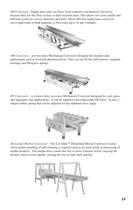
SM Conveyors - Single mass units are Eriez' least expensive mechanical conveyors,because they use the floor or base as their reaction mass. This allows for a low profile and efficient system to convey materials and parts. These efficient single mass conveyors move light loads of bulk materials at flow rates up to 18 tph (16mtph). TM Conveyors are two-mass Mechanical Conveyors designed for medium dutyapplications such as food and pharmaceutical. They use an off-the-shelf motors, standard bearings and fiberglass springs. HV Conveyors ֖ is a heavy duty two-mass Mechanical Conveyor designed for coal,...
Open the catalog to page 13
Eddy Current SeparatorsMagnetic Rails Magnetic Rolls Sheet Fanners Lifting Magnets Holding Magnets Coolant Cleaners Magnetic Conveyors Vibrating Conveyors Mechanical Conveyors Vibratory Feeders Volumatic Feeders Bin Vibrators Precipitator Vibrators Screen Separators CUSTOM EQUIPMENT & APPLICATIONS Eriez operates the largest Test and Research facility of its kind for developing customequipment to meet the most demanding applications. Contact a product manager to design the perfect vibratory solution for your specific needs. NOTES: FOR MORE INFORMATION on vibratory feeders, conveyors or any of...
Open the catalog to page 14All ERIEZ catalogs and technical brochures
 Chip and Parts Conveyors
8 Pages
 Recycling
6 Pages
Archived catalogs
 CHIP & PARTS CONVEYORS
2 Pages
 E-Z TEC® 9000 R
4 Pages
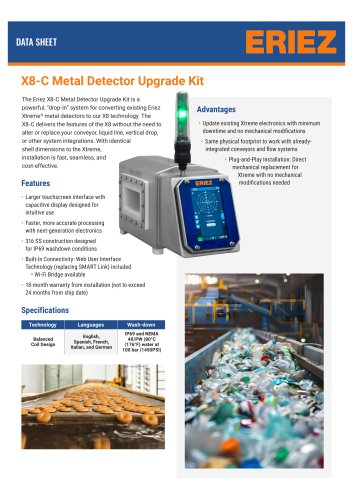
 Xtreme Metal Detector
8 Pages
 HEAVY DUTY VIBRATORY FEEDERS
16 Pages
 VIBRATORY FEEDERS AND CONVEYORS
20 Pages
 lifting magnets
24 Pages
 COOLANT CLEANERS
12 Pages
 Magnetic Drum Separators
16 Pages
 Wet Drum Separators
8 Pages
 Metal Sorting
4 Pages
 PRL Primary Samplers
2 Pages
 PRV Samplers and Splitters
2 Pages
 2614 Pneumatic Vibrator
2 Pages
 DDS Dynamic Drum Separator
2 Pages
 Eddy Current Separators
4 Pages
 Eriez Magna Chute
1 Page
 Magnetic Hoppagrid
2 Pages
 MACSALAB Filter Presses
1 Page
 MACSALAB Jaw Crushers
1 Page
 ProGrade Bullet Magnet
1 Page


- Industrial vacuum cleaner
- Mobile vacuum cleaner
- Horizontal conveyor
- Solids separator
- Inspection system
- Bulk material screening machine
- Centrifugal classifier
- Liquids separator
- Electric drive conveyor
- Inclined conveyor
- Eddy current separator
- Wet vacuum cleaner
- Work conveyor
- Wheel-mounted vacuum cleaner
- Vibration motor
- Cascade separator