
- Catalogs
- ERICHSEN GmbH & Co. KG
- Technical Description Model 293


Technical Description Model 293
Technical Description Model 293
Catalog excerpts
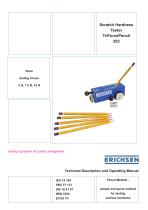
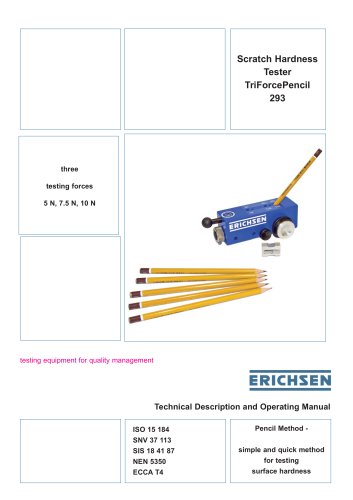
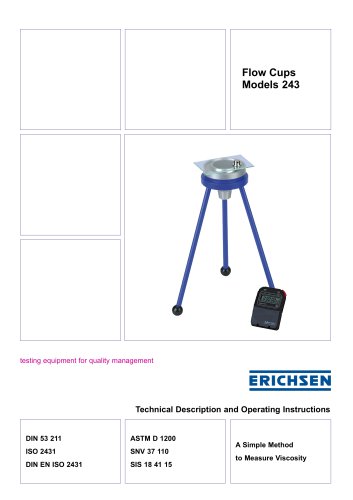
Scratch Hardness Tester testing equipment for quality management Technical Description and Operating Manual ISO 15 184 SNV 37 113 SIS 18 41 87 NEN 5350 ECCA T4 Pencil Method - simple and quick method for testing surface hardness
Open the catalog to page 1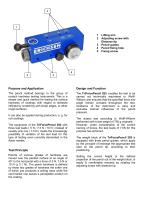
Lifting arm Adjusting screw with Distance tip Pencil guides Pencil fixing hole Fixing screw The pencil method belongs to the group of scratch hardness testing instruments. This is a simple and quick method for testing the surface hardness of coatings with regard to stresses inflicted by scratching with sharp edges, or other rough surfaces. The TriForcePencil 293, enables the test to be carried out technically equivalent to WolffWilborn and ensures that the specified force and angle remain constant throughout the test. Guidance of the instrument is easy and excludes manual influences of the pencil...
Open the catalog to page 2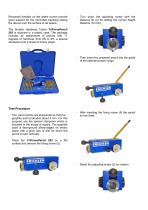
Recessed handles on the wheel covers provide good support for the controlled blanking sliding the device over the surface to be tested. - Turn down the adjusting screw with the distance tip (2) for setting the correct height distance (10 mm). The Scratch Hardness Tester TriForcePencil 293 is supplied in a plastic case. The package includes an assortiment of pencils with 17 degrees of hardness from 6B to 9H, a special sharpener and a sheet of emery paper. - Then insert the prepared pencil into the guide of the selected power range. Test Procedure - The pencil points are sharpened so that the graphite...
Open the catalog to page 3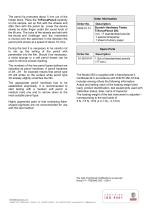
Spare Parts The pencil tip protrudes about 5 mm out of the holder block. Place the TriForcePencil carefully on the sample, set up first with the wheels and after then with the pencil tip. Lower the device slowly by index finger under the round knob of the lift arm. The hubs of the wheels are held with the thumb and forefinger and the instrument is moved over the specimen in the direction the pencil point shows at a speed of about 10 cm/s. During the test it is necessary to be careful not to mix up the writing of the pencil with penetration into the film. Should it be necessary, a moist sponge...
Open the catalog to page 4All ERICHSEN GmbH & Co. KG catalogs and technical brochures
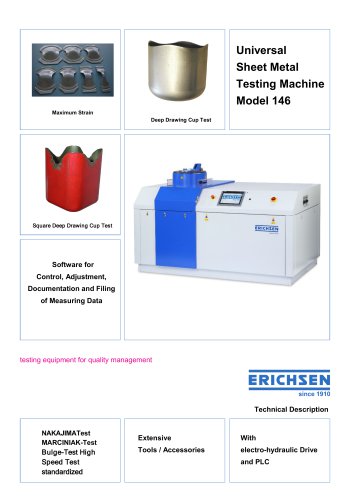 Technical Description Model 146
12 Pages
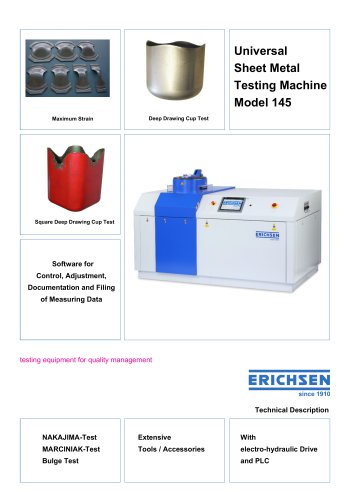 Technical Description Model 145
12 Pages
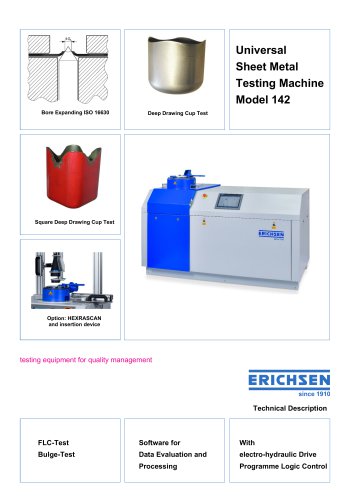 Technical Description Model 142
11 Pages
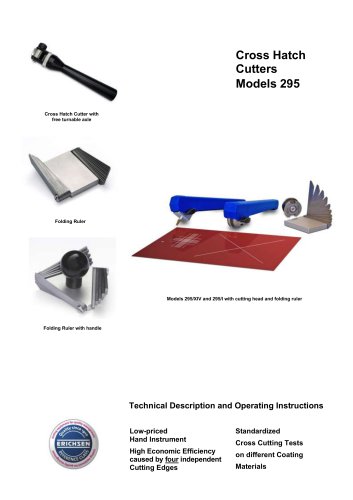 Technical Description Model 295
9 Pages

- Kiln
- ERICHSEN testing machine
- Force sensor
- Measuring device
- Electric furnace
- ERICHSEN test chamber
- Test stand
- Tension/compression force transducer
- Steel load cell
- ERICHSEN automatic testing machine
- ERICHSEN material testing machine
- ERICHSEN temperature test chamber
- Strain gauge force sensor
- ERICHSEN climate chamber
- ERICHSEN quality control test chamber
- Computer-controlled test machine
- Stainless steel force transducer
- ERICHSEN portable tester
- Drying kiln