
- Catalogs
- ERICHSEN GmbH & Co. KG
- Technical Description COATMASTER 510


Technical Description COATMASTER 510
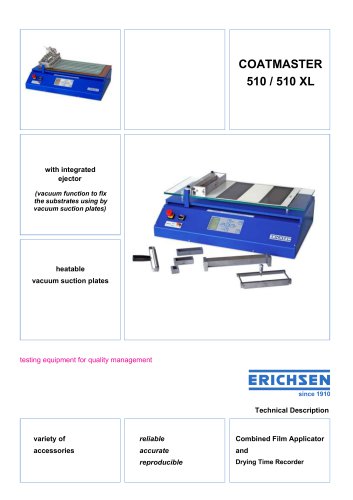
Technical Description COATMASTER 510
Catalog excerpts
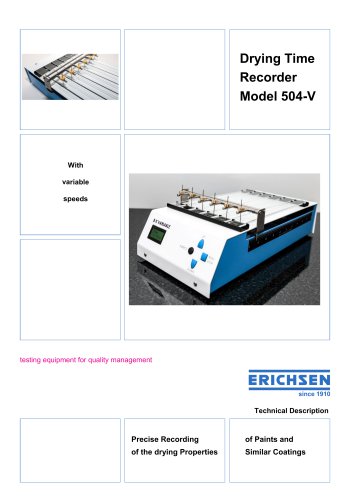
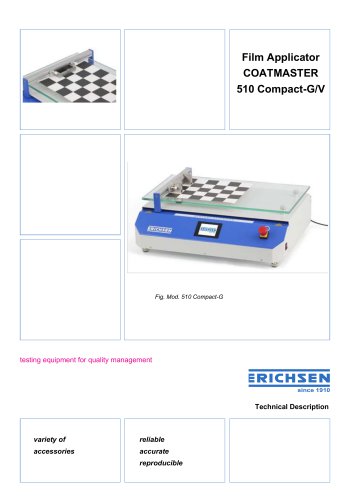
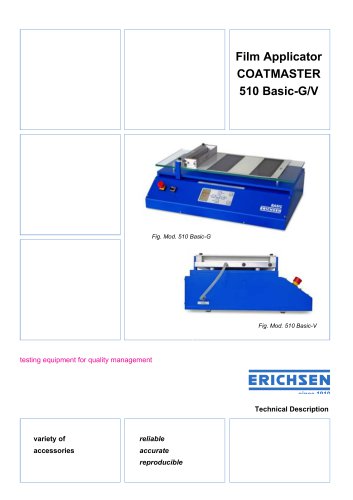
with integrated ejector (vacuum function to fix the substrates using by vacuum suction plates) heatable vacuum suction plates testing equipment for quality management Technical Description Combined Film Applicator Drying Time Recorder
Open the catalog to page 1
Purpose and Application A motorised film applicator is used in cases where • a surface has to be covered with an absolutely uniform film, • reliable information is needed on the relationship between the wet and the dry film thickness, • a large number of exactly identical samples has to be produced. All kinds of inevitable inaccuracies when applying films manually, are avoided by using the automatic drawing method. If extra-long applications are required, the XL variant with a double working distance (80 cm) has proven itself. Often, the particularly accurate and repeatable specification of the...
Open the catalog to page 2
• Vacuum suction plates for foils, papers and cards, in different versions - also electrically heatable, adjustable for temperatures up to 140 °C (upon request up to 150 °C). • Staggered-Gap Film Applicator, Model 421/II, 6 films each 35 mm wide For more detailed information on the film applicators please refer to the individual leaflets 288/358/360/411/421/E as well as 419/E. Attachment for Scratch Hardness Tests • Upon request also heatable platforms without vacuum function are available. Assembly Attachments To mount the film applicators to the COATMASTER appropriate supports are required,...
Open the catalog to page 3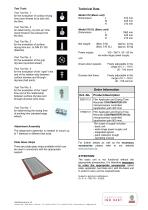
Test Tools Technical Data Test Tool No. 1 for the evaluation of surface drying time (wool thread to be laid onto the film). Model 510 (Basic unit) for determining „no pick-up“ time (wool thread to be pressed into the film). Model 510 XL (Basic unit) dryness (sprocket wheel). Power supply: unit 100 - 240 V, 50 - 60 Hz via wide-range power supply Drawn-down speeds: Freely adjustable in the range of 0.1 - 19.9 / 20 - 100 mm/s Dryness test times: Freely adjustable in the Test Tool No. 6 for the evaluation of the “open time and of the relationship between surface dryness and through-dryness (wire...
Open the catalog to page 4All ERICHSEN GmbH & Co. KG catalogs and technical brochures
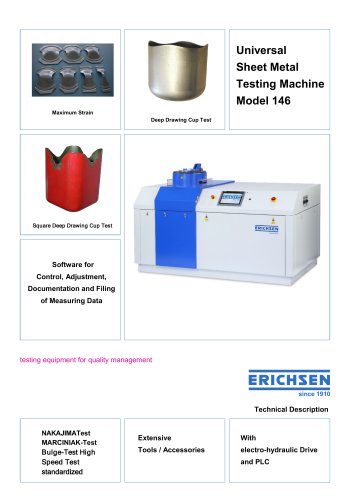 Technical Description Model 146
12 Pages
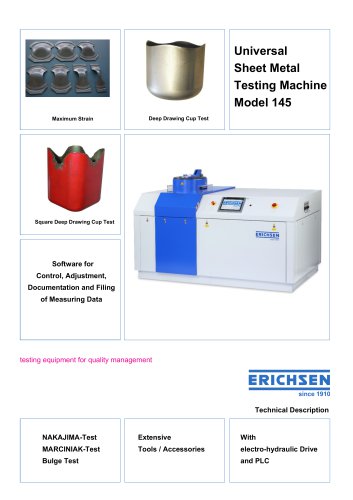 Technical Description Model 145
12 Pages
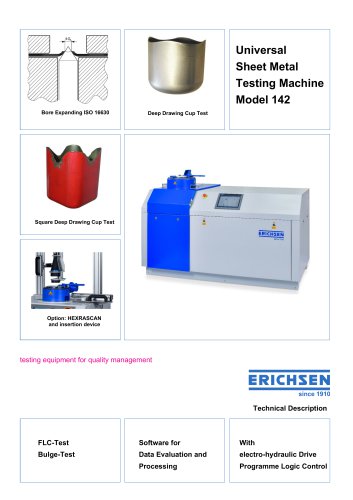 Technical Description Model 142
11 Pages
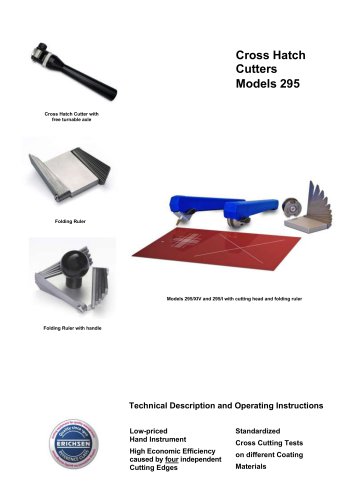 Technical Description Model 295
9 Pages

- Kiln
- ERICHSEN testing machine
- Force sensor
- Measuring device
- Electric furnace
- ERICHSEN test chamber
- Test stand
- Tension/compression force transducer
- Steel load cell
- ERICHSEN automatic testing machine
- ERICHSEN material testing machine
- ERICHSEN temperature test chamber
- Strain gauge force sensor
- ERICHSEN hardness tester
- ERICHSEN climate chamber
- ERICHSEN quality control test chamber
- Computer-controlled test machine
- Stainless steel force transducer
- ERICHSEN portable tester
- Drying kiln