
- Catalogs
- Eredi Caimi S.r.l.
- Pulp biodegrdable packaging


- Company
- Products
- Catalogs
- News & Trends
- Exhibitions
Pulp biodegrdable packaging

Pulp biodegrdable packaging
In today's environmentally conscious world, both consumers and retailers are increasingly aware of the impact of their choices on the planet. Biodegradable packaging is seen as a beneficial development, as it can break down into organic components and return to the environment, reducing pollution and landfill use. However, the effectiveness of biodegradation varies depending on the environment, and current standards primarily apply to industrial composting conditions.
UFP Technologies offers molded fiber packaging made from 100% recycled materials, specifically newspapers and water. This approach not only benefits the environment but also ensures a stable supply of materials, unlike other eco-friendly options that may face shortages. Molded pulp is a proven, sustainable, and biodegradable material that meets high aesthetic standards and is less regulated internationally.
Molded pulp, made from recycled paper, is sustainable, biodegradable, and compliant with environmental standards, unlike EPS, which is non-biodegradable and faces bans. Molded pulp offers stable pricing, excellent protection, and efficient storage and shipping due to its nesting capability. It is unaffected by temperature extremes and is static neutral, making it ideal for electronic components.
Die-cut corrugated packaging is less favorable due to its complicated designs, higher labor costs, and performance issues in humidity. Molded pulp provides consistent vibration and cushioning properties, reducing breakage and costs. It is a more cost-effective and environmentally friendly solution.
Molded pulp is compostable, biodegradable, and offers significant cost savings in storage and freight due to its nesting ability. It provides superior vibration protection, durability, and flexibility, unaffected by temperature changes. Molded pulp also has lower assembly and tooling costs compared to EPS.
Catalog excerpts
There is no question that in today’s world that both consumers and retailers have become more aware of how their decisions are affecting our planet. Few would argue that there is a great benefit in developing products and packaging that are biodegradable. But this begs the question, what does biodegradable mean? While definitions can get very scientific and discuss the differences between aerobic and anaerobic degradation, most people consider biodegradable to mean that the material can be broken down into organic components. Essentially, biodegradable materials can be returned to the environment for re-use as opposed to polluting the earth or increasing landfills for years, decades, or centuries. Of course, as the plastics industry attempts to roll out new biodegradable plastics, people have really started to study the biodegradability of packaging. As one would suspect, biodegradation can take place in many environments, above ground, in soils, in landfills, in compost bins, etc. Unfortunately, while global standards exist to certify compostable plastics (ASTM D6400) and compostable packaging (ASTM D6868), these standards apply primarily to the controlled composting conditions typically found only at industrial composting facilities. It remains quite uncertain as to whether many of these plastics will degrade quickly in standard landfills or backyard compost bins.
Open the catalog to page 1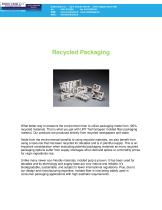
What better way to preserve the environment than to utilize packaging made from 100% recycled materials. That is what you get with UFP Technologies' molded fiber packaging material. Our products are produced entirely from recycled newspapers and water. Aside from the environmental benefits to using recycled materials, we also benefit from using a resource that has been recycled for decades and is in plentiful supply. This is an important consideration when evaluating potential packaging materials as many recycled packaging options suffer from supply shortages when demand spikes or commodity prices...
Open the catalog to page 2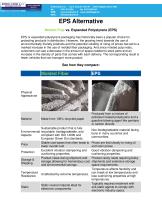
Molded Pulp vs. Expanded Polystyrene (EPS) EPS or expanded polystyrene packaging has historically been a popular choice for protecting products in distribution. However, the growing trend towards the use of environmentally friendly products and the potential volatility of rising oil prices has led to a marked increase in the use of molded fiber packaging. And since molded pulp nests, customers can see a decrease in the amount of space needed to store parts and an increase in the density of parts that comes with each delivery. The corresponding result is fewer vehicles that can transport more...
Open the catalog to page 3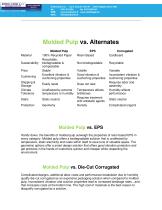
Material Sustainability Price Cushioning Shipping & Storage Climate Tolerance Static Protection Molded Pulp 100% Recycled Paper Recyclable, biodegradable & compostable Stable Excellent vibration & cushioning properties Easily nests Unaffected by extreme temperature or humidity Static neutral Geometry EPS Resin Based Non-biodegradable Volatile Good vibration & cushioning properties Does not nest Temperature affects brittleness Requires treatment with antistatic agents Density Corrugated Cardboard Recyclable Variable Inconsistent vibration & cushioning properties Requires labor and assembly Humidity...
Open the catalog to page 4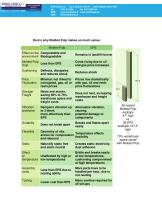
36 nested Molded Pulp endcaps 47" high vs. 36 EPS endcaps 157.5" high 70% warehouse space saved with Molded Pulp
Open the catalog to page 5All Eredi Caimi S.r.l. catalogs and technical brochures
 Polibox
98 Pages
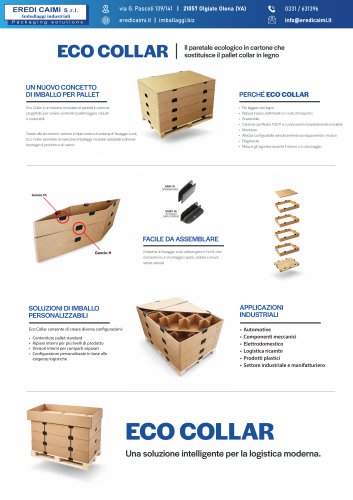 eco collar
1 Page
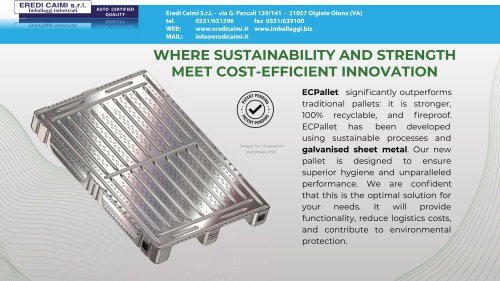 ECP STEEL PALLET
5 Pages
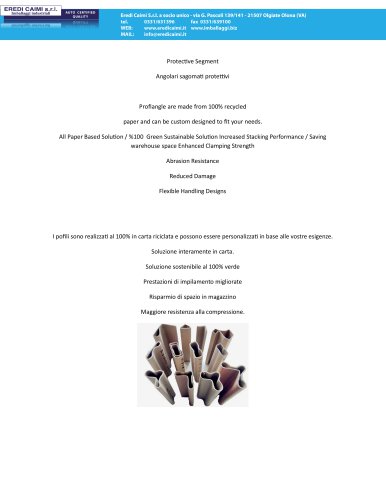 protective segment
4 Pages
 general pulp flex
2 Pages
 box eco pulp
2 Pages
 air cargo system pallet
5 Pages
 wrap pulp
7 Pages
 new componible crate
7 Pages
 paper system protection
1 Page
 cushon paper samples
4 Pages
 About our pulp production
8 Pages
 New pulp solution 2019/2020
2 Pages
 Pulp top finish surface
2 Pages
 case study pulp molded
1 Page
 honeycomb packaging
6 Pages
 plastic collar
1 Page
 dunnage bags 2019
9 Pages
 worldpack
2 Pages
 corner structure
2 Pages
 corner roll edge
1 Page
 corner pre cut
1 Page
 corner huge board
1 Page
 corner coating
2 Pages
 corner production
9 Pages
 corner adhesive
1 Page
 medical pulp packaging
1 Page
 chemic pulp packaging
1 Page
 wine pack magnum
1 Page
 wine pack 3/1
1 Page
 wine pack 1/3
1 Page
 wine pack 1/2
1 Page
 box 800x600
1 Page
 box 1200x800
1 Page
 edge runner for box
2 Pages
 case study carton box
7 Pages
 void filler
2 Pages
 airbag packaging
5 Pages
 cuschion paper
3 Pages
 edge protector corner
6 Pages
 pallet machine assembled
3 Pages
 pulp molded packaging
8 Pages
 wood collars
3 Pages
 molded paper projects
10 Pages
 cardboard square tube
2 Pages
 thernal solution
2 Pages
 WHOLE PULP PACKAGING
1 Page
 PALLET PULP PACKAGING
1 Page
 CRADLES PULP PACKAGING
1 Page
 CHEMICAL PULP PACKAGING
1 Page
 FrameCut Profiles
4 Pages
 Insulated bags
4 Pages
 Mod-Box
2 Pages
 Bend Pulp
2 Pages
 Durable Pallets and Boxes
10 Pages
 thermal cover
3 Pages
 PLATEAUX AUTOMOTIVE
5 Pages
 new patent protection
1 Page
 plastic box
9 Pages
 container galvanized
7 Pages
 equipment for handling
31 Pages
 heating blankets for ibc
3 Pages
 heating blankets
3 Pages
 PLASTIC CASES
62 Pages
 LOGISTIC COMPONENT
6 Pages
 adhesive carton corner
2 Pages
 flanges and spools plastic reels
10 Pages
 roll cradles pulp
3 Pages
 u corner profile
2 Pages
 slipsheet
4 Pages
 round profile
2 Pages
 pallrun
4 Pages
 honeycomb
2 Pages
 frame box corner
2 Pages
 flatboard
2 Pages
 edge board
4 Pages
 edge runner
2 Pages
 carton pallet
4 Pages
 plastic profil edge
3 Pages
 bio system
2 Pages
 LIQUID BOX
1 Page
 PULP PALLET
1 Page
 moulded paper pulp
11 Pages
 cardboard display
6 Pages
 carboard display
6 Pages
 THERMAL BOX
9 Pages
 extension pallet
2 Pages
 paramedical packaging
1 Page
 industrial packaging
2 Pages
 higiene packaging
1 Page
 food packaging
1 Page
 detergent packaging
1 Page
 conserving packaging
2 Pages
 chemical packaging
1 Page
 catering packaging
1 Page
 beverage packaging
2 Pages
 agricultural packaging
2 Pages
 flexible carton protection
4 Pages
 vario system packaging
4 Pages
 BOX ELETTRONICS COMPONENT
29 Pages
 CHEMICAL BOX
3 Pages
 BOX FOLDABLE
3 Pages
 BOX AUTOMOTIVE COMPONENT
29 Pages
 BOX AUTOMOTIVE EXTERIOR
21 Pages
 BOX AUTOMOTIVE INTERIOR
29 Pages
 PLASTIC OCTABIN
7 Pages
 galvanized pallets
11 Pages
 extension pallet
2 Pages
 CARTON PALLET FOR BAG
4 Pages
 DISPLAY PROFILE
2 Pages
 FRAME
FRAME2 Pages
 carton pannel honeycomb
3 Pages
 SAMPLE WINE BOX
17 Pages
 SAMPLE POLISTIRENE
31 Pages
 SAMPLE WOOD
9 Pages
 box pally
4 Pages
 pally sistem
2 Pages
 EURO CASSETTE
2 Pages
 paper pall
3 Pages
 saddle-cradles universal
2 Pages
 new model plastic box
19 Pages
 international presentation
17 Pages
 box s
box s2 Pages
 box ppl cuttering
24 Pages
 tray pallets container
1 Page
 magnum box pallet
2 Pages
 load security pallets
1 Page
 frame pallets
1 Page
 folding box
2 Pages
 euro pallets
1 Page
 collecting trays
7 Pages
 big boxex
2 Pages
 offset production
5 Pages
 flex profile
2 Pages
 frame box
2 Pages
 load edge
2 Pages
 profil general
24 Pages
 dunnage bags
2 Pages


- Vessel
- Rectangular housing
- Storage vessel
- Plastic housing
- Stacking industrial bin
- Storage cabinet
- Floor-mounted cabinet
- Pallet box
- Transport industrial bin
- Plastic vessel
- Plastic pallet
- Plastic crate
- Compact housing
- Single shaft shredder machine
- Foldable industrial bin
- Horizontal tank container
- Container
- Stacking crate
- Transport crate
- Industrial bin with lid