
- Catalogs
- ERALY & Associés
- TEMPERATURE CONTROLLER

TEMPERATURE CONTROLLER

TEMPERATURE CONTROLLER
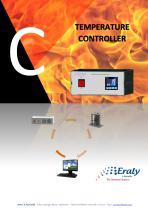
The document discusses the use of temperature controllers in furnaces, emphasizing the integration of P.I.D. (Proportional, Integral, Derivative) control for safety, ease of use, and durability. The controllers can be housed separately or attached to the furnaces.
- Simple Regulation: Involves setting a temperature point and rise time, suitable for conventional operations. It is recommended to avoid PIDs without input rise time to ensure furnace longevity.
- Programmed Regulation: Allows setting multiple temperature sequences, including segments, slopes, and levels, for precise temperature control over time.
- Master/Slave Control Regulation: Recommended for precise temperature regulation, involving two regulators: the master regulates product temperature by adjusting heating resistor temperature, and the slave regulates heating resistor temperature based on the master’s set point.
- Auto-adaptive P.I.D. parameters based on heating element behavior.
- Digital display for regulation set point and measured temperature.
- Power command via synchronous static relay, cutting AC at zero for a parasite-free operation.
- Output power up to 2300 VA max under 230 V.
- Safety feature interrupts power output in case of sensor short-circuit.
- Configurable input measurement for various sensor types, including thermocouples and platinum resistance thermometers.
- Measurement scale from -100 to +1,650°C with a resolution of 0.1 or 1°C.
- Accuracy of approximately 0.1% of the scale.
- Standard presentation in a metal case for laboratory bench placement.
- Manual reset button/automatic shutdown for alarm temperature exceedance.
- Cascade control for automatic correction of product temperature variations.
- Digital inputs for start-up, shutdown, and program pause.
- Configuration and control via computer software (USB port; RS485).
- Low voltage feed via a toroidal transformer.
- Furnace oscillation motor command for reactive mixtures.
- Multiple PIDs in the same case.
- Various output voltages and powers available.
Catalog excerpts
C ERALY & ASSOCIÉS – 4 Rue Georges Besse – Bâtiment i – 78330 FONTENAY-LE-FLEURY, France - Mail : contact@eral
Open the catalog to page 1
THE TEMPERATURE CONTROLLER: Using our furnaces requires the temperature control provided by a temperature regulator. We integrate P.I.D. control (Proportional, integral, derivative) with the requisite electrical components in casings that are either separate or attached to the furnaces. This ensures safety, ease of use as well as the long-term durability of the furnaces. TYPES OF TEMPERATURE REGULATION: We provide simple regulation, programmed regulation, Master/ Slave control regulation, regulation with safety options, computer software-operated regulation and more besides... SIMPLE REGULATION:...
Open the catalog to page 2
TECHNICAL SPECIFICATIONS: - Auto-adaptive: meaning that it automatically calculates and adjusts the best-suited P.I.D. parameters depending on the behaviour of the heating element (power, thermal inertia, charge variation...). Digital display, a red or green electroluminescent display simultaneously indicates the chosen regulation set point and the measured temperature. The power command for the heating element is produced by a synchronous static relay which cuts from alternating current at zero and is therefore parasite-free. Output power as standard up to 2300 VA max, under 230 V. Safety: the...
Open the catalog to page 3All ERALY & Associés catalogs and technical brochures
 MERINAGE
2 Pages
 SULFUR & NITROGEN analyzer
6 Pages
 PYROXYDIZER FURNACE
4 Pages
 LABORATORY TUBE FURNACES
19 Pages


Archived catalogs
 Temperature regulator
2 Pages


- Kiln
- Chamber kiln
- Gas analyzer
- Electric furnace
- Heat treatment kiln
- Concentration analyzer
- Liquids analyzer
- Automatic analyser
- Benchtop analyser
- Digital temperature control
- Solids analyser
- Process analyzer
- Laboratory kiln
- Combustion kiln
- Oxygen analyzer
- Laboratory analyzer
- Compact analyzer
- Calibration analyzer
- Controlled atmosphere oven
- Automatic kiln