
- Catalogs
- ERALY & Associés
- Oxyhydrogene gas blowpipe combustion apparatus (Wickbold Method)

Oxyhydrogene gas blowpipe combustion apparatus (Wickbold Method)

Oxyhydrogene gas blowpipe combustion apparatus (Wickbold Method)
Catalog excerpts
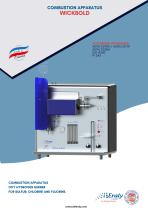
COMBUSTION APPARATUS ACCORDING STANDARDS ASTM D2784 / ASTM D2747 ASTM D2384 ISO 4260 IP 243 COMBUSTION APPARATUS OXY-HYDROGEN BURNER FOR SULFUR, CHLORINE AND FLUORINE.
Open the catalog to page 1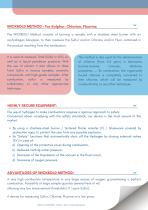
WICKBOLD METHOD - For Sulphur, Chlorine, Fluorine The WICKBOLD Method consists of burning a sample with a stainless steel burner with an oxyhydrogen blowpipe, to then measure the Sulfur and/or Chlorine and/or Fluor contained in the product resulting from this combustion. It is used to measure Total Sulfur in LPG, as well as in liquid petroleum products. With the use of solvent it also allows to dose Total Sulfur in viscous samples, aromatic compounds, and high-grade samples. After combustion, sulfur is measured by turbidimetry or any other appropriate technique HIGHLY SECURE EQUIPMENT: The use...
Open the catalog to page 2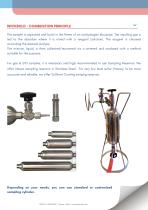
WICKBOLD - COMBUSTION PRINCIPLE The sample is aspirated and burnt in the flame of an oxyhydrogen blowpipe. The resulting gas is led to the absorber where it is mixed with a reagent (solution). The reagent is choosed according the desired analysis. The mixture, liquid, is then collected/recovered via a sintered and analyzed with a method suitable for the purpose. For gas & LPG samples, it is necessary and higly recommended to use Sampling Reservoir. We offer classic sampling reservoir in Stainless Steel. For very low level sulfur (traces), to be more accurate and reliable, we offer Sulfinert Coating...
Open the catalog to page 3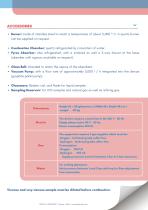
• Burner: made of stainless steel to reach a temperature of about 2,000 ° C. A quartz burner can be supplied on request. • Combustion Chamber: quartz refrigerated by circulation of water. • Pyrex Absorber: also refrigerated, with a sintered as well a 3-way faucet at the base (absorber with vigreux, available on request). • Glass Ball: intended to retain the vapors of the absorbent. • Vacuum Pump: with a flow rate of approximately 3,000 l / h integrated into the device (graphite pallet pump). • Glassware: Beaker, vial, and flasks for liquid samples. • Sampling Reservoir: For LPG samples and natural...
Open the catalog to page 4All ERALY & Associés catalogs and technical brochures
 MERINAGE
2 Pages
 SULFUR & NITROGEN analyzer
6 Pages
 PYROXYDIZER FURNACE
4 Pages
 LABORATORY TUBE FURNACES
19 Pages
 TEMPERATURE CONTROLLER
3 Pages


Archived catalogs
 Temperature regulator
2 Pages


- Kiln
- Chamber kiln
- Gas analyzer
- Electric furnace
- Heat treatment kiln
- Concentration analyzer
- Liquids analyzer
- Automatic analyser
- Benchtop analyser
- Digital temperature control
- Solids analyser
- Process analyzer
- Laboratory kiln
- Combustion kiln
- Oxygen analyzer
- Laboratory analyzer
- Compact analyzer
- Calibration analyzer
- Controlled atmosphere oven
- Automatic kiln