

Pressure assisted 2/2 NC solenoid valve - brass
1 / 2 PagesView full catalog
Pressure assisted 2/2 NC solenoid valve - brass
Product catalog summary
Technical Specifications
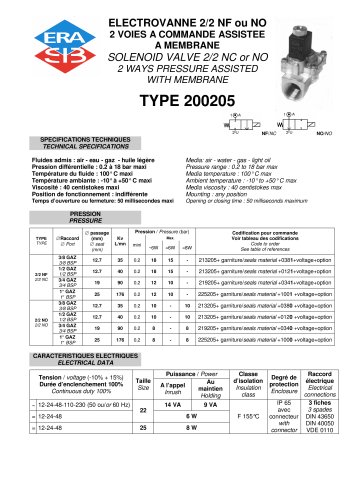
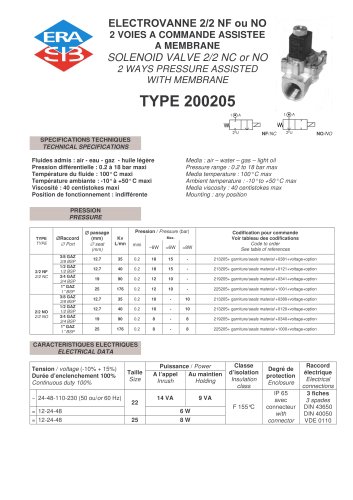
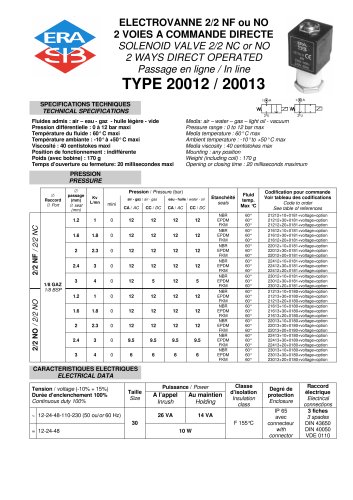
The solenoid valve type 200205 is available in normally closed (NC) or normally open (NO) configurations. It is designed for pressure-assisted operation with a membrane. The valve is suitable for air, water, gas, and light oil, with a differential pressure range of 0.2 to 18 bar maximum. The fluid temperature should not exceed 100°C, and the ambient temperature range is -10°C to +50°C. The maximum viscosity of the media is 40 centistokes, and the valve can be mounted in any position. The opening or closing time is 50 milliseconds maximum.
The solenoid valve type 200205 is available in normally closed (NC) or normally open (NO) configurations. It is designed for pressure-assisted operation with a membrane. The valve is suitable for air, water, gas, and light oil, with a differential pressure range of 0.2 to 18 bar maximum. The fluid temperature should not exceed 100°C, and the ambient temperature range is -10°C to +50°C. The maximum viscosity of the media is 40 centistokes, and the valve can be mounted in any position. The opening or closing time is 50 milliseconds maximum.
Pressure and Port Specifications
The valve is available in various port sizes, including 3/8, 1/2, 3/4, and 1 inch BSP, with corresponding flow coefficients (Kv) and pressure ratings. The ordering code includes the valve type, seals material, voltage, and options.
The valve is available in various port sizes, including 3/8, 1/2, 3/4, and 1 inch BSP, with corresponding flow coefficients (Kv) and pressure ratings. The ordering code includes the valve type, seals material, voltage, and options.
Electrical Data
The valve operates on AC voltages of 12-230V (50 or 60 Hz) with an inrush power of 14 VA and holding power of 9 VA. For DC voltages of 12-48V, the power is 6W or 8W. The insulation class is F (155°C), and the enclosure is rated IP 65 with a connector. Electrical connections are made via a 3-spade DIN 43650 connector.
The valve operates on AC voltages of 12-230V (50 or 60 Hz) with an inrush power of 14 VA and holding power of 9 VA. For DC voltages of 12-48V, the power is 6W or 8W. The insulation class is F (155°C), and the enclosure is rated IP 65 with a connector. Electrical connections are made via a 3-spade DIN 43650 connector.
Construction
The valve body is made of brass, with stainless steel used for the tube and internal parts. Seals and gaskets are available in NBR, EPDM, or FKM. The coil is moulded in polyamide.
The valve body is made of brass, with stainless steel used for the tube and internal parts. Seals and gaskets are available in NBR, EPDM, or FKM. The coil is moulded in polyamide.
Options and Maintenance
Optional features include a PG9 connector for DIN 43650 B or A, and a nickel-plated body. Maintenance kits are available, including a complete plunger, O-rings, and membrane, with specific ordering codes.
Optional features include a PG9 connector for DIN 43650 B or A, and a nickel-plated body. Maintenance kits are available, including a complete plunger, O-rings, and membrane, with specific ordering codes.
See more
All ERA-SIB catalogs and technical brochures
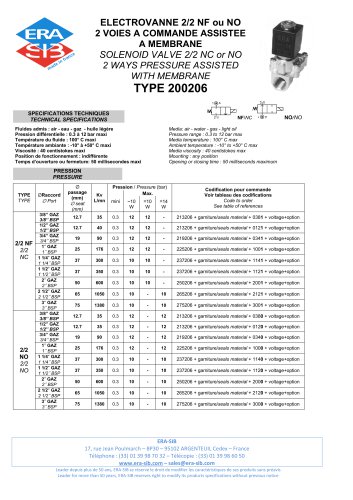 TYPE 200206
2 Pages
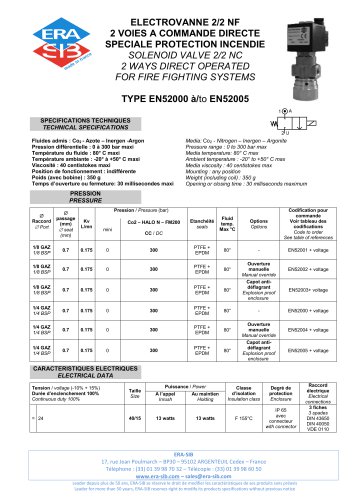 TYPE EN52000 à/to EN52005
2 Pages
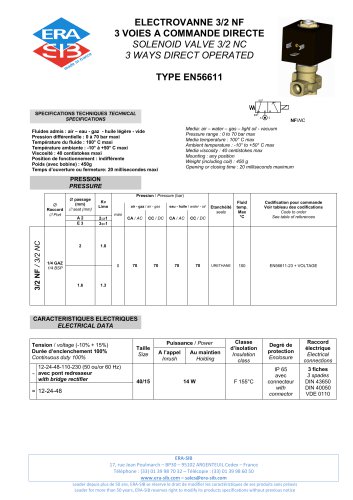 TYPE EN56611
2 Pages
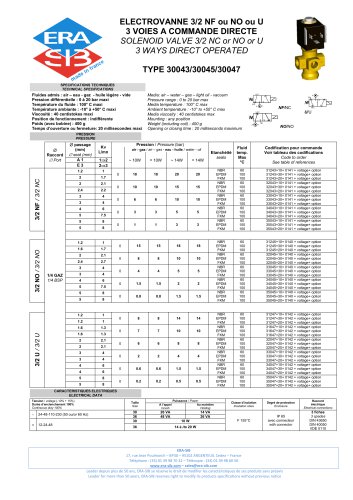 TYPE 30043/30045/30047
2 Pages
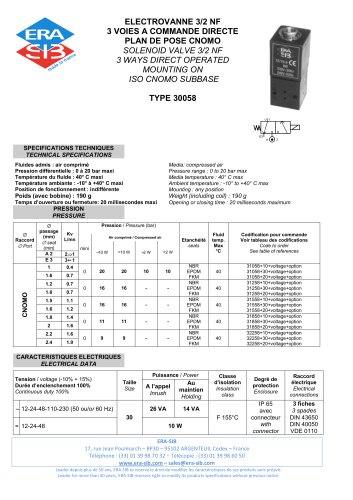 TYPE 30058
2 Pages
 Railways specialist
2 Pages
 Petrol distribution
2 Pages
 Cryogenic solenoid valves
2 Pages
 Solenoid valves
2 Pages
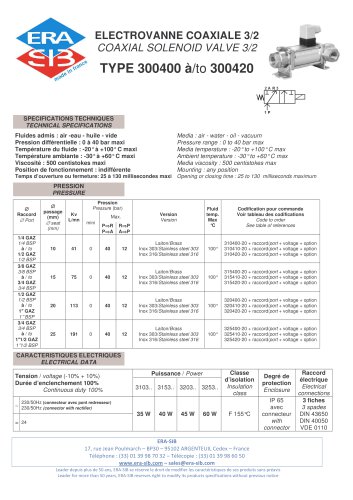 300400
2 Pages
 WF
WF2 Pages
 GF
GF2 Pages
 200201
2 Pages
 200200
3 Pages
 30023
300232 Pages
 30019
300192 Pages
 300200
2 Pages
 30029
300292 Pages
 21126
211262 Pages
 200206
2 Pages
 200205
2 Pages
 20012
200122 Pages
 wp
wp2 Pages
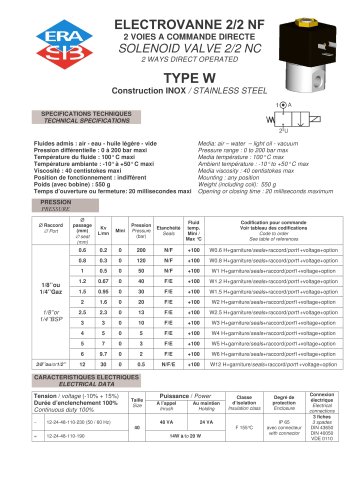 w
w2 Pages
 20033
200332 Pages
 20051
200512 Pages
 20014
200142 Pages
 20011
200112 Pages
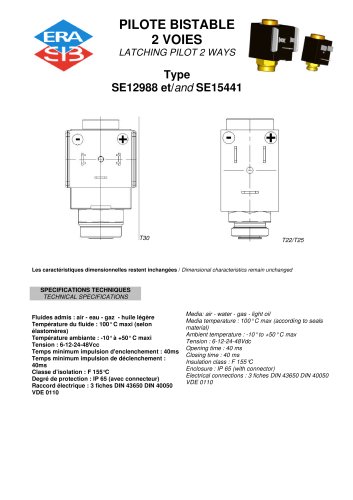 latching pilot valve
2 Pages
 3/2 solenoid valve
2 Pages
 coaxial valve datasheet
2 Pages
 Pilot and coil datasheet
1 Page
 direct acting solenoid valve
2 Pages



Related Searches
- Gas solenoid valve
- 2-way solenoid valve
- NC solenoid valve
- Direct-operated solenoid valve
- Metal solenoid valve
- Water solenoid valve
- Air solenoid valve
- Stainless steel solenoid valve
- Oil solenoid valve
- Membrane solenoid valve
- Control solenoid valve
- Steam solenoid valve
- Piston solenoid valve
- Air-operated solenoid valve
- CO2 solenoid valve
- Nitrogen solenoid valve
*Prices are pre-tax. They exclude delivery charges and customs duties and do not include additional charges for installation or activation options. Prices are indicative only and may vary by country, with changes to the cost of raw materials and exchange rates.