
- Catalogs
- Epsilon Technology
- Model 3550 Axial/Torsional Extensometer

Model 3550 Axial/Torsional Extensometer

1 / 1 PageView full catalog
Model 3550 Axial/Torsional Extensometer
Product catalog summary
Overview: The document describes the Model 3550 extensometer, designed for measuring axial and torsional deflections in specimens tested in axial/torsional machines. It is primarily used on round specimens in bi-axial test machines capable of simultaneous axial and torsional loading.
Specifications: The extensometer supports bi-directional displacement, suitable for cyclic testing under fully reversed loading conditions. It is self-supporting on specimens ranging from 0.375 to 1.000 inches (9.5 to 25.4 mm) and features conical point contacts made from tungsten carbide. The design minimizes crosstalk between axes and provides high accuracy measurements, featuring a dual flexure design.
Temperature and Compatibility: The standard temperature range is -40 °C to 100 °C, with options extending from -265 °C to 175 °C. Both inch and metric versions are available, with various gage lengths and measuring ranges.
Features: The extensometer includes a full bridge, 350 ohm strain gaged design compatible with most test systems. It meets ASTM class B-1 and ISO 9513, class 0.5 accuracy requirements, and comes with a high-quality foam-lined case.
Technical Specifications: Recommended excitation is 5 to 10 VDC, with a maximum of 12 VDC or VAC. The output is 2 to 4 mV/V, with linearity ≤0.15% of the full-scale measuring range. Operating force is typically less than 30 g, and crosstalk is less than 0.5%.
Options: Connectors are available to interface with nearly any brand of test equipment. Additional options include a shunt calibration module and the Model 3590AT axial/torsional calibrator.
Model Variants: Various models are available with different axial gage lengths, axial strain, and strain angles. The document lists specific models with their respective specifications.
Design and Measurement: The extensometer is designed to directly measure shear strain without needing to know the specimen's radius. The relationship between shear strain and the angle of twist is provided, illustrating the variation of the angle of twist with changes in specimen diameter.
See more
All Epsilon Technology catalogs and technical brochures
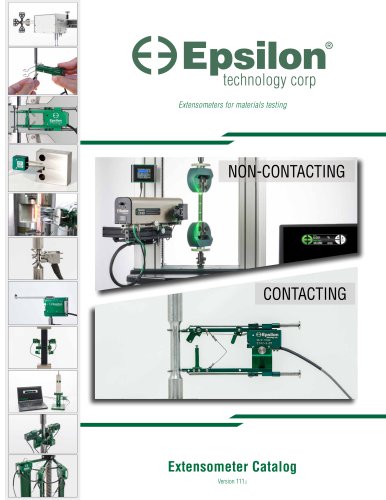 Extensometer Catalog version 111.2
132 Pages
 3542 Axial Extensometers
2 Pages
 Model VREF
1 Page
 Model ESCS
1 Page
 Model 3590VHR
2 Pages
 DSCUSB USB
1 Page
 Model SGA
1 Page
 Model 7642
2 Pages
 7650A
7650A2 Pages
 LE-05 and LE-15
2 Pages
 Model 7641
2 Pages
 Model 3549
2 Pages
 3421
34212 Pages
 3567
35672 Pages
 7651
76512 Pages
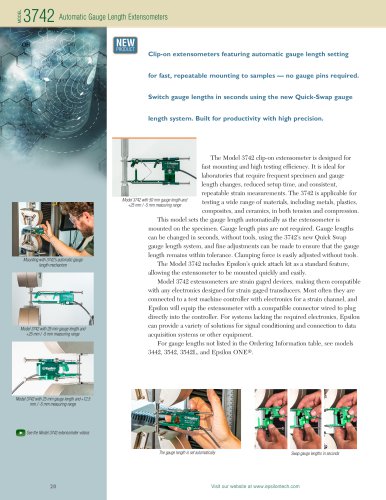


Archived catalogs
 Epsilon Technology
52 Pages


Related Searches
- Precision calibration equipment
- Industrial test kit
- Digital calibrator
- Signal conditioner
- Sensor signal conditioner
- High-precision calibration bench
- Analog signal conditioner
- Epsilon strain gauge extensometer
- Epsilon axial extensometer
- Epsilon tensile extensometer
- Calibration test kit
- Digital signal conditioner
- Amplifier signal conditioner
- Calibration standard
- Multi-channel signal conditioner
- Surface testing device
- Epsilon high-temperature extensometer
*Prices are pre-tax. They exclude delivery charges and customs duties and do not include additional charges for installation or activation options. Prices are indicative only and may vary by country, with changes to the cost of raw materials and exchange rates.
About DirectIndustry
DirectIndustry is a marketplace that offers B2B players a complete experience, from product sourcing to purchase. DirectIndustry is an entity of VirtualExpo Group.
Are you a buyer?
Are you a supplier?