
- Catalogs
- Epsilon Technology
- Epsilon Technology extensometer catalog - ver. 109

Epsilon Technology extensometer catalog - ver. 109

Epsilon Technology extensometer catalog - ver. 109
Epsilon Technology specializes in strain measurement for materials testing, with over 40 years of experience. They design and build extensometers for various materials and test types, including tensile, compression, and fracture mechanics. Epsilon is globally recognized, with sales in over 70 countries, known for its broad product line and expertise in testing and extensometers.
Epsilon extensometers use a full Wheatstone bridge design and require external electronics for readings. They can be calibrated with existing electronics using methods like shunt calibration and digital electronic calibrators. Epsilon provides fully calibrated systems with their electronics, ensuring ease of use and high accuracy.
Epsilon extensometers are designed for ruggedness, light weight, and ease of attachment. They operate in both tension and compression and are suitable for cyclic tests. The extensometers are highly accurate, exceeding ASTM and ISO standards, and come with a one-year warranty. The dual flexure design and replaceable parts enhance durability and versatility.
Epsilon offers a full one-year warranty covering defects in materials or workmanship. They provide quick response for repairs and maintain high quality standards. Spare parts are included for items subject to wear.
Epsilon extensometers can remain on samples through specimen failure, although knife edges may wear faster on high-strength materials. They are compatible with existing electronics, and Epsilon provides support for any technical questions or issues.
Most Epsilon extensometers are strain-gaged transducers compatible with various materials testing controls. They can be interfaced with data acquisition systems and are available with necessary connectors for direct plug-in. Some models use capacitive sensing technology or DVRT sensors, which include required electronics. For controls designed for LVDT type extensometers, Epsilon provides compatible electronics.
Epsilon offers a unique shunt calibration module for easy calibration of extensometer electronics. The extensometers use a full Wheatstone bridge design, requiring standard signal conditioning electronics. Epsilon provides signal conditioners if needed.
The selection depends on factors like signal conditioner resolution, dynamic performance, and space constraints. Typical measuring ranges are 5% to 20% for elastic region measurements and 20% to 100% for strain at failure, depending on material ductility.
Extensometers provide accurate strain measurements by eliminating machine and grip deflections, unlike crosshead displacement measurements.
Customers praise Epsilon extensometers for their ruggedness, versatility, and excellent technical support. They are noted for their quick response times and high-quality service.
The catalog lists various models, including the Model 3542 and 3442, with different gauge lengths and measuring ranges. These models are suitable for a wide range of materials and testing conditions, including high and low temperatures.
Epsilon extensometers are designed for both tension and compression testing, with quick attach kits for easy mounting. They meet ASTM and ISO standards for accuracy and are equipped with mechanical overtravel stops and replaceable components for durability.
The catalog mentions various options like quick attach kits, adapter kits, special coatings, and shunt calibration modules to enhance the extensometers' functionality.
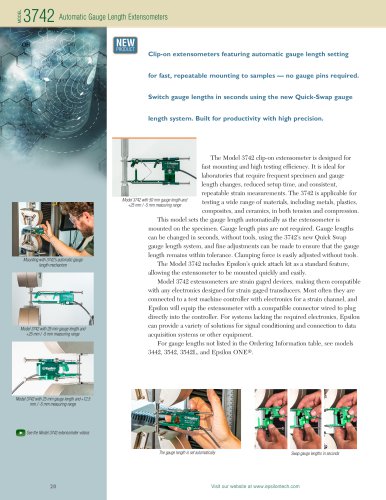
Designed for high elongation measurements with outputs that can mimic strain gaged devices, allowing compatibility with various signal conditioning electronics. Features include a stationary main body, lightweight traveling heads, and a large measuring range up to 500 mm (20 inches).
High precision, non-contacting units using laser technology for strain measurement, suitable for materials testing. Measurement range: LE-05 from 8 to 127 mm, LE-15 from 8 to 381 mm, with high resolution and accuracy.
Designed for high temperature testing up to 1200 °C, using a self-supporting design with ceramic fiber cords. Features include compatibility with various test systems, mechanical overtravel stops, and the ability to operate without cooling.
All models are hot mountable and retractable, with the ability to remain on through specimen failure. Standard units meet ASTM class B-1 requirements for accuracy, with ISO 9513 class 0.5 test certificates available. Options include constant temperature water re-circulating baths, various rod tip styles, and load frame mounting brackets.
The document outlines the specifications for various models of extensometers and clip-on gages used in high-temperature and fracture mechanics testing. Key specifications include analog output, digital output, cyclic testing capabilities, linearity and hysteresis, resolution, temperature range, and operating force.
Several options are available for customization, including high-temperature options, load frame mounting brackets, bulkhead adapters for vacuum chambers, and various rod tip styles.
Customers are advised to provide specific details such as furnace dimensions and electrical outlet type when ordering. External mounting brackets and specific power requirements are necessary for operation. Special configurations are available upon request.
Examples of model configurations are provided, detailing gauge lengths, measuring ranges, and temperature ranges.
Highlighted features include compatibility with high-temperature environments without cooling for some models, improved performance at high frequencies, reduced size and weight, digital controllers with built-in calibration and tare functions, and compliance with ASTM and ISO standards for accuracy.
The extensometers and gages are suitable for various testing applications, including tensile, compression, cyclic testing, and fracture mechanics studies. They are designed to meet specific standards such as ASTM E1820 for fracture toughness testing.
Designed for high-temperature testing up to 1600 °C. Compatible with strain gaged transducers and test machine controllers. Features include full bridge design, compliance with ASTM E1820, and rugged dual flexure design.
Suitable for fracture mechanics testing up to 700 °C without cooling. Features improved noise rejection, resolution, and accuracy, with a digital controller included.
Used for measuring deformations in various tests with a magnetic base for easy mounting. Features include full bridge strain gaged design, linearity of 0.25% FS, and compliance with ASTM and ISO accuracy classes.
All models are compatible with electronics designed for strain gaged transducers. Signal conditioning electronics are typically included with test machine controllers. For systems lacking required electronics, Epsilon provides solutions for connecting to data acquisition boards and other equipment.
Designed for general-purpose transverse or diametral strain measurement. Compatible with specimens up to 25 mm in width or diameter. Used for Poisson’s ratio measurement and testing anisotropic materials.
Designed for small or thin specimens, suitable for transverse or diametral strain measurement. Features a lightweight, self-supporting design with dual flexure for dynamic applications.
Used for measuring plastic strain ratio (r-value) in sheet metal testing. Measures lateral strain at two locations and provides an average output.
Model 3580 is designed for use at temperatures up to 1000 °C, suitable for furnace and induction heating systems. Features include a dual flexure design and compatibility with high-temperature testing of metals, ceramics, and composites.
All models are strain gaged for compatibility with various electronics and test systems. Options include connectors for different test equipment, shunt calibration modules, and specialty knife edges.
Designed for use up to 1000 °C, suitable for measuring Poisson’s ratio per ASTM E132. Features include a full bridge, 350-ohm strain-gaged design, rugged dual flexure for strength, and compatibility with various test systems.
Capable of operating up to 700 °C without cooling, ideal for determining Poisson’s ratio and characterizing anisotropic materials.
Designed for compressive strength tests on rock, concrete, and other large samples, providing an average output from two readings.
All models are compatible with various electronics and can be connected to data acquisition boards, chart recorders, or other equipment. Special configurations and custom orders are available upon request.
Designed for small diameter specimens with a full bridge, 350 ohm strain gaged design. Compatible with most test systems and meets ASTM class B-1 accuracy requirements.
Used for large compression samples, measuring changes in circumference for accurate diametral strain determination.
Designed for simple performance testing of asphalt, compatible with NCHRP Report 465 and AASHTO TP062 standards.
Used for testing asphalt core samples, measuring both lateral and vertical deformations.
All models are strain gaged devices compatible with electronics designed for strain gaged transducers. Signal conditioning electronics are typically included with the test machine controller, with options for additional solutions provided by Epsilon.
Designed for testing asphalt core samples, this model is available in different gauge lengths and configurations. It is compatible with various test equipment and includes options like gauge length adapters and shunt calibration modules.
This model is used for indirect tensile testing of asphalt, measuring lateral deformation. It features a full bridge, 350-ohm strain-gaged design, and is compatible with most test systems.
Suitable for measuring small diametral strains in rock and concrete samples, this model is self-supporting and compatible with strain-gaged transducers.
These extensometers measure both lateral and axial strains, making them ideal for testing anisotropic materials.
Designed for simultaneous axial and torsional testing, this model is used on round specimens in bi-axial test machines.
All models feature a temperature range of -40 °C to +100 °C as standard, with options for extended ranges. They include integral, ultra-flexible cables and are compatible with a wide range of test equipment.
Features a 25 mm gauge length with ±10% axial and ±2° torsional shear strain measuring range. Compatible with most test systems due to its full bridge, 350 ohm strain gaged design.
Designed for use in high-temperature environments up to 1600 °C. Capable of measuring bi-directional displacement in both axes for strain-controlled fatigue testing.
Measures in-plane bi-axial strains at high temperatures on specimens tested in X-Y bi-axial machines.
All models include high-quality foam-lined cases and are shipped fully calibrated. Options available for high-temperature use, load frame mounting, and various connectors for interfacing with test equipment.
Excitation: Recommended 5 to 10 VDC, maximum 12 VDC or VAC. Output: 2 to 4 mV/V nominal, varies by model. Linearity: ≤0.20% of full scale, model-dependent. Temperature Range: Standard (-ST) from -40 °C to +100 °C, Optional (-LHT) from -270 °C to +200 °C.
Connectors for various test equipment, shunt calibration module.
Model 4013: Available in various measuring and temperature ranges. Example: 4013-005M-ST indicates a 0.5 mm measuring range with a standard temperature range.
Designed for measuring shear properties of sandwich cores and rigid cellular plastics. Compatible with ASTM and ISO standards.
Used for tests in water or compatible liquids. Includes signal conditioning electronics. Made of stainless steel with Teflon cables.
Custom designs available for specific testing needs, including high temperature and biaxial extensometers.
Various styles available, including standard, dual bevel, ceramic, and vee knife edges, each suited for different testing environments and specimen types.
SGA Analog Signal Conditioners: Suitable for cyclic and high-speed testing. Features adjustable excitation voltage and high accuracy amplifier.
Model SGA: Available in single and dual-channel versions, these analog signal conditioners are designed for static mechanical testing without the need for a digital display.
Model 3590VHR: A very high-resolution digital electronic calibrator with a resolution of 20 nanometers. It meets ASTM E83 Class B-1 and ISO 9513 Class 0.5 standards.
Automatic recognition and calibration of multiple extensometers. High accuracy and resolution for precise measurements.
Epsilon Tech offers a broad range of signal conditioners and calibrators designed to meet the needs of mechanical testing and extensometer calibration. Their products are characterized by high accuracy, ease of use, and compatibility with modern data acquisition systems.
Specifications: The Model 3590 calibrator has a measuring range of 50 mm (2 inches) with a maximum displacement range of 125 mm (0-5 inches).
The calibrator includes a digital display, an autozero button for simplified readings, and a foam-lined storage case.
Various adapter sets and extension posts are available for different extensometer models.
The document describes SCM Shunt Calibration Modules and VREF Modules, which facilitate the transfer of Epsilon's calibration to customer electronics.
Epsilon is accredited by A2LA to the ISO/IEC 17025 international standard and certified by DNV to the ISO 9001 standard.
Epsilon offers a limited warranty covering defects in materials or workmanship for one year from the date of shipment.
Epsilon provides a comprehensive range of calibrators and calibration modules, supported by robust accreditation and warranty policies, ensuring high-quality and reliable products for materials testing.
Catalog excerpts
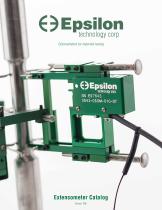
Extensometers for materials testing Extensometer Catalog Version 109.2
Open the catalog to page 1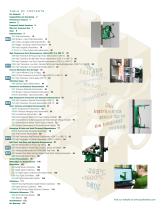
TA B L E O F C O N T E N T S Our Company 1 Compatibility and Interfacing 2 Performance Features 4 Service 5 Frequently Asked Questions 6 What Our Customers Say 7 Axial 9 Extensometers 9 3542 Axial Extensometers 10 3442 Miniature / Low Profile Extensometers 12 3542L Extra-Long Gauge Length Extensometers 14 3543 Rugged, Long Gauge Length Extensometers 16 3800 High Elongation Extensometers 18 LE-05 and LE-15 Non-Contact Laser Extensometers 20 High Temperature Axial Extensometers (Above 200 ˚C or 400 ˚F) 23 3448 High Temperature Self-Supporting Furnace Extensometers (1200 °C) 24...
Open the catalog to page 2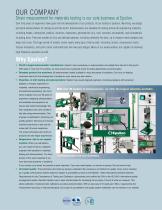
Strain measurement for materials testing is our sole business at Epsilon. Over forty years of experience have gone into the development of our products. At our facility in Jackson, Wyoming, we design and build extensometers for testing around the world. Extensometers are available for testing almost all engineering materials, including metals, composites, plastics, ceramics, elastomers, geomaterials (e.g. rock, concrete, and asphalt), and biomaterials including bone. There are models for tiny and delicate samples, including relatively fine wire, up to massive metal samples and large rock cores....
Open the catalog to page 3
Interfacing Epsilon extensometers to test equipment. Compatibility All of Epsilon’s strain gaged transducers employ a full Wheatstone bridge design. They are powered by an excitation voltage, typically between 5 and 10 VDC. The output of the extensometer is proportional to the excitation. For this reason the calibrated output is often expressed as a mV/V value. An extensometer with a full scale span of 2.345 mV/V will have a full scale output of 23.450 mV if the excitation is 10V. This span data is provided by Epsilon on each extensometer test certificate. All strain gaged sensors must be connected...
Open the catalog to page 4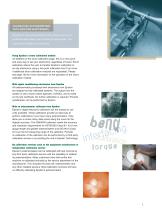
CALIBRATING EXTENSOMETERS WITH EXISTING ELECTRONICS Required for any extensometer you buy, this process can be performed many ways, most of which are quite simple. The most common options are as follows: Using Epsilon’s shunt calibration module detailed on the shunt calibration page, this is a very quick As and easy way to set your electronics, regardless of brand. Shunt calibration allows the user to transfer Epsilon’s calibration to on-site electronics using a two point calibration line fit (or more if additional shunt calibration modules are requested). Please see page 120 for more information...
Open the catalog to page 5
OUTSTANDING PERFORMANCE FEATURES IN EVERY MODEL • Most models may be left on through specimen failure Light weight to minimize specimen influence Most models operate in both tension and compression Most models are capable of being used in cyclic tests Low operating force, normally less than 40g, with many under 20g Easy to attach to specimens, with quick attach kits for most models Performance Features Rugged construction withstands constant handling and mounting Immersible in many non-conductive fluids Initial gauge length accurately established All come with foam lined case Backed by many years...
Open the catalog to page 6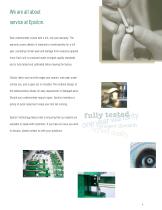
We are all about service at Epsilon. Each extensometer comes with a full, one year warranty. The warranty covers defects in materials or workmanship for a full year, excluding normal wear and damage from excessive applied force. Each unit is produced under stringent quality standards and is fully tested and calibrated before leaving the factory. Certain items such as knife edges and ceramic rods wear under normal use, and a spare set is included. The modular design of the extensometers allows for easy replacement of damaged parts. Should your extensometer require repair, Epsilon maintains a policy...
Open the catalog to page 7
Can Epsilon extensometers be left on through specimen failure? Yes. All Epsilon standard extensometers are designed to withstand remaining on the sample through specimen failure. On certain materials, such as high strength metals, knife edges will wear out faster if the extensometer is left on through failure. A spare set of knife edges is included. Frequently Asked Questions Will the extensometer be compatible with my existing electronics? All extensometers in this catalog can easily be shipped with the mating connector already installed, so you can plug right in to your existing electronics....
Open the catalog to page 8
“ At Laborator Dinamic we are using your Epsilon extensometers for modernizing different kinds of Universal Testing Machines or on new machines. ... I really appreciate your product’s simple and clever embedding solutions “ I use Epsilon extensometers because they are rugged, well built and with high quality and technical performances.” economical. I find their versatility to be their most appealing aspect. We interface them with several data acquisition systems as well as testing machines. We use them in traditional testing modes to non-traditional, stand JOHN DINA LABORATOR DINAMIC, ROMANIA...
Open the catalog to page 9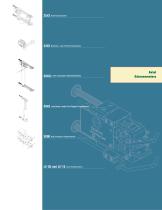
3442 Miniature / Low Profile Extensometers Model 3543-SR-xxxx-xxxx-xx Large Gage Length Extensometer 3542L Extra-Long Gauge Length Extensometers Axial Extensometers MODEL 3800-xxxx-xxx High Elongation Extensometer 3543 Long Gauge Length Extra Rugged Extensometers 3800 High Elongation Extensometers 2 inch [50 mm] gage length 1 inch [25 mm] gage length
Open the catalog to page 11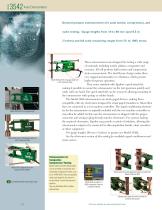
3542 Axial Extensometers General purpose extensometers for axial tensile, compression, and cyclic testing. Gauge lengths from 10 to 80 mm (and 0.5 to 2 inches) and full scale measuring ranges from 5% to 100% strain. Model 3542 with 25 mm gauge length Model 3542 with 0.5 inch gauge length and ±25% measuring range These extensometers are designed for testing a wide range of materials, including metals, plastics, composites and ceramics. All will perform both tension and compression strain measurement. The dual flexure design makes them very rugged and insensitive to vibrations, which permits Model...
Open the catalog to page 12All Epsilon Technology catalogs and technical brochures
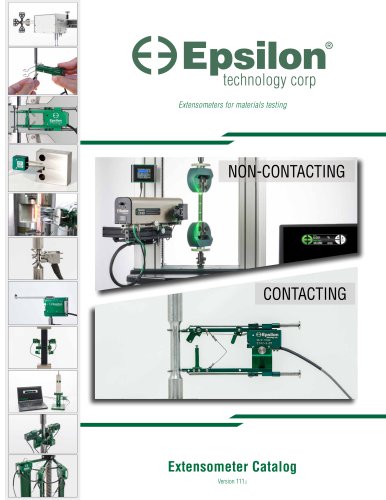 Extensometer Catalog version 111.2
132 Pages
 3542 Axial Extensometers
2 Pages
 Model VREF
1 Page
 Model ESCS
1 Page
 Model 3590VHR
2 Pages
 DSCUSB USB
1 Page
 Model SGA
1 Page
 Model 7642
2 Pages
 7650A
7650A2 Pages
 LE-05 and LE-15
2 Pages
 Model 7641
2 Pages
 Model 3549
2 Pages
 3421
34212 Pages
 3567
35672 Pages
 7651
76512 Pages


Archived catalogs
 Epsilon Technology
52 Pages


- Precision calibration equipment
- Industrial test kit
- Digital calibrator
- Sensor signal conditioner
- High-precision calibration bench
- Epsilon strain gauge extensometer
- Epsilon tensile extensometer
- Calibration test kit
- Digital signal conditioner
- Amplifier signal conditioner
- Calibration standard
- Multi-channel signal conditioner
- Surface testing device
- Epsilon high-temperature extensometer