
- Catalogs
- Eppendorf SE
- Shift the Paradigm


Shift the Paradigm
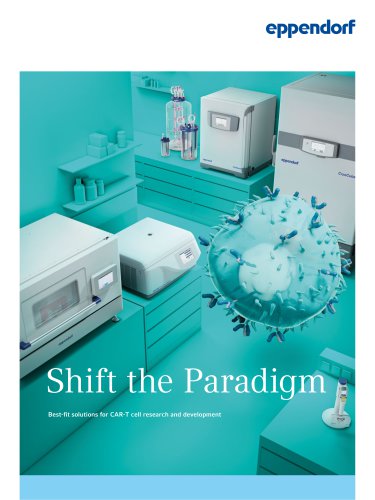
Shift the Paradigm
Abstract: Lentiviral vectors (LVs) are promising for gene therapy but face production challenges with traditional culture methods. This note describes a successful setup using HEK 293T cells on Fibra-Cel® disks in a BioBLU 5p Single-Use Vessel, achieving high titers and particle counts comparable to conventional methods.
Abstract: T cells are crucial for adoptive cell therapy. This study evaluates the BioBLU® 0.3c Single-Use Bioreactors for CD4+ T cell expansion, showing that lower dissolved oxygen levels may enhance proliferation.
Abstract: Gene therapy for single-gene disorders often uses rAAV vectors. This note discusses a scale-down model for rAAV production using Sf9 cells, facilitating efficient process development.
Abstract: The demand for scalable viral vector production is rising. This study scales up rAAV production from shake flasks to stirred-tank bioreactors, maintaining consistent growth and production.
Abstract: Suspension cell culture offers advantages for vaccine production. This note demonstrates a scalable AAV production platform using suspension-adapted HEK293 cells, achieving high yields.
Catalog excerpts

Best-fit solutions for CAR-T cell research and development
Open the catalog to page 1
CAR-T Cells: Breakthroughs in Cancer and Autoimmune Therapies One of the most revolutionary cell therapies to transition from bench to bedside in the past decade is undoubtedly the development of chimeric antigen receptor (CAR)-T cells. Here, CAR-T cells have found a plethora of different applications. Firstly, by proving to be an effective treatment for certain blood cancers that were previously deemed incurable. Secondly, in holding promise for treating certain auto-immune diseases and solid tumours. As ongoing research broadens the applications of CAR-T cells, the potential for transformative...
Open the catalog to page 3
Designing of CAR encoding vector CAR transduction into isolated T cells Injection of CAR-T cells into patient Binding of CAR-T cell to cancer cell Destruction of cancer cell
Open the catalog to page 4
CAR-T Cell Development – The Future of Fighting Cancer CAR-T cells, genetically engineered and equipped with specific receptors to target and combat cancer cells, are primarily divided into two categories: autologous and allogenic CAR-T cells. Hereby, autologous CAR-T cells derive from the patient’s own white blood cells and are reintroduced after modification, whereas allogenic CAR-T cells are designed as off-the-shelf solutions for use in different patients. However, both approaches have their challenges. The manufacturing process for autologous CAR-T cells is complex and costly, as each patient’s...
Open the catalog to page 5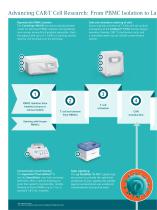
Advancing CAR-T Cell Research: From PBMC Isolation to Lar Safe and consistent culturing of cells Ensure optimal activation of T-Cells with the uniform atmosphere of the CellXpert® C170i. Fanless design, seamless chamber, 180 °C sterilization cycle, and a removable water tray for reliable contamination control. Reproducible PBMC isolation The Centrifuge 5910 Ri has soft acceleration/break ramps for optimized PBMC isolation and significant time savings during Ficoll gradient separation. High throughput with up to 4 × 1,000 mL working volume ideal for cell harvesting on the benchtop. 1 PBMC isolation...
Open the catalog to page 6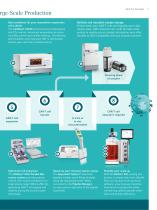
rge-Scale Production Best conditions for your mammalian suspension cell culture! The CellXpert CS220 ensures precise temperature and CO₂ control, minimized evaporation by active humidity control and reliable shaking. The stainless steel chamber and integrated 180 °C sterilization protect your cells from contaminations. Reliable and traceable sample storage Freeze down your CAR-T cells and digitally store data (donor, date, CAR contstruct etc.) with the Safe Code system to readily access sample information even after transfer to LN2 (compatible with any barcode scanner). Freezing down of samples...
Open the catalog to page 7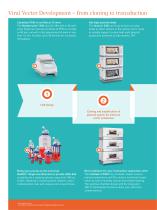
Viral Vector Development – from cloning to transduction Countless PCRs in as little as 15 mins The Mastercycler® X50 with the 384-well or 96-well silver block can process hundreds of PCRs in as little as 40 min and with a fast polymerase kit even in less than 15 min. Connect up to 50 devices for increased throughput. Get high plasmid yields The Innova® S44i can fit up to twice as many flasks as other shakers in the market and is ready to reliably support current high-yield plasmid production protocols at high speeds, 24/7. Cloning and amplification of plasmid system for lentiviral vector production...
Open the catalog to page 8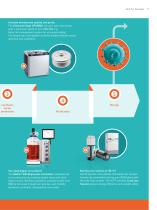
Increase downstream quality and purity The Ultracentrifuge CP100NX can spin your viral vector with a maximum speed of up to 803,000 × g. Rotor life management system for increased safety! The broad rotor and adapter portfolio enables flexible vessel selection and scalability. Lentivirus vector production You need higher virus titers? The BioFlo® 320 Bioprocess Controller revolutionizes virus production by enabling higher titers with intelligent control. Achieve consistent, scalable results from R&D to full-scale through our precise, user-friendly bioreactor controller, designed for virus yield....
Open the catalog to page 9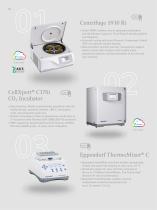
Centrifuge 5910 Ri > Faster PBMC isolation due to optimized acceleration and deceleration ramps for Ficoll-Paque® density gradient centrifugation > Accurate cooling with smart Dynamic Compressor Control (DCC) for optimal sample integrity. > Documentation function and user management support quality control with multiple authorization levels, password protection and documentation of all runs and user activities. > Easy cleaning, reliable contamination prevention with the fanless design, seamless chamber, 180 °C sterilization cycle, and removable water tray. > Uniform atmosphere thanks to temperature...
Open the catalog to page 10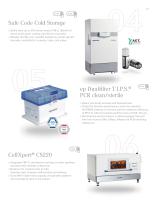
> Safely store up to 576 freezer boxes (740 L). Benefit of future-proof green cooling and efficient insulation > Reliably identify your valuable samples by vessel-specific barcodes, available for cryovials, tubes, and plates ep Dualfilter T. I. P. S.® ^PCR clean/sterile > Retain practically aerosols and biomolecules > Tested for filtration performance under the standard EN 29463 yielding a minimum particle collection efficiency of 99.5 % with test aerosol particles sizes of 0.05-0.5 pm. > Sterilized by electron beams, certified pyrogen-free and free from human DNA, DNase, RNase and PCR-inhibiting...
Open the catalog to page 11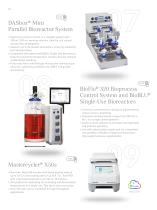
DASbox® Mini Parallel Bioreactor System > Experience precise control in a compact system with 100 mL-250 mL working volumes, ideal for cell culture and process development. > Supports up to 24 parallel bioreactors, ensuring scalability and reproducibility. > Compatible with glass and BioBLU Single-Use Bioreactors, featuring liquid-free temperature control and easy exhaust condensation handling. > Fully mass flow-controlled gas mixing with individual gas mixtures, optimizing conditions for CAR-T cell growth and viability. (CLICK <|jjMastercycler® X50s > Run time: About 40 minutes with block heating...
Open the catalog to page 12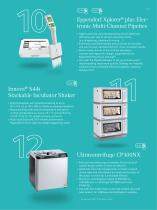
> Higher precision and reproducibility and an additional efficiency gain due to various operating modes (e.g. dispensing, pipetting & mixing, ...) > Extremely consistent sample pickup across all channels and user-to-user reproducibility for more consistent results. > Better results thanks to the intuitive operating concept and ergonomic design, supported by the Eppendorf PhysioCare Concept® > Use with the Pipette Manager to set up and document liquid-handling steps more quickly. Settings are instantly available on all connected electronic pipettes, avoiding setting errors. > High throughput with...
Open the catalog to page 13All Eppendorf SE catalogs and technical brochures
 Exceeding Your Expectations
15 Pages
 Incubator Shaker Guide
28 Pages
 Optimized mAb Development
2 Pages
 Eppendorf Instrument Services
15 Pages
 Accelerate Your Growth
8 Pages
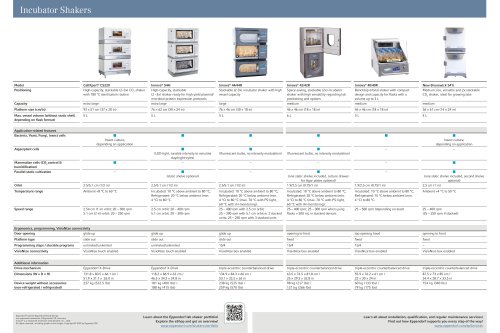 Incubator Shakers
1 Page
 Our environmental awareness
354 Pages
 Bioprocess Catalog
218 Pages
 Catalogue
358 Pages
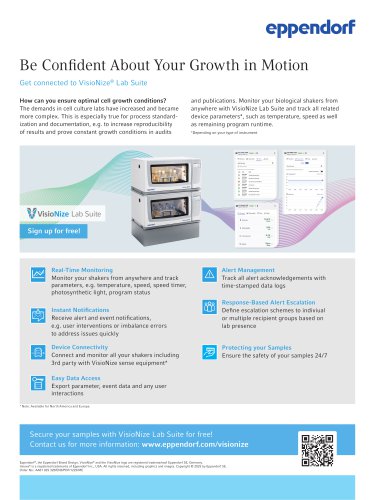
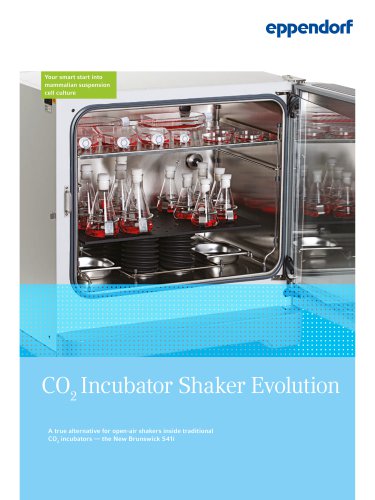
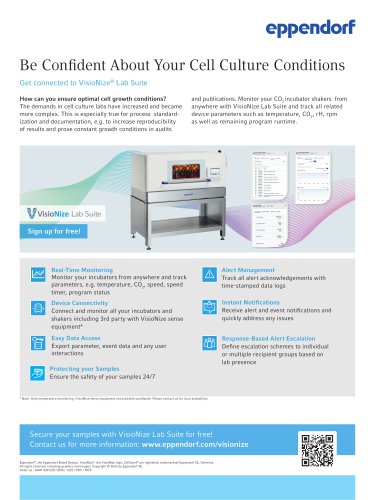

- Management software solution
- Rack system
- Cloud-based software
- Monitoring software solution
- Plastic vessel
- Storage warehouse rack system
- Laboratory shaker
- Eppendorf incubator
- Laboratory incubator
- Metal racking
- Eppendorf laboratory freezer
- Digital laboratory stirrer
- Eppendorf vertical centrifuge
- Eppendorf laboratory centrifuge
- Vertical freezer
- Bench-top laboratory stirrer
- Temperature monitoring module
- Eppendorf natural convection incubator
- Environmental monitoring system