


O-Ring

O-Ring
O-rings are elastomer rings used for fluid sealing in static and dynamic applications, defined by their inner diameter and cross-section thickness. The document details various types of O-rings, including homogeneous material and encapsulated O-rings, and outlines manufacturing processes such as injection moulding, compression moulding, machining, extrusion, and vulcanization.
Different materials for O-rings are discussed, including thermoset elastomeric polymers, detectable elastomers, thermoplastic elastomer polymers, fluoropolymers, and metals, chosen based on specific properties and application requirements.
Elastomers are evaluated based on physical, electrical, thermal properties, chemical resistance, and flame behavior, determining their suitability for various industrial applications.
The catalogue lists certification entities and details certificates according to EN 10204, ensuring products meet international standards.
Describes production methods for O-rings, including moulded, cord rings, encapsulated, and "X-Ring" O-rings, tailored to specific application needs and production volumes.
Guidelines for O-ring assembly and installation cover housing design, extrusion gaps, back-up rings, chamfering, and installation techniques.
Solutions for static sealing include different housing designs for radial and axial sealing. Dynamic sealing solutions for hydraulic and pneumatic applications are also covered, detailing recommended housings and surface finishes.
Common causes of O-ring failures are discussed, along with strategies for prevention and troubleshooting.
Information on reception, storage, and handling of O-rings is provided to ensure product integrity and performance.
Includes a nomenclator of materials, ISO80 tolerance table, chemical resistance data, classification according to ASTM D 2000 / UNE 53-535-94, and a list of standard O-rings.
Epidor offers training services tailored to customer needs, enhancing understanding and application of their products.
Electrical Properties: Discusses electrical properties of materials, focusing on resistivity, conductivity, dielectric constant, and power factor, with tests governed by ASTM D 257.
Thermal Properties: Coefficient of thermal expansion is crucial for understanding material changes with temperature, with tests governed by ASTM D 454 and ASTM D 1329/ISO 2921.
Chemical Resistance: Effects of oil, ozone, and water on elastomers are outlined, with tests governed by ASTM D 471 and ISO 1817.
Flame Behavior: Elastomers exhibit specific behaviors when exposed to flames, with a table detailing various reactions.
Surface Treatments: High-performance surface treatments modify O-ring functionality, improve wear resistance, and reduce friction.
Lubrication Treatments: Lubricants like silicone oils and PTFE improve assembly and dynamic behavior.
Certifications: Various certification bodies ensure material safety for food, pharmaceutical, and biotechnology applications.
1. EU and US Regulations: Covers EC 10/2011, NSF/ANSI Standards, and WRAS.
2. Hazardous Substances and Chemical Regulations: Discusses RoHS and REACH.
3. Food Safety and Hygiene Standards: Covers 3-A Sanitary Standards and EHEDG.
4. Material and Product Certifications: Discusses USP, DVGW, and ADI Free.
5. Manufacturing and Production Standards: Covers EN 10204 and O-Ring Production.
6. Specific Standards for Gas and Water: Discusses AED/RGD Standards and KTW.
Conclusion: Highlights the importance of compliance with international standards for safety, quality, and environmental protection.
- Compression Step-Molding System: Moulds static seal section by section, allowing production of O-rings of any length and diameter.
- Continuous Moulding: Offers improved tensile strength and reduced deformation.
- Continuous moulding improves tensile strength and reduces deformation.
- Encapsulated O-rings combine chemical resistance with elasticity.
- Designed for chemical resistance and elasticity, suitable for static sealing and low-speed dynamic applications.
- Available in various designs, with temperature ranges from -50 ºC to +260 ºC.
- FDA certification is necessary for food contact applications.
- Detailed tolerances for inside diameter and cross-section are provided.
- Proper installation is crucial for longevity, with recommendations for heating FEP O-rings for elasticity.
Outlines installation of encapsulated gaskets using a monoblock cone, emphasizing the need for flexibility and avoiding damage.
X-Ring Seals: Designed for high-pressure hydraulic services, reducing friction and wear.
Material Specifications: Elastomeric materials like FPM, NBR, and EPDM are available, each with specific temperature ranges.
O-Ring Housing and Extrusion Gap: Details geometry and dimensions of O-ring housings, warning against excessive extrusion gaps.
General Assembly Considerations: Emphasizes clean working area and proper installation techniques.
Static Sealing: Provides recommended housing dimensions for static sealing.
Recommended Housings: Tables for recommended housing dimensions for standard and encapsulated O-rings.
Rectangular Housing for Axial Sealing: Design must consider fluid pressure direction.
Recommended Housings for O-Rings: Emphasizes precise measurements for proper sealing.
Triangular Housing for Radial/Axial Sealing: Used in threaded flanges and lids.
Trapezoidal Housing for Radial Sealing: Recommended for O-rings with a thickness of 3.5 mm or more.
Surface Finishes: Recommendations for PTFE O-rings and axial sealing.
Dynamic Sealing
General Considerations: Differentiates between hydraulic and pneumatic applications.
Hydraulics - Rectangular Housing for Rotative Movement: Alternatives like the DR 115 model are suggested.
Hydraulics - Rectangular Housing for Axial Movement: Used when space is limited.
Pneumatics - Rectangular Housing for Axial Movement with Radial Sealing: Focuses on minimizing friction.
Pneumatics - Floating Design for Axial Movement: Suitable for pistons or plungers.
Outlines recommended housing dimensions for molded O-rings.
Procedures:
Dynamic sealing involves using rectangular pockets for pneumatics.
O-Ring Failures:
Common causes include extrusion, residual deformation, and chemical attack.
Recommendations:
Design adequate housings and choose the right elastomer.
Storage and Handling:
Store O-rings in original packaging, protected from environmental factors.
Measurement Tools:
Various tools recommended for measuring O-rings.
Complementary Products:
O-ring boxes and extraction tools are available.
Annexes:
Provide additional information on material nomenclature and chemical resistance.
Outlines alternative manufacturing procedures for non-standard seals.
Training Services:
Emphasizes the importance of training and knowledge dissemination regarding sealing systems, offering tailored training to customers.
Catalog excerpts

Seals and Rubber Technology
Open the catalog to page 1
Seals and Rubber Technology Epidor INDEX
Open the catalog to page 3
EPI INDUSTRIES Family of Companies, a consolidated group of companies with more than sixty years of experience, creates in May 2016 EPIDOR Seals and Rubber Technology. Epidor Seals and Rubber Technology A new company was born with the mission of continuing to develop the business of sealing and vibration insulation products of Epidor SAU and Lidering SAU, prestigious firms with several decades of experience in the market. Epidor Seals and Rubber Technology Cfntril • tVadquvtm Epidor Seals and Rubber Technology inherits all the knowledge of the product and the market and is oriented to the development...
Open the catalog to page 4
Seals and Rubber Technology Epidor Seals and Rubber Technology offers equipment manufacturers (OEMs) a wide range of product-related • Design and development of innovative technical solutions for high quality mechanical engineering components. • Reports of first samples, quality controls. • Vibration isolation for the protection of people, equipment and working environments. • Trainings adapted to each need. • Support in the design of your equipment. • Personalized logistics: special labels, kits for spare parts or assembly, stock of material, packaging adapted to each product. • Product failure...
Open the catalog to page 5
OUR CUSTOMERS EQUIPMENT MANUFACTURERS (OEM) Our value contribution to equipment manufacturers (OEMs) lies in our collaboration to design the best solution for their products. This implies intense communication to understand the technical needs of the product to be manufactured, as well as its characteristics and the competitive advantages that this product must meet in its market. We collaborate with the technical, engineering, product and prototype design, purchasing and procurement departments to define the standards of pre-shipment, service, deliveries, schedules, assembly kits or spare parts...
Open the catalog to page 6
Seals and Rubber Technology MAIN PRODUCTS Since the middle of the 20th century, we have established close cooperation with the world’s leading manufacturers of sealing and vibration isolation products. From this collaboration is born a very wide range of products and solutions. In the whole product range we have the ability to make tailor-made solutions. HYDRAULICS AND PNEUMATICS SEALING The experience accumulated over more than 50 years in the design, manufacture and marketing of sealing solutions for hydraulic and pneumatic cylinders, allows us to offer a wide range of collars, scrapers and...
Open the catalog to page 7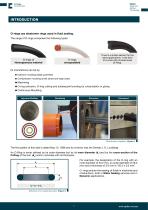
O-rings Introduction O-rings are elastomer rings used in fluid sealing. The range of O-rings comprises the following types: O-rings of Homogeneous material There is a similar element for the same applications, in the form of a cross with rounded ends (X-Ring). O-rings encapsulated Its manufacture can be by: Injection moulding (large quantities) Compression moulding (small series and large sizes) Machining O-ring extrusion, O-ring cutting and subsequent bonding by vulcanization or gluing Continuous Moulding Injection Molding Manufacture of gaskets. Figure 1 The first patent of this seal is dated...
Open the catalog to page 9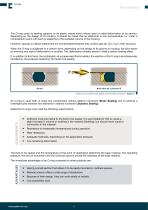
The O-ring owes its sealing capacity to its elastic nature which allows axial or radial deformation of its section, depending on the design of its housing. It should be noted that an elastomer is non-compressible; i.e. under a compression load it will react by adapting to the available volume of the housing. However, spongy or cellular elastomers are compressible because they contain gas (air CO2, N2) in their structure. When the O-ring is subjected to a certain force, depending on the design of its groove or housing, the joint reacts by showing one type of deformation or another. This deformation...
Open the catalog to page 10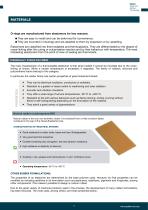
Epidor Seals and Rubber Technology MATERIALS O-rings are manufactured from elastomers for two reasons: ■ They are easy to install and can be deformed for convenience. ■ They are mounted in housings and are adapted to them by expansion or by upsetting. Elastomers are classified into thermostables and thermoplastics. They are differentiated by the degree of cross-linking after the curing or vulcanisation reaction and by their behaviour with temperature. The most interesting elastomers from the point of view of sealing are thermosets. THERMICALLY STABLE POLYMERS The main characteristic of a thermostable...
Open the catalog to page 11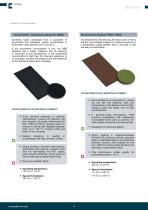
Materials I ... THERMICALLY STABLE POLYMERS Acrylonitrile / Butadiene copolymer (NBR) Synthetic rubber developed from a copolymer of acrylonitrile and butadiene, whose concentration in acrilonitrile varies between 18 % and 50 %. If the acrylonitrile concentration is low, the NBR obtained has a higher resilience and its elasticity is improved at low temperature. If the acrylonitrile concentration is high then the chemical resistance to oil increases, however the elasticity and the resistance to the remaining deformation decrease. Fluorelastomers, Viton® being the best known of them, are the most...
Open the catalog to page 12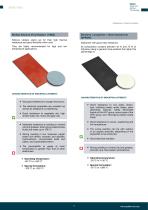
Epidor Seals and Rubber Technology THERMICALLY STABLE POLYMERS ... Methyl Silicone Vinyl Rubber (VMQ) Ethylene / propylene / diene terpolymer (EPPDM) Silicone rubbers stand out for their high thermal resistance and good flexibility when cold. They are highly recommended for high and low temperature applications. Elastomer with good wear resistance. Its composition contains between 45 % and 75 % of ethylene, being in general more resistant the higher this percentage is. ■ Very good resistance to oxygen and ozono. ■ The electrical properties are excellent as well as its resistance to weathering....
Open the catalog to page 13
... THERMICALLY STABLE POLYMERS Hydrogenated acrylonitrile / butadiene copolymer (H-NBR) Perfluorocarbon Rubber (FFPM / FFKM) They are fully fluorinated polymers with elastomer characteristics and are highly recommended for applications with aggressive chemicals at high temperatures. Its properties depend on the initial concentration of acrylonitrile and the degree of hydrogenation of the copolymer butadiene. CHARACTERISTICS OF INDUSTRIAL INTEREST: Almost universal chemical inertia, similar to PTFE. High temperature thermal stability. CHARACTERISTICS OF INDUSTRIAL INTEREST: Excellent resistance...
Open the catalog to page 14All Epidor Seals & Rubber Technology catalogs and technical brochures
 CUSTOM SEALING
12 Pages
 General presentation
12 Pages