
- Catalogs
- EPHYMESS GmbH
- Thermocouples

- Products
- Catalogs
- News & Trends
- Exhibitions
Thermocouples

Thermocouples
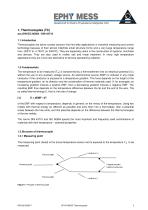
Thermocouples are widely used in industrial settings for temperature measurement due to their compact size and broad temperature range (-200°C to +1700°C or 2300°C). They are cost-effective for high-temperature applications, including system and device construction, and molten salt and metal treatment.
Thermocouples generate an electromotive force (EMF) based on temperature differences across metal conductors. This EMF is influenced by the temperature gradient and material properties, as defined by standards like DIN 43710 and IEC 60584.
- Measuring Point: The sensor exposed to the target temperature.
- Thermocouple: Consists of two different metals joined at the measuring point for a stable temperature-potential relationship.
- Comparison Point (Cold-End Point): Located at the free ends, requiring a stable reference temperature for accurate measurements.
- Extension Grade Wire: Extends the thermocouple using materials with similar thermal properties for cost efficiency.
Thermocouples are classified by their permissible deviation from standard temperature-voltage values, as per DIN 43710 and IEC 60584. Detailed tables are provided in the appendix.
Maximum deviations for thermocouple types (T, E, J, K, R/S, B) are outlined, with specific temperature ranges and deviation values. Thermocouples are typically delivered to meet these tolerances above -40°C.
Thermocouples must be selected based on maximum temperature and medium. Protective measures like thermowells are necessary for high temperatures to prevent contamination.
EPHY-MESS offers various thermocouples and wires, including bare and insulated thermowires, coil head thermocouples, and metal sheathed thermocouples, each with specific applications and temperature limits.
Used when uninterrupted thermoelectric wires are not feasible, offering mechanical stability and cost reduction, conforming to DIN 43710 and IEC 60584 norms.
Includes welded, bare, and insulated measuring points, each with specific applications and advantages like compact form and short response times.
Detailed data for various thermocouple types, including operating temperatures, dimensions, and electric strength, with unique features for specific configurations.
Used for temperatures up to 400°C in applications like polymer processing and motors. They feature a stainless steel protective pipe and bayonet cap for optimal heat transfer.
Suitable for difficult-to-access locations, known for small size, fast response, and vibration resistance. They conform to IEC 60584 and DIN 43710 standards.
- Thermocouple Types and Maximum Operating Temperatures: Type J (800°C), Type K (1100°C), Type S/R (1300°C).
- Jacket Diameters: 3-6 mm for types S and R, 3-8 mm for types L, J, and K.
- Jacket Materials and Maximum Operating Temperatures: Various materials with specific temperature limits.
- Norms and Tolerances: DIN 43710 and IEC 60584 standards.
- Nominal Lengths: 100 to 1000 mm, with custom lengths available.
- Installation Types: Includes soldered screw pegs and sliding threaded joints for different diameters and materials.
- Thermowells: Material selection based on stability under operating conditions, guided by DIN norms.
Five choices available, conforming to IP 53, with maximum environmental temperatures of 200°C for light metal models and 120°C for plastic.
Designed for installation in protective armatures, not suitable for direct use as sensors. Available with insert tube or jacket lead.
Used for attaching thermal elements to measuring units, available in standard, miniature, and printed board mounting models.
Series of voltage values in millivolts (mV) across different temperature ranges, though specific temperature values are not provided.
Three tolerance classes with maximum deviations specified for different types across various temperature ranges.
Maximum tolerances specified for types U and L, with base voltages and maximum tolerances for temperatures from -200°C to 900°C.
Outlines the IP protection rating system, detailing protection levels against solid objects and water.
Contact details for EPHY-MESS, including address, phone, fax, and website.
Catalog excerpts
1. Thermocouples (TC) acc.DIN IEC 60584 / DIN 43710 1.1 Introduction Thermocouples are active contact sensors that find wide applications in industrial measuring and control technology because of their almost indefinite small structure forms and a very large temperature range from -200°C to +1700°C (or 2300°C). They are especially useful in the construction of systems, machines and devices. They are also used in molten salt and metal treatment. In many high temperature applications they are a low cost alternative to devices operated by radiation. 1.2 Fundamentals The temperature to be measured...
Open the catalog to page 4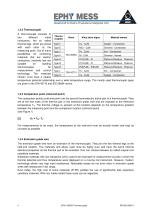
1.3.2 Thermocouple A thermocouple consists of Thermo two different metal Norm Alloy short signs Material names couples conductors, the so called Cu - CuNi Copper - Constantan thermal legs, which are joined Type T with each other at the Type E NiCr - CuNi Chromel - Constantan measuring point. Out of many Type J Fe - CuNi Iron - Constantan possibilities for combining IEC 60584 Ni - CrNi Type K Chromel - Alumel materials that are electric Pt10%Rh - Pt Platinum/Rhodium - Platinum conductors, relatively few are Type S Pt13%Rh - Pt Platinum/Rhodium - Platinum suitable for building Type R Type B Pt30%Rh...
Open the catalog to page 5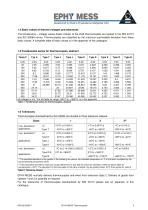
EPHY MESS Gesellschaft fur Elektro-Physikalische MeBgerate mbH 1.4 Basic values of thermal voltages and tolerances The temperature - voltage values (basic values) of the shelf thermocouples are quated in the DIN 43710 and IEC 60584 norms. Thermocouples are classified by the maximum permissible deviation from these basic values. A complete table of basic values is in the appendix of this catalogue. Table 2: Tolerance classes EPHY-MESS normally delivers thermocouples and wires from tolerance class 2. Delivery of goods from classes 1 and 3 is possible on request. For the tolerances of thermocouples...
Open the catalog to page 6
1.7 Operation conditions To maintain high measurement accuracy of thermocouples over long periods of time, it is necessary to select them carefully for their intended use. Two factors are very important: maximum temperature and medium to be measured in. A Ni-CrNi thermocouple (type K) is, for example, highly resistant to oxidizing agents, but if it is heated to over 850°C then its thermal electric properties change in such a way that even at low temperatures (<0°C) there are residual deviations. Thermal pairs of types J and L, which are made Fe-CuNi, are threatened by oxidizing agents at above...
Open the catalog to page 7
1.8 Product line overview Table 3: TC product line EPHY-MESS Thermocouples
Open the catalog to page 8
2. Extension grade wires Extension grade wires (= substitute materials for the thermoelectric wires with equal thermo electric properties) are usually used in the following cases: • the use of an uninterrupted thermoelectric wire is technically not possible (e.g. thermocouple with connector head or ducts) • the original thermoelectric wires does not have sufficient mechanical stability • the resistance of the original thermoelectric wires is too high for the measuring circuit • significant cost reduction in the case of the thermoelectric wires of noble metals The following extension grade wires...
Open the catalog to page 9
EPHY MESS Gesellschaft fur Elektro-Physikalische MeBgerate mbH 2.2 Thermocouples with bare (naked) measuring point This is the simplest version acc. DIN 43732, structure C and D. The extension grade or thermoelectric wire can remain bare or might be insulated over the entire length of the thermocouple, excluding the measuring bead. 2.3 Thermocouple with insulated measuring point i.e. coil head thermocouples (TE-WK) This type of configuration has its origin and main application range in the electric motors, generators, and transformers industries. Because of its compact form and insulation, these...
Open the catalog to page 10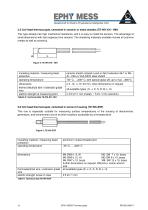
EPHY MESS Gesellschaft fur Elektro-Physikalische MeBgerate mbH 2.5 Coil head thermocouple, cemented in ceramic or metal sheaths (TE-WK-KH / -MH) This type already has high mechanical resistance, and it is easy to install the sensors. The advantage of small dimensions with fast response time remains. The sheathing materials available include all common metals as well as ceramics. insulating material / measuring bead protection Tabelle 5: Technical data TE-WK-KH / MH 2.6 Coil head thermocouple, cemented in screw-in housing (TE-WK-ESF) This one is especially suitable for measuring surface temperatures...
Open the catalog to page 11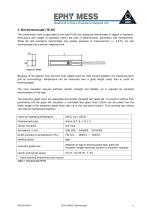
EPHY MESS Gesellschaft fur Elektro-Physikalische MeBgerate mbH 3. Slot thermocouple (TE-NT) This construction form is equivalent to the rigid Pt100 slot resistance thermometer in regard to insulation, dimensions and ranges of operation (within the coils of electromotors, generators and transformers). While the slot resistance thermometer has greater precision of measurement (+/- 0.3°C), the slot thermocouple has a shorter response time. Because of the special inner structure with copper sheet for heat contact between the measuring point and its surroundings, temperature can be measured over a...
Open the catalog to page 12
EPHY MESS Gesellschaft fur Elektro-Physikalische MeBgerate mbH 4. Pad thermocouples (TE-FPI) 4.1 Application range Stick-on pad thermocouples have been specially designed for measurements on surfaces. Hence their application ranges lie in research, development and manufacture, where, for example, temperature distribution and gradients in housing, heat utilization must be measured quickly, or where no space is available for larger thermometers. Pad thermocouples offer the following advantages: • high flexibility • small dimensions (7 x 7 x 0.16 mm) • low response times (as low as 0.06s) • simple...
Open the catalog to page 13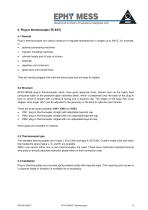
EPHY MESS Gesellschaft fur Elektro-Physikalische MeBgerate mbH 5. Plug-in thermocouple (TE-EST) 5.1 General Plug-in thermocouples are used to measure or regulate temperatures in ranges up to 400°C, for example, in • polymer processing machines • injection moulding machines • cylinder heads and oil tubs of motors • bearings • pipelines and containers • generators and transformers They are usually plugged into machine bores parts and are easy to replace. 5.2 Structure EPHY-MESS plug-in thermocouple, which have good response times, absorb heat via the highly heat conductive base of the protective...
Open the catalog to page 14All EPHYMESS GmbH catalogs and technical brochures
 VibroTherm®
2 Pages
 Wind power sensors
2 Pages
 Railway Sensors
2 Pages
 Industry sensors
2 Pages
 Bimetallic switches
9 Pages
 Electric band heaters
13 Pages
 Semiconductor sensors
25 Pages
 Railway Sensors_2018
19 Pages
 Resistance Thermometers
36 Pages
 Product Overview
19 Pages

Archived catalogs
 Leaflet Industy
4 Pages
 Slot Resistance Thermometers
11 Pages
 Products and solutions
11 Pages

- EPHYMESS temperature sensor
- EPHYMESS resistance temperature sensor
- Waterproof temperature sensor
- EPHYMESS Pt100 temperature sensor
- EPHYMESS stainless steel temperature sensor
- RTD temperature sensor
- Pt1000 temperature transducer
- Liquids level gauge
- EPHYMESS threaded temperature sensor
- Analog temperature sensor
- Process temperature sensor
- Insertion temperature sensor
- EPHYMESS compact temperature sensor
- EPHYMESS 3-wire temperature sensor
- High-temperature temperature sensor
- Temperature sensor with thermowell
- Sight glass level indicator
- Air temperature probe
- EPHYMESS 4-wire temperature sensor