


WEAR Technologies

WEAR Technologies
Catalog excerpts

WEAR™ Pipe Restraint Vibration Isolator
Open the catalog to page 1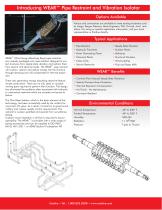
Introducing WEAR™ Pipe Restraint and Vibration Isolator Options Available Various end connections are available to meet existing hardware such as Lisega, Bergen Paterson, Basic Engineers, PSA, Grinnel, Anvil and others. For sizing or specific application information, call your local representative or Enidine directly. Typical Applications • Pipe Restraint • Hydraulic Transients These new generation energy absorbing restraints feature simple construction. There are no oils, seals or complex moving parts required to perform their function. The design has eliminated the problems often associated...
Open the catalog to page 2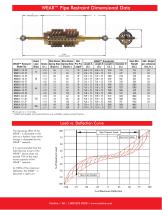
WEAR™ Restraint Model No. *Pin-to-pin is ±1.5 inches. ** Additional lengths and customizations are available, please contact factory. Load vs. Deflection Curve The damping effect of the WEAR™ is illustrated in the plot as a hysteric loop which energy is dissipated by the WEAR™ restraint. It is recommended that the total thermal travel of the WEAR™ device does not exceed 75% of the total travel capacity of the WEAR™ restraint. At 100% of the maximum deflection the WEAR™, it becomes a rigid unit.
Open the catalog to page 3
Enidine 7 Centre Drive Orchard Park, New York 14127 • USA Phone: 716-662-1900 Fax: 716-667-1909 Email: [email protected] www.enidine.com
Open the catalog to page 4All Enidine catalogs and technical brochures
 Shock Absorbers and Rate Controls
118 Pages
 ULTRA-HERM® - Defense
4 Pages
 Air Springs (Legacy)
40 Pages
 Wire Rope Technologies
4 Pages
 Enidine Capabilities A4
8 Pages
 Air Springs (Expanded)
16 Pages
 Wire Rope Isolator Technologies
78 Pages
 Infrastructure Products
18 Pages
 Heavy Vehicle Solutions
2 Pages
 Elastomeric Technologies
4 Pages
 Heavy Industry Products
2 Pages
 Crane Industry Products
4 Pages
 Steel Industry Products
4 Pages
 ITT Industrial Bumpers
8 Pages
 ITT Enidine Capabilities
8 Pages
 PXR Series
8 Pages
 Enidine Product Overview A4
2 Pages
 Enidine Product Overview
2 Pages
 Tow bar Snubbers
2 Pages





Archived catalogs

- Actuator
- Linear actuator
- Rolling bearing
- Compact actuator
- Enidine anti-vibration mount
- Enidine hydraulic damper
- Enidine shock damper
- Wire spring
- Enidine mechanical damper
- Pneumatic actuator
- Enidine metal anti-vibration mount
- Flow switch
- Enidine industrial damper
- Compression spring
- Metal damper
- Liquid flow switch
- Rubber anti-vibration mount
- Enidine vibration damper
- Gas spring