

E214

E214
- Product Index: Lists products like swing cylinders, linear cylinders, valves, and system components with page numbers for navigation.
- Power Sources: Details pumps and power units, including air hydraulic, electric, and manual pumps, with applications and specifications.
- Valves: Covers manual, electric, and air poppet valves, their functions, and installation.
- System Components: Describes components like accumulators and digital gauges essential for hydraulic systems.
- Yellow Pages: Offers resources such as safety instructions, basic hydraulics, and best practices for optimizing hydraulic systems.
- Global Resource: Provides imperial and metric specifications for workholding solutions.
- Quality Assurance: Enerpac products are ISO 9001 certified.
- Logistics Excellence: Emphasizes global distribution expertise.
- Product Selection Guide: Step-by-step guide for selecting products based on function, mounting style, and capacity.
- Upper Flange (SU series): Manifold or threaded port connection, easy installation.
- Lower Flange (SL series): No fixture hole required, suitable for large parts.
- Threaded Body (ST series): Precise height positioning.
- Cartridge (SC series): Minimal space required.
- Compact design for efficient fixture layout.
- Double and single-acting cylinders for various hydraulic requirements.
- Innovative clamp arm design for quick positioning.
- Collet-Lok® positive locking for mechanical holding without hydraulic pressure.
- WF Series: Includes manifold, threaded, lower flange, and cartridge models.
- WS Series: Features spring advance work supports with manifold, threaded, lower flange, and cartridge mount styles.
- WP Series: Utilizes Collet-Lok® design for maintaining support position without hydraulic pressure.
- Push Force: 2950-6300 lbs
- Pull Force: 1250-3150 lbs
- Stroke: 0.87-1.12 inches
- Pressure: 500-5000 psi
- PU Series: Upper flange pull cylinders designed for integrated manifold mounting solutions.
- PL Series: Lower flange cylinders with similar mounting solutions.
- PT Series: Threaded body pull cylinders that can be bolted to fixtures.
- MRS Cylinders: Designed for palletized applications, using heavy disk springs for clamping force and hydraulic pressure for release.
- Collet-Lok® Push Cylinders: Mechanically hold the workpiece after hydraulic pressure is removed.
- RW Series Cylinders: Suitable for high-pressure applications requiring additional force.
- MRS Cylinders: Clamping force determined by the plunger's retraction distance.
- Collet-Lok® Sequence: Involves pressurizing specific ports to extend, lock, and release the plunger.
- Manual Mode: Operates as long as the operator holds the pendant button.
- AUTO Mode without Timer: Runs until a user-adjustable pressure setting is reached.
- AUTO Mode with Timer: Runs until the pressure setting is reached and the adjustable timer runs out.
- Pressure: Up to 5000 psi
- Flow Rate: 60-120 in³/min
- Motor: 1.0 or 1.5 hp
- Reservoir Capacity: 1.0-10 gallons
- Air Operated Pumps: Suitable for small to medium circuits with intermittent duty.
- Electric Operated Pumps: Ideal for large circuits with high duty requirements.
- WUD-1100 Series: Provides advance/auto-retract for single-acting cylinders.
- WUD-1300 Series: Offers advance/hold/retract capabilities.
- Manual 3-way, 2-position and 3-way, 3-position valves: Used for single-acting cylinders.
- Manual 4-way, 3-position valves: Suitable for double-acting cylinders.
- Sequence Valves: Control flow to secondary circuits based on pressure settings.
- Pilot Operated Check Valves: Designed to hold cylinder loads and ensure remote unlocking.
- Flow Control Valves: Regulate oil flow with a poppet valve design.
- Pressure Reducing Valves: Provide precise control of hydraulic pressure.
- Locking options available for load-holding applications.
- Various mounting options, including pump and remote mounting.
Locating, Clamping, and Supporting Workpieces:
Locating a Body: Locating involves positioning the workpiece within the clamping device to ensure consistent machining within specified tolerances.
Clamping: Clamping secures a positioned workpiece for machining.
Supported Workpiece: Support ensures force transmission and prevents deformation.
Introduction: Provides guidelines for estimating cutting forces in machining operations.
Catalog excerpts

Section Index Swing cylinders & Work supports 8-41 Enerpac Worldwide Locations Africa ENERPAC Middle East FZE Office 423, JAFZA 15 P.O. Box 18004 Jebel Ali, Dubai United Arab Emirates Tel:+971 (0)4 8872686 Fax:+971 (0)4 8872687 Australia, New Zealand Actuant Australia Ltd. Block V Unit 3 Regents Park Estate 391 Park Road Regents Park NSW 2143 (P.O. Box 261) Australia Tel:+61 297 438 988 Fax:+61 297 438 648 Brazil Power Packer do Brasil Ltda. Rua dos Inocentes, 587 04764-050 - Sao Paulo (SP) Tel:+55 11 5687 2211 Fax:+55 11 5686 5583 Toll Free: 0800 891 5770 [email protected] Canada Actuant Canada Corporation 6615 Ordan Drive, Unit 14-15 Mississauga, Ontario L5T 1X2 Tel:+1 905 564 5749 Fax:+1 905 564 0305 Toll Free: Tel: +1 800 268 4987 Fax:+1 800 461 2456 Technical Inquiries: [email protected] China Actuant China Ltd. 1F, 269 Fute N. Road Waigaoqiao Free Trade Zone Pudong New District Shanghai, 200 131 China Tel:+86 21 5866 9099 Fax:+86 21 5866 7156 Actuant China Ltd. (Beijing) 709B Diyang Building Xin No. 2 Dong San Huan North Rd. Beijing City, 100028 China Tel: +86 10 845 36166 Fax:+86 10 845 36220 Japan Applied Power Japan LTD KK Besshocho 85-7 Kita-ku, Saitama-shi 331-0821 Japan Tel:+81 48 662 4911 Fax:+81 48 662 4955 France and Switzerland ENERPAC Une division de ACTUANT France S.A.S. ZA de Courtaboeuf 32, avenue de la Baltique 91140 VILLEBON /YVETTE France Tel:+33 1 60 13 68 68 Fax:+33 1 69 20 37 50 Germany, Austria, Switzerland, Greece, Central and Eastern Europe ENERPAC GmbH P.O. Box 300113 D-40401 Düsseldorf Willstätterstrasse 13 D-40549 Düsseldorf Germany Tel:+49 211 471 490 Fax:+49 211 471 49 28 India ENERPAC Hydraulics (India) Pvt. Ltd. No. 1A, Peenya Industrial Area, IInd Phase, Bangalore, 560 058 India Tel:+91 80 40 792 777 Fax:+91 80 40 792 792 Middle East, Turkey and Caspian Sea ENERPAC Middle East FZE Office 423, JAFZA 15 P.O. Box 18004 Jebel Ali, Dubai United Arab Emirates Tel:+971 (0)4 8872686 Fax:+971 (0)4 8872687 Russia and CIS (excl. Caspian Sea Countries) Actuant LLC Admiral Makarov Street 8 125212 Moscow Russia Tel:+7-495-9809091 Fax:+7-495-9809092 Singapore Actuant Asia Pte Ltd. 37C, Benoi Road Pioneer Lot, Singapore 627796 Tel:+65 68 63 0611 Fax:+65 64 84 5669 Toll Free: Tel: +1800 363 7722 Technical Inquiries: [email protected] Italy ENERPAC S.p.A. Via Canova 4 20094 Corsico (Milano) Tel:+39 02 4861 111 Fax:+39 02 4860 1288 South Korea Actuant Korea Ltd. 3Ba 717, Shihwa Industr. Complex Jungwang-Dong, Shihung-Shi, Kyunggi-Do Republic of Korea 429-450 Tel:+82 31 434 4506 Fax:+82 31 434 4507 Spain and Portugal ENERPAC SPAIN, S.L. Avda. Los Frailes 40 – Nave C & D Pol. Ind. Los Frailes 28814 Daganzo de Arriba (Madrid) Spain Tel:+34 91 661 11 25 Fax:+34 91 661 47 89 The Netherlands, Belgium, Luxembourg, Sweden, Denmark, Norway, Finland, Baltic States ENERPAC B.V. Galvanistraat 115, 6716 AE Ede P.O. Box 8097, 6710 AB Ede The Netherlands Tel:+31 318 535 911 Fax:+31 318 525 613 +31 318 535 848 Technical Inquiries Europe: [email protected] ENERPAC Daalakkerweg 24 6041 BL Roermond P.O. Box 49, 6040 AA, Roermond The Netherlands Tel:+31 475 355 000 Fax:+31 475 331 774 United Kingdom and Ireland ENERPAC Ltd., Bentley Road South Darlaston, West Midlands WS10 8LQ, England Tel:+44 (0)121 50 50 787 Fax:+44 (0)121 50 50 799 USA, Latin America and Caribbean ENERPAC P.O. Box 3241 6100 N. Baker Road Milwaukee, WI 53209 USA Tel:+1 262 781 6600 Fax:+1 262 783 9562 User inquiries: +1 800 433 2766 Distributor inquiries/orders: +1 800 558 0530 Technical Inquiries: [email protected] ENERPAC 704 W. Simonds Dallas, TX 75159, USA Tel: +1 972 287 2390 Fax:+1 972 287 4469 Internet: www.enerpac.com Your Enerpac distributor: Email: [email protected] © Enerpac 2008 - Subject to change without notice. WORKHOLDING CATALOG A global resource of workholding solutions
Open the catalog to page 1
Product index Refer to the “Yellow Pages” of this catalog for: • Safety instructions • Basic hydraulic information • Advanced hydraulic technology • FMS (Flexible Machining Systems) technology • Conversion charts and hydraulic symbols Swing cylinders & Work supports 8-41 Yellow Pages * These models are only shown in imperial versions in this catalog. Contact Enerpac to order metric models. Section index
Open the catalog to page 2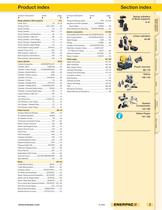
Product index Power sources 86-119 Valves 120-143 Yellow Pages 161-192 Yellow pages System components Power sources Swing cylinders & Work supports 8-41 Linear cylinders Swing cylinders Work supports Section index
Open the catalog to page 3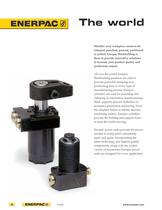
The world Whether your workpiece needs to be clamped, punched, pressed, positioned or pulled, Enerpac Workholding is there to provide innovative solutions to increase your product quality and production output. All over the world, Enerpac Workholding products are used to provide powerful clamping and positioning force to every type of manufacturing process. Enerpac cylinders are used for punching and clamping in automotive manufacturing. Work supports prevent deection in aerospace production machining. From the simplest xture to robotic assisted machining centers, Enerpac cylinders provide the...
Open the catalog to page 4
10 Good Reasons to Work with Enerpac 1. Expert Design 2. Quality 3. Innovative Products 4. Reliability 5. Service Excellence 6. Availability Working with us couldn’t be easier! 2D and 3D CAD les of Enerpac Workholding products are available on-line (www.enerpac.com). This service includes swing cylinders, work supports, and other clamping cylinders, along with all accessories. Catalogs in other languages and service information, including spare parts lists, are also available upon request through the Enerpac website. 8. Application Support 9. Global Vision 10. Worldwide Experience Total Quality...
Open the catalog to page 5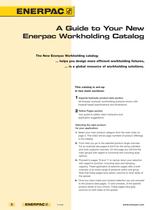
A Guide to Your New Enerpac Workholding Catalog The New Enerpac Workholding catalog; ... helps you design more efcient workholding xtures, ... is a global resource of workholding solutions. This catalog is set-up in two main sections: 1 Imperial hydraulic product data section All Enerpac hydraulic workholding products shown with imperial based specications and dimensions. 2 Yellow Pages section Your guide to safety, basic hydraulics and application suggestions. Selecting the right product for your application: 1. Select your main product category from the main index on page 3. This index shows...
Open the catalog to page 6All ENERPAC catalogs and technical brochures
 HTM, LPHT, MHT Series
1 Page
 SCTB-Series Toolbox Sets
1 Page
 Bolting Tools E415
136 Pages
 INDUSTRIAL TOOLS E330a
428 Pages
 ZE2-SERIES ELECTRIC PUMPS
2 Pages
 ETR-Series Trolley Systems
4 Pages
 Skidding Systems HSK-Series
2 Pages
 Hydraulic Presses
10 Pages
 Inline Filters
1 Page
 Manifolds
3 Pages
 Load Skates
2 Pages
 Hydraulic and Mechanical Pullers
14 Pages
 PA-Series Air Pumps
1 Page
 Machine Lifts SOH series
1 Page
 PR-Series Wheeled Jacks
2 Pages
 ZA4-Series Air Pumps
2 Pages
 Directional Control Valves
6 Pages
 Workholding Pumps
40 Pages
 JS-Series Jack-Up Systems
8 Pages
 LW-series
1 Page
 Hydraulic Pumps and Power Units
50 Pages
 MP series
1 Page
 Pressure Intensifiers
2 Pages
 Coupler Packages
13 Pages
 SFP-Series, Split-Flow Pumps
2 Pages
 MS-Series
4 Pages
 TM LH Series
1 Page
 DuroTech™-Series
4 Pages
 High Tonnage Cylinder
20 Pages
 E328a
E328a288 Pages
 E329 Industrial Tools Catalog
294 Pages
 A, C-Series
1 Page
 STB-Series
2 Pages
 E328e
E328e280 Pages
 E413 Bolting Tools
88 Pages
 E413e Bolting Tools
88 Pages
 E327e Industrial Tools
268 Pages
 WCC World Class Collection
16 Pages
 Tools for Bridge Maintenance
2 Pages
 E327 Industrial Tools
258 Pages
 Bolting Solutions
88 Pages
 SBL-1100 Hydraulic Gantry
4 Pages
 Collet-Lok® Product Family
2 Pages
 TQ-700 Electric Wrench Pump
4 Pages
 XC-SerieS CORDLESS PuMPS
2 Pages
 E501 Mechanical Actuators
92 Pages
 Integrated Solutions Capability
28 Pages
 E215 Workholding - Imperial
232 Pages
 E326e Industrial Tools
260 Pages


