

Torque Limiters

Torque Limiters
Overview
This document provides comprehensive technical information, installation guidelines, adjustment procedures, and specifications for ENEMAC safety couplings and torque limiters. It covers multiple product types designed to protect machinery by disengaging torque transmission during overload conditions, ensuring reliable and adjustable torque limitation in various industrial applications.
1. Product Types and Features
- Safety Couplings: Types ECA, ECB, ECC featuring various bearing and hub configurations, including stainless steel versions and metal bellows (ECC) for shaft misalignment compensation.
- Torque Limiters: Types ECE, ECF, ECG, ECH, ECI, ECR designed for different drive elements such as toothed belts, chains, and pulleys, incorporating sliding bearings and clamping hubs.
- Additional Models: ECO and ECP safety couplings offering compact design, integrated bearings, and adjustable torque settings.
2. Operating Principle
Torque transmission occurs via steel balls pressed by disk springs engaging recesses in the flange ring. Upon overload, the hub rotates relative to the flange ring, pushing balls out of recesses, causing the coupling to "click over" and activate a proximity switch to stop the drive. The system allows short-term overload clicking and automatic reengagement after disturbance removal.
3. Technical Specifications
- Torque Ranges: From 0.5 Nm up to 1600 Nm depending on model and size.
- Maximum Rotational Speeds: Range from 800 to 4000 min⁻¹ based on product type.
- Installation Fits: Sliding fits such as H7/j6 or G7/k6 recommended between bushings/hubs and shafts.
- Screw Threads and Tightening Torques: Specified for hub and flange ring screws to ensure proper assembly.
- Misalignment Compensation: ECC type uses metal bellows allowing lateral (up to 0.27 mm) and axial (±0.8 to ±1.3 mm) shaft misalignments; ECF type compensates radial misalignments up to 0.9 mm.
4. Installation Guidelines
- Use cross-wise tightening of screws to prevent axial run-out and wobble, which can cause pulley tilting and malfunction.
- Pre-install draw-off screws for dismounting bushings, especially when axial space is limited.
- Emergency switching via proximity switches must immediately shut off the drive upon overload detection.
- Vertical axis mounting requires caution as residual torque after disengagement may not prevent axis descent.
- Specific instructions per model: ECA requires axial alignment of pulley and bearing centers; ECB requires flat pulley surfaces and separate shaft centering; ECC bellows must be handled carefully to avoid deformation.
5. Adjustment of Disengagement Torque (TA)
- Torque is continuously adjustable without changing the disk spring.
- Factory preset at approximately 70% of maximum torque.
- Adjustment performed by turning an adjustment nut after loosening Allen set screws.
- Due to disk spring characteristics, clockwise rotation decreases TA, counter-clockwise increases TA—opposite to common practice.
- Torque must not be set below the MIN mark to avoid blocking the disk spring and coupling failure.
- After adjustment, secure the nut with set screws and threadlocker (e.g., LOCTITE 222).
6. Shaft Misalignment Compensation
- ECC Type: Metal bellows compensate for lateral and axial misalignments; measurement requires 360° rotation of dial gauge setup.
- ECF Type: Compensates radial misalignments; measurement involves shaft rotation and dial gauge readings.
7. Safety and Operational Recommendations
- Emergency shutdown must be immediate upon overload detection to protect machinery and coupling.
- Couplings are designed for a limited number of overload cycles (typically around 250).
- Proper alignment and fit are critical to avoid premature wear or failure.
- Metal bellows (ECC) are fragile and require careful handling.
- Vertical CNC machine axes may require additional measures to prevent axis descent after disengagement.
8. Additional Notes on Torque Limiters (ECE, ECF, ECG, ECH, ECI, ECR)
- Operate on the same ball-and-spring principle as safety couplings.
- Drive elements (pulleys, chain wheels) are bolted onto the clutch and transmit torque by friction.
- Sliding bearings are necessary to support tractive forces; the clutch itself cannot absorb these forces.
- Maximum speeds depend on clutch and drive element limitations.
- Emergency switching via proximity switches is essential.
- Torque adjustment follows the same principles as safety couplings.
9. Standards and Norms
- Keyways conform to DIN 6885 sheet 1.
- Screws and bolts comply with DIN 912 and DIN 933 standards.
- Use of LOCTITE 222 or similar adhesives recommended for securing set screws.
10. Summary of Critical Parameters
| Type | Torque Range (Nm) | Max Speed (min⁻¹) | Misalignment Limits | Key Installation Notes |
|---|---|---|---|---|
| ECA/ECB/ECC | 0.5 - 400 | 2000 - 3000 | Lateral: up to 0.27 mm (ECC), Axial: ±0.8 to ±1.3 mm | Sliding fit, cross-wise screw tightening, careful bellows handling (ECC) |
| ECE/ECF/ECG/ECH/ECI/ECR | 2 - 1600 | 800 - 3000 | Radial and axial misalignments per type (e.g., ECF radial up to 0.9 mm) | Sliding fit, axial fixation by threaded pins, sliding bearings required |
11. Model-Specific Highlights
- ECA: Compact safety coupling with built-in bearing for direct pulley mounting; preset torque approx. 70% TA max.
- ECB: Safety coupling with built-in shaft bearing; compatible with existing pulleys.
- ECC: Flexible shaft-to-shaft connection with metal bellows for misalignment compensation.
- ECE: Torque limiter requiring drive element bearings; adjustable torque.
- ECG: Torque limiter with flexible claw coupling and rubber intermediate part.
- ECF: Torque limiter with elastic claw coupling for shaft-to-shaft joints.
- ECH: Torque limiter designed for chain wheels and pulleys; requires sliding bearing in drive element.
- ECI: Integrated chain wheel torque limiter; low-cost, accurate alternative to slip clutches.
- ECR: Stainless steel torque limiter with integrated bearing and labyrinth seal for dirt protection.
- ECO: Cost-effective safety coupling with clamping hub and sliding bearing.
- ECP: Safety coupling with integrated ball bearing for high axial and radial loads; quiet running.
12. Ordering and Customization
- Ordering examples provided for each model specifying size, bore diameter, keyway, and torque setting.
- Special versions and adjustments available on request, including different torque ranges, reengagement points, and stainless steel options.
Conclusion
ENEMAC safety couplings and torque limiters offer reliable overload protection through a robust ball-and-spring mechanism with adjustable disengagement torque. Proper installation, alignment, and adjustment are critical for optimal performance and safety. The document emphasizes adherence to technical specifications, careful handling of sensitive components, and the necessity of emergency shutdown systems to prevent damage during overload events. Compliance with DIN standards ensures compatibility and quality across applications.
Catalog excerpts
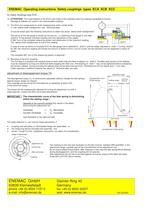
10. ATTENTION! The metal bellows of the ECCs are made of thin stainless steel thus beeing susceptible to shocks. Damage to bellows can result in an unserviceable coupling ! 11. The ECC can compensate for shaft misalignments within certain limits (= max. lateral shaft misalignment see Technical data). ECC It must be acted upon the following instructions to obtain the actual lateral shaft misalignment: The set-up of the dial gauge is shown by the picture, i. e. fastening of the gauge to one side (shaft 2) of the already mounted coupling and zero adjustment of the caliper. A 360Ұ turn of the complete...
Open the catalog to page 3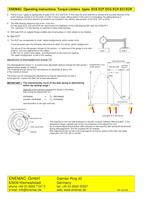
8. Points 6 and 7 apply as appropriate to types ECG, ECI and ECR. In this case the drive element is centred and mounted directly on the clutch bearing instead of on the shaft. In order to have a lower sliding speed in the event of overloading, the sliding bearing is incorporated in the drive element (is therefore not included in the delivery specification of the ECG, ECI or ECR). 9. The slide bearing clearance has to be tolerance f 7 of the bearing is matched to these slide bearings. 10. With type ECE an adapter flange enables also small pulleys or chain wheels to be installed. < 0,03 mm. For...
Open the catalog to page 5All ENEMAC catalogs and technical brochures
 MECHANICAL CLAMPING ELEMENTS
15 Pages
 SHAFT COUPLINGS
48 Pages
 TORQUE LIMITERS
36 Pages
 ECP
ECP1 Page
 ECOL
ECOL1 Page
 ECK
ECK1 Page
 ECI
ECI1 Page
 ECG
ECG1 Page
 ECH
ECH1 Page
 ECS
ECS2 Pages
 ECE
ECE1 Page
 ECB
ECB1 Page
 ECA
ECA1 Page
 TORQUE LIMITERS
28 Pages
 SHAFT COUPLINGS
36 Pages
 MECHANICAL CLAMPING ELEMENTS
14 Pages