
- Catalogs
- Endress+Hauser Sensors & Components
- Technical Information - Radar sensor USR30


Technical Information - Radar sensor USR30
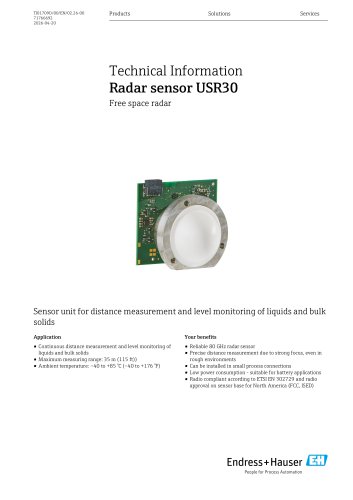
Technical Information - Radar sensor USR30
The document provides technical details about the Radar Sensor USR30, designed for distance measurement and level monitoring of liquids and bulk solids. It covers the sensor's applications, benefits, and compliance with radio standards.
- Measuring Range: Up to 35 m (115 ft) for liquids and bulk solids.
- Operating Frequency: 80 GHz.
- Ambient Temperature: –40 to +85 °C (–40 to +176 °F).
- Output Signal: Digital UART with specific protocol parameters.
- Power Supply: 3.5 to 5.5 VDC for the sensor and 1.7 to 3.6 VDC for the digital interface.
The sensor uses the time-of-flight method (ToF) with Frequency Modulated Continuous Wave (FMCW) radar signals to measure distance without contacting the process medium.
- Accuracy: Depends on medium type and distance, with specific maximum errors for liquids and solids.
- Temperature Coefficient: ≤ 4 mm per 10 K.
Proper installation is crucial to avoid interference, requiring integration into a closed housing with specific mechanical and electrical considerations.
The sensor complies with RoHS directives and radio standards such as ETSI EN 302 729, FCC, and Industry Canada regulations.
The document details the USR30 radar sensor's compliance with international standards, including the Radio Equipment Directive 2014/53/EU, FCC Part 15, and Industry Canada RSS standards. Installation must be performed by trained personnel, with specific instructions on antenna positioning and height restrictions near astronomy stations.
The device should be mounted vertically downwards and installed at least 4 km away from specified astronomy stations unless approved by authorities. If within 4 to 40 km, the installation height must not exceed 15 m above ground.
The device meets FCC regulations, requiring specific labeling and testing for spurious emissions. Industry Canada compliance mandates a 10 km distance from the Dominion Astrophysical Radio Observatory unless coordinated otherwise.
The USR30 sensor is part of Endress+Hauser's closed measuring systems, complying with EN 61010-1 safety standards and bearing the CE mark. Customers must obtain approvals for their end systems.
The document emphasizes compliance with the WEEE Directive 2012/19/EU, advising against disposal as unsorted municipal waste and offering return options to Endress+Hauser for disposal.
Information on supplementary documentation and accessories, such as adapter cables, is provided, along with contact details for further inquiries.
Catalog excerpts
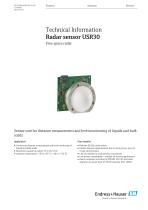
Technical Information Sensor unit for distance measurement and level monitoring of liquids and bulk solidsApplication ■ Continuous distance measurement and level monitoring of liquids and bulk solids ■ Maximum measuring range: 35 m (115 ft)) Your benefits ■ Reliable 80 GHz radar sensor ■ Precise distance measurement due to strong focus, even in rough environments ■ Can be installed in small process connections ■ Low power consumption - suitable for battery applications ■ Radio compliant according to ETSI EN 302729 and radio approval on sensor base for North America (FCC, ISED) People for Process Automation
Open the catalog to page 1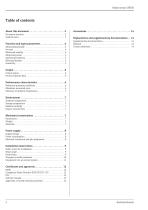
Table of contents About this document . . . . . . . . . . . . . . . . . . . . . . . . . . . .3 Document function . . . . . . . . . . . . . . . . . . . . . . . . . . . . . . . . . . . . 3 Symbols used . . . . . . . . . . . . . . . . . . . . . . . . . . . . . . . . . . . . . . . . . 3 Explanations and supplementary documentation . . 14 Function and input parameters . . . . . . . . . . . . . . . . . . .4 Measuring principle . . . . . . . . . . . . . . . . . . . . . . . . . . . . . . . . . . . Process . . . . . . . . . . . . . . . . . . . . . . . . . . . . . . . . . . . . . . . . . . . . . . Measured...
Open the catalog to page 2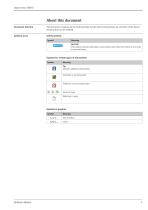
About this document Document function This document contains all the technical data for the device and provides an overview of the device versions that can be ordered. This symbol contains information on procedures and other facts which do not result in personal injury. Symbols for certain types of information
Open the catalog to page 3
Measuring principle The Micropilot is a measuring system, operating based on the time-of-flight method (ToF). It measures the distance from the reference point to the product surface. The radar signals based on the "Frequency Modulated Continuous Wave" (FMCW) principle are emitted by an antenna, reflected off the product surface and received again by the radar system. Process ■ The Measurement can be carried out directly through the tank -> This is only possible for electrically non-conductive tank walls No contact is made with the process medium. Measured variable Measured process variables:...
Open the catalog to page 4
Medium Media: solids and liquids The usable measuring range depends on the reflection properties of the medium, the installation position and possible interference reflections. Measurement of the following media with absorbing gas phase For example the following media ■ Methyl ethyl ketone ■ VCM (vinyl chloride monomer) To measure absorbing gases, either use a guided radar, measuring devices with another measuring frequency or another measuring principle. If measurements must be performed in one of these media, please contact Endress+Hauser. The operating frequency is for measurement purposes...
Open the catalog to page 5
Output signal Digital: UART (8N1 inverted) Baud rate: 230.4 kBd data bits: 8 Parity: none Polarity: inverted (idle low) Protocol-specific data The USR30 has the following read and write parameters: Reference operating conditions Maximum measured error Pressure = 960 mbar abs. (14 psi) ±100 mbar (±1.45 psi) Humidity = 60 % ± 5 % Reflector: metal plate with a diameter > 1m (40in) No major interference reflections inside the signal beam Frequency mode 1: default setting of 77 to 81 GHz The accuracy is the sum of the non-linearity, non-repeatability and hysteresis. Non-repeatability is already included...
Open the catalog to page 6
Influence of ambient temperature Environment Ambient temperature Storage temperature Relative humidity Mechanical construction Dimensions Sensor unit NOTICE The fixing screws of the circuit board must not be removed! Sensor unit with antenna: 68 g • Radar antenna: Plastic PBT • Coupling adapter: PPS GF40 (metallized)
Open the catalog to page 7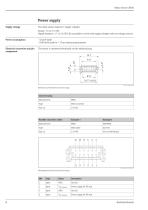
Supply voltage The radar system requires 2 supply voltages: Digital interface: 1.7 to 3.6 VDC (It is possible to cover both supply voltages with one voltage source). ~1000mW peak for <10ms during measurement Electrical connection and pin The sensor is connected electrically via the attached plug. Dimensions of the electrical connector plug
Open the catalog to page 8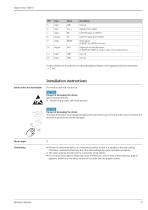
Further details are described in the Operating Manual Radar (see Supplementary documentation ^ 1 14) For work on and with the device: NOTICEDanger of damaging the device Static sensitive devices. ► Handle only at static safe work stations! Danger of damaging the device The radar antenna is secured against falling with a protective cap. If the protective cap is removed, the antenna may fall down and be damaged. Beam angle Positioning Mount the measuring device in a horizontal position so that it is parallel to the tank ceiling. Otherwise, undesired reflections from the surroundings can cause interference...
Open the catalog to page 9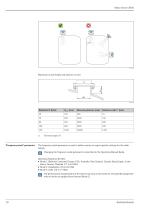
Maximum nozzle height and distance to wall "Frequency mode" parameter The frequency mode parameter is used to define country or region-specific settings for the radar Changing the frequency mode parameter is described in the Operating Manual Radar. ■ Mode 1 (Default): Continent Europe, USA, Australia, New Zealand, Canada, Brazil, Japan, South Korea, Taiwan, Thailand (77 to 81 GHz) The performance characteristics of the device may vary on the mode set. The specified properties refer to device as supplied from factory (Mode 1).
Open the catalog to page 10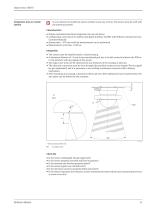
Integration into an overall It is not allowed to modify the sensor module in any way or form. The sensor must be used with system the antenna provided. ■ Simple mechanical/electrical integration into an end device ■ Configuration and control via widely used digital interface (UART) with defined command set (see Customer Manual) ■ Startup time: <250 ms until first measurement can be performed ■ Measurement cycle time: <100 ms ■ The sensor must be installed inside a closed housing. ■ A minimum distance of >2 mm to any mechanical part has to be left around and above the PCB as to not interfere with...
Open the catalog to page 11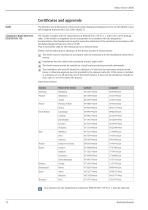
RoHS The Directive on the Restriction of the Use of Certain Hazardous Substances 2011/65/EU (RoHS 2) and the Delegated Directive (EU) 2015/863 (RoHS 3). Compliance Radio Directive ETSI EN 302 729 The module complies with the requirements of ETSI EN 302 729 V2.1.1 (2016) for a level probing radar. If the module is integrated into an end product in accordance with the integration documentation, this standard can be used to assess the conformity of the end device in accordance with the Radio Equipment Directive 2014/53/EU. That is exclusively valid for the listed products in delivery status. Please...
Open the catalog to page 12All Endress+Hauser Sensors & Components catalogs and technical brochures
- Level probe
- Liquid level sensor
- Pressure probe
- Membrane pressure sensor
- Digital output level sensor
- Analog pressure sensor
- Vessel level sensor
- Pressure transducer
- Relative pressure sensor
- Stainless steel pressure sensor
- Analog pressure transducer
- IP68 level sensor
- Absolute pressure sensor
- Gas pressure sensor
- Sensitive element pressure sensor
- Liquid pressure sensor
- Membrane pressure transducer
- Solid level sensor
- Precision pressure sensor
- Digital pressure sensor