

Considerations for using charge amplifiers with high temperature piezoelectric accelerometers
Considerations for using charge amplifiers with high temperature piezoelectric accelerometers
Catalog excerpts

Considerations for using charge amplifiers with high temperature piezoelectric accelerometers Technical Paper 339 By Scott Mayo
Open the catalog to page 1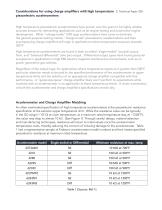
High temperature piezoelectric accelerometers have proven over the years to be highly reliable, accurate sensors for demanding applications such as jet engine testing and automotive engine development. While "voltage-mode" IEPE type accelerometers have come to dominate the general purpose testing market, "charge-mode" piezoelectric accelerometers and their accompanying charge amplifiers still reign in applications where temperature exposure exceeds 300°F. High temperature accelerometers are found in both so-called "single-ended" (coaxial) output form, and "balanced differential" (two pin) output....
Open the catalog to page 2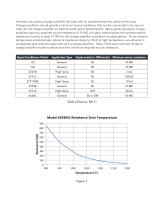
However not just any charge amplifier will work with an accelerometer that performs this way. Charge amplifiers should specify a minimum source resistance that can be connected to its input in order for the charge amplifier to meet its entire set of specifications. Many general-purpose charge amplifiers specify a required source resistance of 10 MQ or higher, meaning that the accelerometer's resistance must be at least 10 MQ for the charge amplifier to perform to expectations. So an extreme temperature accelerometer, where its resistance drops to 10 kQ at high temperature, would work in unexpected...
Open the catalog to page 3
Several questions arise at this point: • Why does the accelerometer's resistance drop? • How does a charge amplifier work? • Why do some charge amplifiers fail to work properly with low source resistances? Let's tackle each of these separately. Material Resistivity (Q-m) (at room temperature) Accelerometer Resistance Piezoelectric accelerometers use piezoelectric crystalline material as its sensing element, whether that material is a "single" crystal (quartz and tourmaline, for example) or a "polycrystalline" ceramic (PZT or many others). These materials are insulators (more scientifically known...
Open the catalog to page 4
and the electrons will begin to drift in one direction, thus creating a current flow. But the electrons are still thermally excited and moving about, colliding with one another. As the temperature is increased, the level of thermal excitement increases, increasing the number of electron collisions and impeding current flow. So the resistance of a conductor increases with increasing temperature, a positive temperature coefficient (PTC). What happens in an insulator at temperature is much different. While the electrons are thermally excited, because the material is an insulator, there are not many...
Open the catalog to page 5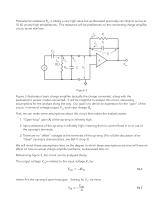
Piezoelectric resistance RPE is ideally a very high value but as discussed previously can drop to as low as 10 kΩ at very high temperatures. This resistance will be problematic to the connecting charge amplifier circuit, as we shall see. IRf Figure 3 Figure 3 illustrates a basic charge amplifier (actually the charge converter), along with the piezoelectric sensor model connected. It will be insightful to analyze this circuit, discussing assumptions for the analysis along the way. Our goal is to derive an expression for the “gain” of the circuit, in terms of voltage output Vout and input charge...
Open the catalog to page 6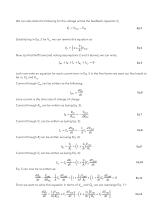
We can also state the following for the voltage across the feedback capacitor Cf Substituting in Eq. 2 for V , we can rewrite this equation as Now, by Kirchhoff's law (and noting assumptions 2 and 3 above), we can write, Let's now write an equation for each current term in Eq. 5 in the final terms we want our final be in, Q and V ,. Current through CpE can be written as the following: dQv since current is the time rate of change of charge. Current through RPE can be written as (using Eq. 2): Current through Cc can be written as (using Eq. 2): Current through Rf can be written as (using Eq. 4):...
Open the catalog to page 7
Using advanced solution techniques (beyond the scope of this article [see Ref 5: chap 2]), Eq. 12 can be solved as: where j is the complex number and w is angular frequency. Rearranging and solving for Vout/Qp, we have: Eq 14 If we invoke assumption 1 from the list above, that gain A is infinitely large, and we assume Rf is infinitely large as well, Eq. 14 simplifies to: If we assume only that Rf is finite, but still assume gain A is infinitely large, we can see the effect Rf has on our circuit: Where it can be shown that this equation has a frequency response of a high pass filter, with a frequency...
Open the catalog to page 8
Further if RPE becomes small enough, due to the leakage currents and offset voltages at the op-amp terminals, enough current will flow in RPE to also cause the op-amp to saturate. Circuit designers take steps in the design to mitigate these effects. But this is where the performance of a “generalpurpose” charge amplifier and one designed for high temperature accelerometers (where one knows RPE will be small at extreme temperature) begin to separate. Using a low RPE accelerometer with a general-purpose charge amplifier, because of its circuit design, will likely result in an undesirable frequency...
Open the catalog to page 9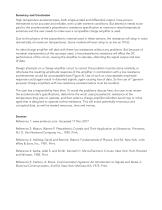
Summary and Conclusion High temperature accelerometers, both single-ended and differential output, have proven themselves to be accurate and reliable, even under extreme conditions. But attention needs to be paid to the accelerometer’s piezoelectric resistance specification at maximum rated temperature extremes and the user needs to make sure a compatible charge amplifier is used. Due to the physics of the piezoelectric material used in these sensors, the resistance will drop in value dramatically at maximum temperatures. Some models will even drop to as low as 10 kΩ. An ideal charge amplifier...
Open the catalog to page 10
www.endevco.com | Tel: +1 (866) ENDEVCO [+1 (866) 363-3826] | 10869 NC-903, Halifax, NC 27839 USA © 2020 PCB Piezotronics of N orth Carolina, Inc. (doing business as Endevco). In the interest of constant product improvement, specifications are subject to change without notice. PCB®, ICP®, Swiveler®, Modally Tuned®, and IMI® with associated logo are registered trademarks of PCB Piezotronics, Inc. in the United States. ICP® is a registered trademark of PCB Piezotronics Europe GmbH in Germany and other countries. UHT-12TM is a trademark of PCB Piezotronics, Inc. SensorLineSM is a servicemark of...
Open the catalog to page 11All Endevco catalogs and technical brochures
 Model 4416C
3 Pages
 Model 2680M1-M7
3 Pages
 Model 2510
3 Pages
 Mechanical Impedance Testing
16 Pages
 44A
44A3 Pages
 43A
43A3 Pages
 42A
42A3 Pages
 41A
41A3 Pages
 35B
35B3 Pages
 6243M3
3 Pages
 6243M1
3 Pages
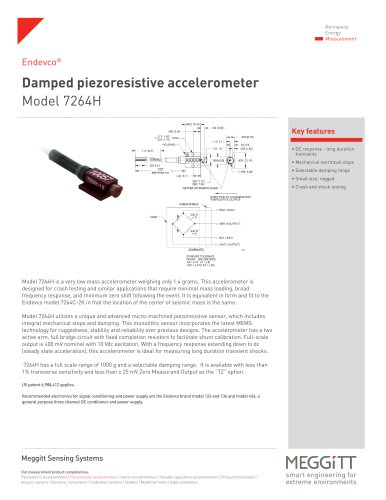 7264H
7264H3 Pages













Archived catalogs
 The Endevco® Model 2222D
2 Pages










- Copper cable
- Calibration system
- Multi-strand cable
- Pressure probe
- Signal amplifying integrated circuit
- Optical cable
- Armored cable
- Single-axis accelerometer
- Membrane pressure sensor
- Analog pressure sensor
- Optical data cable
- Triaxial acceleration sensor
- Precision calibration equipment
- Relative pressure sensor
- Compact accelerometer
- Signal conditioner
- Twisted pair cable
- Absolute pressure sensor