
- Catalogs
- EmulXion Mixers
- EmulXion Catalogue

EmulXion Catalogue
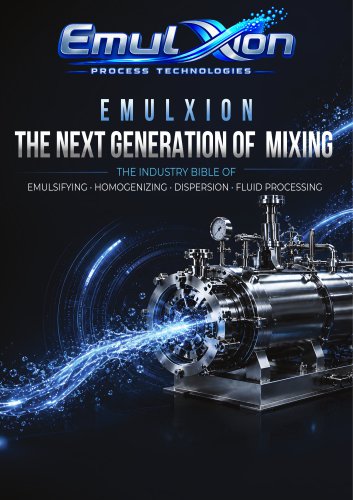
EmulXion Catalogue
The document introduces EmulXion, a company specializing in advanced fluid processing technologies. It emphasizes the evolution from traditional mixing to precise engineering of fluid behavior to meet modern manufacturing demands.
Key Variables in Fluid Processing
Success in fluid processing is determined by controlling variables such as particle size, droplet distribution, flow dynamics, viscosity behavior, and thermal transfer. These factors are crucial for product stability, texture, and performance.
Challenges in Modern Processing
Traditional mixing methods are insufficient for modern products that require precise control over microscopic structures. EmulXion focuses on engineering forces like mechanical shear, hydraulic shear, and cavitation to create stable and high-performance products.
Technologies and Solutions
EmulXion offers technologies that concentrate energy transfer to improve process efficiency, particle reduction, emulsification, and overall product stability. Their systems are designed for various industries, including pharmaceuticals, cosmetics, and food.
Importance of Particle Size
Particle size distribution is critical in processing, affecting stability, texture, and shelf life. Reducing particle size enhances product quality by improving stability, bioavailability, and reaction efficiency.
Shear Forces in Processing
Shear forces, including mechanical, hydraulic, and turbulent shear, are engineered to reduce particle size and improve suspension quality. EmulXion designs systems to maximize energy transfer efficiency.
Emulsification and Homogenization
Emulsification involves creating stable structures from immiscible phases, while homogenization reduces particle size for uniform product structure. EmulXion's systems use high-pressure techniques to achieve these goals.
Dispersion and Vacuum Processing
Proper dispersion of powders is challenging due to factors like electrostatic attraction and surface tension. EmulXion's vacuum systems eliminate entrained air, improving texture and consistency.
Inline Processing
Inline processing focuses energy into process chambers, enhancing mixing, particle reduction, and emulsification. This approach offers improved efficiency and scalability compared to traditional batch systems.
Advanced Technologies
EmulXion's inline mixers and homogenizers deliver concentrated mechanical energy for superior emulsification, dispersion, and homogenization. Their systems are engineered for precision and repeatability.
Turnkey Solutions
EmulXion provides fully integrated process systems, including inline mixing, high-pressure homogenizers, and vacuum emulsifying systems. These solutions are designed for GMP-ready manufacturing and scalable production.
Conclusion
The future of manufacturing lies in precise fluid engineering. EmulXion's technologies transform instability into stability and inconsistency into repeatability, representing the next generation of fluid processing.
Catalog excerpts
EMULSIFYING • HOMOGENIZING • DISPERSION • FLUID PROCESSING
Open the catalog to page 1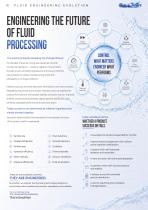
ENGINEERING THE FUTURE OF FLUID Particle size. Fluid acceleration control what matters engineer what performs The science of liquid processing has changed forever. For decades, industrial mixing was viewed as a simple mechanical operation — rotate an agitator, move product Droplet distribution. Vacuum conditions. through a tank, and blend ingredients until visual uniformity was achieved. In today’s manufacturing world, that Flow dynamics. philosophy is no longer sufficient. Modern products are more advanced. Formulations are more complex. Regulatory requirements are stricter. Manufacturers are...
Open the catalog to page 2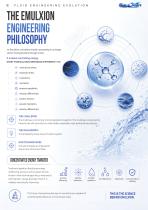
THE EMULXION At EmulXion, we believe modern processing is no longer about moving product through a tank. It is about controlling energy. EVERY FORMULATION RESPONDS DIFFERENTLY TO: mechanical shear, hydraulic shear, turbulence cavitation, pressure gradients, velocity differentials, surface tension, powder hydration, velocity differentials, THE CHALLENGE The challenge is not simply mixing ingredients together. The challenge is engineering these forces with precision to create stable, repeatable, high-performance products. THIS PHILOSOPHY This philosophy drives every EmulXion system. OUR TECHNOLOGIES...
Open the catalog to page 3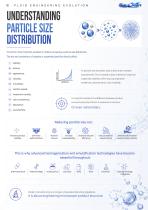
UNDERSTANDING One of the most important variables in modern processing is particle size distribution. The size and consistency of droplets or suspended particles directly affect: stability, texture, As particle size decreases, total surface area increases exponentially. This increased surface interaction improves suspension stability while reducing separation tendencies, sedimentation, and instability. mouthfeel, reaction speed, suspension quality, In many formulations, the difference between product color consistency, success and product failure is measured in microns. Reducing particle size...
Open the catalog to page 4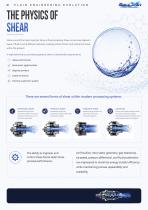
THE PHYSICS OF Shear is one of the most important forces in fluid processing. Shear occurs when adjacent layers of fluid move at different velocities, creating internal friction and mechanical stress within the product. In high-performance processing systems, shear is intentionally engineered to: reduce particle size break apart agglomerates disperse powders create emulsions improve suspension quality There are several forms of shear within modern processing systems: MECHANICAL SHEAR HYDRAULIC SHEAR TURBULENT SHEAR Generated through direct interaction between moving and stationary components such...
Open the catalog to page 5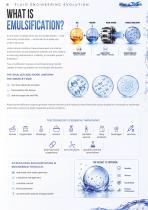
An emulsion is created when two immiscible phases — most commonly oil and water — are forced into a stable and uniform structure. Under natural conditions, these phases resist one another. Surface tension causes droplets to separate over time, leading to creaming, sedimentation, instability, or complete product breakdown. True emulsification requires concentrated energy transfer capable of reducing droplets into microscopic distributions. THE SMALLER AND MORE UNIFORM THE DROPLET SIZE: the more stable the emulsion the smoother the texture and the longer the shelf life. Advanced emulsification systems...
Open the catalog to page 6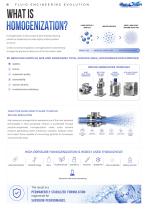
Homogenization is the process of permanently reducing particle or droplet size to create highly uniform product structure. Unlike conventional agitation, homogenization fundamentally changes the physical architecture of the formulation itself. BY REDUCING PARTICLE SIZE AND INCREASING TOTAL SURFACE AREA, HOMOGENIZATION IMPROVES: stability texture suspension quality bioavailability reaction kinetics overall process consistency. MAKE THIS IMAGE SAME TO SAME IT SHOULD BE HIGH RESOLUTION High-pressure homogenization represents one of the most advanced technologies in fluid processing. Product is accelerated...
Open the catalog to page 7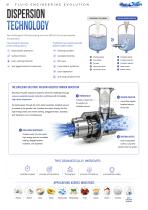
Few challenges in fluid processing are more difficult than proper powder incorporation. Fine powders naturally resist wetting due to: Traditional top-loading powder systems often create: electrostatic attraction floating powders surface tension excessive dusting poor wetting behavior inconsistent hydration poor dispersion and long process times THIS DRAMATICALLY IMPROVES: hydration speed powder incorporation process consistency
Open the catalog to page 8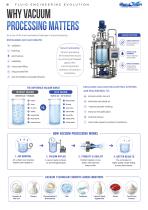
Air is one of the most overlooked challenges in liquid processing. ENTRAINED AIR CAN CREATE: oxidation foaming poor texture instability inaccurate filling reduced shelf life Vacuum processing Vacuum processing eliminates these issues by removing entrapped gases while improving powder hydration and product consistency. and inconsistent viscosity behavior. EMULXION VACUUM EMULSIFYING SYSTEMS ARE ENGINEERED TO: process under vacuum eliminate entrained air improve powder wetting enhance emulsification improve texture and create superior product consistency
Open the catalog to page 9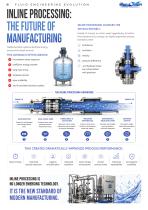
INLINE PROCESSING: INLINE PROCESSING CHANGES THE PHYSICS ENTIRELY. Instead of moving an entire vessel aggressively, EmulXion Inline Systems focus energy into highly engineered process chambers where: turbulence Traditional batch systems distribute energy across entire vessel volumes. THIS APPROACH OFTEN CREATES: inconsistent shear exposure pressure differentia inefficient energy transfer and hydraulic shear are concentrated with precision. long cycle times excessive rework poor scalability and inconsistent product quality. THIS CREATES DRAMATICALLY IMPROVED PROCESS PERFORMANCE: faster mixing improved...
Open the catalog to page 10
FLUID ENGINEERING EVOLUTION EMULXION INLINE EmulXion Inline High Shear Mixers and Homogenizers are engineered to deliver concentrated mechanical energy directly into the product stream for superior: W emulsification <£ hydration 0 dispersion «&£ and particle size reduction. At the core of every system is a precision-engineered rotor-stator assembly designed to generate:@ mechanical shea A hydraulic shear # cavitation (?) and fluid acceler As product enters the mixing chamber, it is accelerated through narrow shear gaps between rotating and stationary components. Velocity differentials create...
Open the catalog to page 11
EMULXION INLINE EmulXion High-Pressure Homogenizers represent one of the most advanced technologies available for particle size reduction and fluid stabilization. THESE SYSTEMS ARE ENGINEERED FOR APPLICATIONS REQUIRING: ultra-fine particle size Product is pressurized and accelerated through precision homogenization valves under extreme pressure cell disruption conditions. As the fluid exits the homogenization gap, violent turbulence, liposomal processing cavitation, impact forces, and hydraulic pharmaceutical homogenization shear reduce particles to microscopic and nanometer scale. biotechnology...
Open the catalog to page 12All EmulXion Mixers catalogs and technical brochures
 Inline Processing Systems
12 Pages
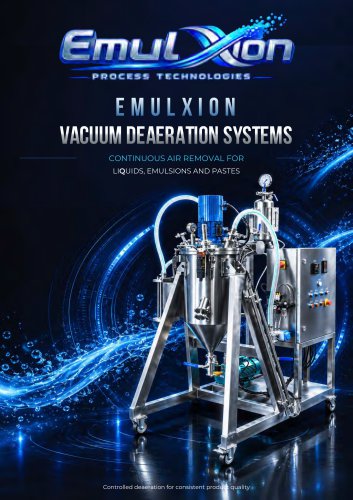 Process Deaerators
12 Pages
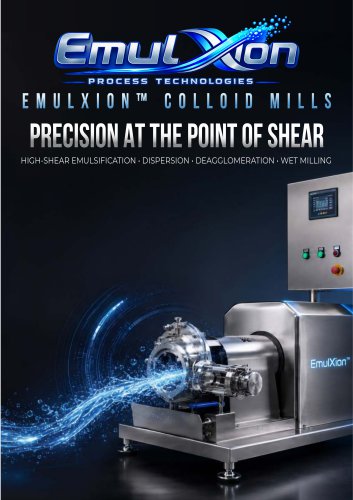 Colloid Mills
20 Pages
- Grinding mill
- Food lump breaker
- Cutting mill
- Lump breaker for the food industry
- Mill for the pharmaceutical industry
- Dynamic homogenizer
- Compact lump breaker
- Stainless steel pulverizer
- Homogenizer for the food industry
- Grinding mill for the chemical industry
- Liquid homogenizer
- Degasser
- Continuous homogenizer
- Homogenizer for the chemical industry
- Homogenizer for the cosmetics industry
- Stainless steel homogenizer
- Homogenizer for the pharmaceutical industry
- Solid/liquid homogenizer
- Wet grinding mill