
- Catalogs
- EmulXion Mixers
- Colloid Mills

Colloid Mills

Colloid Mills
EmulXion™ colloid mills are specialized for high-shear emulsification, dispersion, deagglomeration, and wet milling. They are tailored to specific application needs, such as throughput and temperature limits, ensuring optimal performance for each manufacturing process.
Functionality of Colloid Mills
These mills are high-shear rotor-stator devices used for processing liquids, emulsions, suspensions, and pumpable pastes. They are not substitutes for bead mills or high-pressure homogenizers, particularly for hard crystals or nanoscale targets. The primary functions include emulsification, wet milling, deagglomeration, and dispersion.
Process Stages
The milling process consists of controlled feed, acceleration, working gap, breakup and dispersion, and discharge, each crucial for achieving desired product consistency and quality.
Engineering Relationships
Key parameters such as rotor tip speed, shear-rate indicator, nominal head residence time, specific energy, and the Weber number are essential for understanding the balance between applied stress and resistance during milling.
Selection Criteria
Choosing a colloid mill involves considering formulation, feed quality, working gap, tip speed, flow rate, number of passes, and temperature, all of which influence the milling outcome.
Process Integration Options
EmulXion™ offers flow path modes like single pass, recirculation, and multi-stage, with integration options including feed pumps, heat exchangers, and automated valves for efficient operation.
Subsystem Engineering
Components such as the sanitary milling head, drive assembly, seal system, process connections, and controls are engineered for performance, safety, and maintainability.
Hygienic Design
Hygienic performance is ensured through material selection, surface condition, weld quality, and cleaning flow documentation, with options for sanitary connections and FDA-compliant materials.
Material and Wear Considerations
Materials like 316L stainless steel are chosen for corrosion resistance, with seal systems designed for product lubricity, abrasiveness, and pressure conditions.
Thermal and Pressure Management
Shear energy often converts to heat, affecting product viscosity and stability. Pressure management involves evaluating the entire system to ensure safe operation.
Applications in Food and Beverage
Colloid mills are used in food processing for sauces, dressings, nut products, and beverage emulsions, each with specific demands on feed size, torque, wear, and temperature control.
Applications in Cosmetics and Pharmaceuticals
Used for creams, lotions, ointments, and suspensions, colloid mills refine pre-emulsions, disperse actives, and ensure uniformity, with validation involving defined process parameters and quality attributes.
Applications and Engineering Focus
In chemicals, coatings, adhesives, agrochemicals, and energy materials, the focus is on pigment dispersion, viscosity uniformity, solvent compatibility, abrasiveness, color changeover, polymer dispersion, and more.
System-Level Requirements
Requirements include heated piping for bitumen emulsions, stability in phase distribution for fuel emulsions, and deagglomeration for battery slurries.
Scale-Up Framework
Emphasizes preserving process conditions during scale-up, including droplet and particle distribution and viscosity, with documentation of formulation and feed conditions.
Evaluation and Comparison
A checklist for evaluating suppliers includes application basis, tool geometry, gap control, performance tests, seal systems, thermal management, cleaning, materials, controls, integration, and lifecycle commitments.
Technical Information Required
Necessary data for product evaluation includes product composition, rheology, feed conditions, target distribution, production requirements, thermal and pressure conditions, materials, cleaning methods, area classification, and controls.
Contact Information
For further inquiries, contact John Paul at Proc-X Manufacturing Group.
Catalog excerpts

EmulXion™ Colloid Mills PRECISION AT THE POINT OF SHEAR HIGH-SHEAR EMULSIFICATION • DISPERSION • DEAGGLOMERATION • WET MI
Open the catalog to page 1
CONSIDERING AN IKA COLLOID MILL? Put EmulXion™ on Your Shortlist. Established names deserve consideration. So does a processengineered alternative built around the product you actually manufacture. EmulXion™ colloid mills are configured from the application outward. We begin with the required throughput, rheology, particle or droplet target, temperature limit, pressure boundary, sanitation standard and plant-control philosophy. The resulting machine is not simply selected from a catalog—it is defined against a documented basis of design. Application-selected milling geometry and working-gap strategy...
Open the catalog to page 2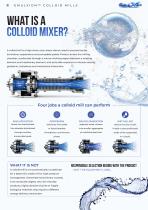
What is a A colloid mill is a high-shear rotor–stator device used to process liquids, emulsions, suspensions and pumpable pastes. Product enters the milling chamber, accelerates through a narrow working region between a rotating element and a stationary element, and exits after exposure to intense velocity gradients, turbulence and mechanical interaction. Four jobs a colloid mill can perform break one liquid phase distribute fine solids separate weak clusters reduce the size of soft, into droplets distributed into smaller aggregates through another solids while suspended immiscible liquid. Responsible...
Open the catalog to page 3
EMULXION™ COLLOID MILLS INSIDE THE SHEAR ZONE FROM FEED TO FINISHED DISPERSION A pump or gravity-fed arrangement delivers a stable, air-minimized feed to the mill. Feed consistency matters because flow, temperature and composition determine the ^ energy applied per unit of product. Acceleration The rotating tool accelerates the product and establishes the velocity difference that drives shear. Product passes through the controlled region between rotor and stator. Gap geometry influences residence time, maximum allowable feed size, shear intensity and risk of contact. Droplets deform and divide;...
Open the catalog to page 4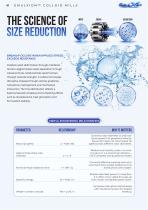
04 EMULXION™ COLLOID MILLS BREAKUP OCCURS WHEN APPLIED STRESS EXCEEDS RESISTANCE * Droplets resist deformation through interfacial tension. Agglomerates resist separation through cohesive forces. Solid particles resist fracture through material strength. A colloid mill creates disruptive stresses through velocity gradients, turbulence, impingement and mechanical interaction. The final distribution reflects a balance between breakup and competing effects such as recoalescence, heat generation and formulation stability. USEFUL ENGINEERING RELATIONSHIPS
Open the catalog to page 5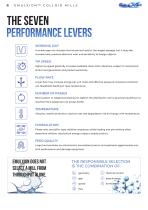
the seven WORKING GAP A smaller gap can increase local stress and restrict the largest passage, but it may also increase heat, pressure demand, wear and sensitivity to foreign objects. TIP SPEED Higher tip speed generally increases available shear and turbulence, subject to mechanical limits, heat generation and product sensitivity. FLOW RATE Lower flow may increase energy per unit mass and effective exposure; excessive restriction can destabilize feeding or raise temperature. NUMBER OF PASSES Recirculation or staged processing can tighten the distribution until a practical equilibrium is reached....
Open the catalog to page 6
06 EMULXION™ COLLOID MILLS Single pass Product passes through the mill once and continues downstream. Continuous production, stable feed, moderate size reduction, high throughput. Simple piping and control; performance must be achieved in one controlled exposure. Product returns to a vessel and passes through the mill repeatedly. Batch development, difficult emulsions, progressive deagglomeration, flexible endpoint control. Vessel turnover, air entrainment and batch-temperature rise must be managed. Two or more processing heads or different technologies are arranged in sequence. Premix plus fine...
Open the catalog to page 7
emulxion mill Subsystem Engineering purpose Sanitary milling head Rotor/stator processing zone with application-selected geometry and adjustable or engineered working-gap strategy. Drive assembly Motor and transmission sized for required torque, tip speed, product viscosity and duty cycle. Seal system Selected against pressure, temperature, lubricity, solids, volatility, sanitation and dry-running risk. Process connections Sanitary or industrial connections configured for the customer’s piping standard and cleanability requirements. Stable, cleanable support structure designed for alignment,...
Open the catalog to page 8
three control EMULXION COLLOID ARCHITECTURES NO CONTROL PANEL MANUAL CONTROL PLC/HIM CONTROLS Mill supplied for integration with a customer-provided VFD, MCC, PLC or plant distributed-control system. OEMs, system integrators, standardized plant-control platforms. MANUAL CONTROL Local start/stop, emergency stop, speed adjustment and status indication without a full automation layer. Standalone duty, simple recipes, operator-controlled production. Automated sequences, permissives, alarms, recipes, trends and integration with pumps, valves and instruments. Validated, repeatable or multi-product...
Open the catalog to page 9
hygienic design is A polished exterior does not make a process hygienic. HYGIENIC PERFORMANCE DEPENDS ON THE COMPLETE PRODUCT BOUNDARY: material selection surface condition dead legs weld quality connection orientation cleaning flow Available hygienic engineering scope Questions a serious supplier should answer What are the exact product-contact materials and how are they certified? What surface finish is supplied, how is it measured, and where does the requirement apply? Can the product-contact path drain without disassembly? How is the mechanical seal cleaned or flushed? Which components require...
Open the catalog to page 10
materials, wear, Material choice Selection caution Food, beverage, cosmetic, pharmaceutical and many chemical duties Corrosion resistance depends on chemistry, chloride level, temperature and cleaning agents. Duplex / high-alloy materials More aggressive corrosion environments Requires application-specific compatibility review and fabrication controls. Hard coatings / wear materials Abrasive pigments, minerals, metal oxides and filled polymers Coating selection must consider adhesion, thermal expansion, impact and contamination limits. Static seals and gaskets Select for product chemistry, temperature,...
Open the catalog to page 11All EmulXion Mixers catalogs and technical brochures
 EmulXion Catalogue
14 Pages
 Inline Processing Systems
12 Pages
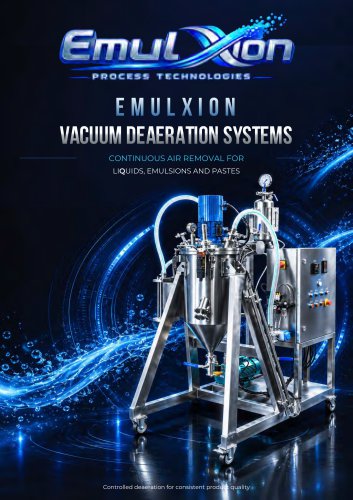 Process Deaerators
12 Pages
- Food lump breaker
- Cutting mill
- Lump breaker for the food industry
- Mill for the pharmaceutical industry
- Dynamic homogenizer
- Compact lump breaker
- Stainless steel pulverizer
- Homogenizer for the food industry
- Grinding mill for the chemical industry
- Liquid homogenizer
- Degasser
- Continuous homogenizer
- Homogenizer for the chemical industry
- Homogenizer for the cosmetics industry
- Stainless steel homogenizer
- Homogenizer for the pharmaceutical industry
- Solid/liquid homogenizer
- Wet grinding mill