
- Catalogs
- EMS Dr. Thomas Wünsche e.K.
- CAN Plug-In Board CPC-PCIe

- Company
- Products
- Catalogs
- News & Trends
- Exhibitions
CAN Plug-In Board CPC-PCIe

CAN Plug-In Board CPC-PCIe
- Passive CAN interface for PCIe x1 slots with options for 1, 2, or 4 CAN controllers using NXP SJA1000.
- Optional galvanic separation between CAN controller and PC, and between CAN channels.
- Supports both 11-bit and 29-bit frames.
- Available in low profile versions with up to 2 CAN channels.
- Supports Linux socketCAN and includes free development kits for Windows and Linux.
The CPC-PCIe is a passive CAN plug-in board designed for industrial applications, offering a robust and cost-efficient solution. It supports multiple CAN channels that can operate independently at different data rates. The board maps CAN controllers directly into the PC's address space, allowing low-latency access to CAN messages. It is compatible with existing software for the supported CAN controller and provides free software development kits for Windows and Linux.
Optional galvanic separation is available to enhance isolation between the PC and CAN bus, as well as between CAN channels using separate DC/DC converters. A low profile version is available for compact embedded PCs.
Configuration and communication with the CPC-PCIe are managed through the PC's memory address area, allowing low latency CAN communication. The memory is divided into sections for control registers, interface type detection, and hardware resets. Separate memory spaces are used for each interface's CAN controllers, with accessible sending and receiving buffers and control registers.
Specifications for accessing CAN controllers and drivers for Windows and Linux are available separately.
- CAN plug-in board CPC-PCIe
- User manual
- proCANtool CAN-Monitor for Windows 7/8.x/10/11
- Pin assignment: Connector D-Sub9, compliant with CiA DS-102.
- Physical connection type: ISO 11898 / Transceiver PCA82C251.
- Maximum voltage on bus pins: ±30 V relative to bus ground.
- Isolation voltage with galvanic separation: ±1000 V DC.
Catalog excerpts

CAN Plug-In Board CPC-PCIeSpecial Features • Passive CAN interface for PCIe x1 slots • Optional galvanic separation of CAN controller to PC • Optional galvanic separation between CAN channels • Supports 11-bit frames and 29-bit frames • Also available as low profile versions with max. 2 CAN channels • Linux socketCAN is supported • Free of charge development kits for Windows 7/8.x/10/11 and Linux CPC-PCIe is a passive CAN plug-in board for PCIe x1 slots. CPC-PCIe was designed for industrial series application and has a robust and cost efficient construction. CPC-PCIe supports either one, two or four CAN channels that can be operated independently with different data rates. The interface comes with the NXP CAN controller SJA1000, that offers good diagnostic attributes. CPC-PCIe maps the CAN controller(s) directly in the address space of the PC and allows access to the CAN messages with low latencies. Existing software for the supported CAN controller can easily be adapted. For the operating systems Windows and Linux software development kits with identical API are available free of charge. Optionally, CPC-PCIe is available with galvanic separation between PC and CAN bus. A galvanic separation between the CAN channels is also possible by separate DC/DC converters. For applications in compact embedded PCs CPC-PCIe is also available as a low profile version with max. two CAN channels.
Open the catalog to page 1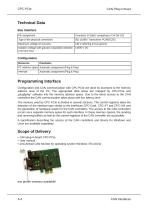
Technical Data Bus Interface Configuration and CAN communication with CPC-PCIe are done by accesses to the memory address area of the PC. The appropriate data areas are mapped by CPC-PCIe and „plug&play” software into the memory address space. Due to the direct access to the CAN controllers the CAN communication takes place with low latency time. The memory used by CPC-PCIe is divided in several sections. The control registers allow the detection of the interface type similar to the interfaces CPC-Card, CPC-XT and CPC-104 and the generation of hardware resets for the CAN controllers. The access...
Open the catalog to page 2All EMS Dr. Thomas Wünsche e.K. catalogs and technical brochures
 USB/CAN FD Interface
2 Pages


Archived catalogs


- Automation software solution
- Monitoring analyzer
- Digital I/O
- Automatic analyser
- Windows software
- IO module
- Control software
- Analog I/O
- Digital IO module
- Monitoring software solution
- Communication gateway
- Interface software
- Industrial gateway
- Fieldbus gateway
- Ethernet gateway
- Fieldbus I/O module
- Serial gateway
- Analog IO module
- Development software