
- Catalogs
- Emile Egger & Cie SA
- Utilizing potentials for energy saving

Utilizing potentials for energy saving

Utilizing potentials for energy saving
This document discusses the potential for energy savings in sewage treatment plants by optimizing the air feed to aeration basins. The focus is on using thermal mass flowmeters and Iris diaphragm control valves to achieve process stability and energy efficiency.
Energy Consumption in Sewage Treatment
The aeration process in sewage treatment plants is a significant energy consumer. Optimizing this process can lead to substantial energy and cost savings. The air feed is typically controlled based on the oxygen concentration in the basin, with a target value of 2 mg/l O2 as specified by the ATV bulletin.
Air Feed Control System
Pressurized air is generated by compressors and distributed to aeration basins. The control system requires measuring both oxygen concentration and network pressure. Iris diaphragm control valves, combined with air flow metering, are used for precise control.
Thermal Mass Flow Meters
ABB Sensyflow thermal air flow meters are ideal for this application due to their wide measurement range, low pressure loss, fast response time, and high accuracy. They operate on the hot film anemometer principle, directly measuring mass flow without needing density corrections.
Iris Diaphragm Control Valve
The Iris diaphragm control valve features a rugged design, large control range, and energy-efficient control curve. It minimizes pressure loss and energy costs due to its flow-optimized design.
Design and Control Characteristics
Control armatures must be designed considering system data and flow characteristics. The control characteristic is influenced by the armature curve and pipeline dynamics. A stable control area is achieved with a gain factor between 0.5 and 2.0.
Control Cycle Design
Oxygen controllers should operate as a cascaded control system, improving control characteristics in terms of linearity, stability, and dynamics. This setup ensures efficient air supply and significant energy cost savings.
Benefits of the System
The combination of Iris diaphragm control valves and ABB Sensyflow meters offers lower energy costs, easy installation, and precise control. It allows for system monitoring and targeted maintenance, enhancing overall efficiency.
Catalog excerpts
Wasser, Luft und Boden • Zeitschrift fur Umwelttechnik Umwelttechnik made in Israel Industrie park Hochst Luftiei nhaltung / Klimaschutz: Experte fiir J?eine Luft am Abfa lltechn ik/ Recyd i ng: Laserspektroskopie ermbglicht Materia I erkennung in Echtzeit Energie einsparen Lufteintrag in Belebungsbecken prozess- stabil und energetisch optimiert regetn
Open the catalog to page 1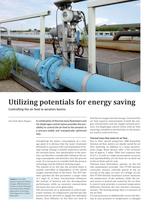
Utilizing potentials for energy saving Controlling the air feed to aeration basins Uwe Pohl, Remo Biegert Authors: Uwe Pohl Industry Specialist Water/ Sewage, ABB Automation Products GmbH, Göttingen (Germany); Remo Biegert, Application Technology, Emile Egger & Co. GmbH, Mannheim A combination of thermal mass flowmeters and Iris diaphragm control valves provides the possibility to control the air feed to the aeration in a process-stable and energetically optimized way. Considering the power consumption of a sewage plant it is obvious that the water treatment definitely is a process with a lot...
Open the catalog to page 2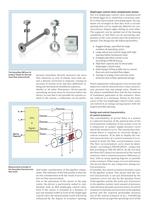
The Iris diaphragm control valve manufactured by Emile Egger & Co. GmbH has a structure similar to that of previously used diaphragms. Six segments are arranged so that they form a circular opening that can be steplessly adjusted via convex/concave shaped edges sliding on each other. The segments can be pushed out of the housing completely so that there are no narrowing components in the cross section once the armature is opened. This design has the following benefits: Diaphragm control valve complements sensor The Sensyflow FMT500-IG product family for thermal mass flow measurement Measurement...
Open the catalog to page 3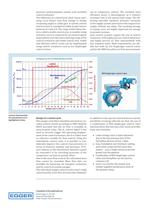
pressure system/pipeline system with installed control armature. The difference to a theoretical, ideal, linear operating curve (linear ratio flow change to change of opening angle) is called gain. A system control characteristic is considered stable at gain factors between 0.5 and 2.0. The range within these limits is called a stable control area. A steadily rising armature curve is required for an uninterrupted, large (almost over the entire opening range of the control armature) and stable control area. Stable and efficient control cycles can be implemented using control armatures such as...
Open the catalog to page 4All Emile Egger & Cie SA catalogs and technical brochures
 Egger Company Presentation
4 Pages
 Pumps and valves
48 Pages
 Pump seals
4 Pages
 Wastewater pumps EOA / EOSA
2 Pages
 Egger Chemical Industry
8 Pages
 Egger Hybrid Pumps TEO
2 Pages
 Turo® Vortex Pumps T
2 Pages
 Egger Wastewater
8 Pages
 Elbow Pumps RPP
2 Pages
 Egger Submerged Sump Pumps S
4 Pages
 Egger Submersible pumps
2 Pages
 Egger Hybrid Pumps TEO
2 Pages
 Egger Turo® Vortex Pumps
10 Pages
 Egger Process Pumps EO/EOS
12 Pages


Archived catalogs
 Egger Iris® Contol Valve
2 Pages