
- Catalogs
- Emerson Automation Solutions - ROSEMOUNT
- Rosemount Analytical: Wastewater Industry Solutions

- Products
- Catalogs
- News & Trends
- Exhibitions
Rosemount Analytical: Wastewater Industry Solutions

Rosemount Analytical: Wastewater Industry Solutions
Catalog excerpts

Wastewater Industry Solutions Complete and Reliable Liquid Analysis Visualize > Analyze > Optimize ROSEMOUNT EMERSON Ana lytica I Process Management
Open the catalog to page 1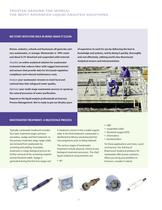
TRUSTED AROUND THE WORLD: THE MOST ADVANCED LIQUID ANALYSIS SOLUTIONS WE START WITH ONE IDEA IN MIND: MAKE IT CLEAN Homes, industry, schools and businesses all generate sani- of experience to work for you by delivering the best in tary wastewater, or sewage. Wastewater is +99% water knowledge and systems, and by doing it quickly, thoroughly and about 0.3% dissolved and suspended solid material. and cost-effectively, utilizing world-class Rosemount Visualize an online analytical solution for wastewater Analytical sensors and instrumentation. treatment that reduces labor with rugged instruments...
Open the catalog to page 2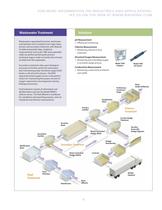
FOR MORE INFORMATION ON INDUSTRIES AND APPLICATIONS, SEE US ON THE WEB AT WWW.RAIHOME.COM Wastewater Treatment Solutions pH Measurement • Effluent pH monitoring Wastewater is generated by homes, businesses, and industries and is treated in two major steps, primary and secondary treatment, with disposal of solids during both steps. Analytical measurements such as pH, ORP, and suspended solids are performed during the primary treatment stage in order to monitor the removal of solids from the wastewater. Chlorine Measurement • Monitoring chlorine in final treatment Dissolved Oxygen Measurement •...
Open the catalog to page 3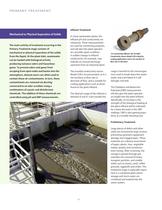
PRIMARY TREATMENT Influent Treatment Mechanical or Physical Separation of Solids The main activity of treatment occurring in the Primary Treatment stage consists of mechanical or physical separation of the solids from the liquid. At the plant inlet, wastewater can be loaded with biological activity producing nuisance odors and hazardous In many wastewater plants, the influent pH and conductivity are measured. These measurements are used for monitoring purposes, and will alert the plant operator of a possible upset condition. A sudden change in influent conductivity, for example, may indicate...
Open the catalog to page 4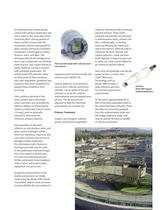
A combined sewer system design carries both sanitary wastewater and storm water in the same pipe to the treatment plant. During periods of heavy rainfall or snow melt, the wastewater volume may exceed the plant capacity and excess untreated wastewater is discharged to nearby streams, rivers, and lakes. This discharge disturbs the biological systems, may contaminate our drinking water sources, and creates threats to public health by coming in contact with untreated wastewater. The United States EPA estimates there are thousands of these incidents each year. Regulation, guidelines and measures...
Open the catalog to page 5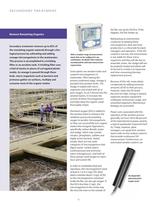
SECONDARY TREATMENT the floc use up the DO first. If this happens, the floc breaks up. Remove Remaining Organics Secondary treatment removes up to 85% of the remaining organic material through a biological process by cultivating and adding sewage microorganisms to the wastewater. This process is accomplished in a trickling filter or an aeration tank. A trickling filter uses With a complete range of measurement inputs that can be configured in any combination, the Model 1056 is ideal for municipal plants with dual measurement requirements. a bed of stones or pieces of corrugated plastic media....
Open the catalog to page 6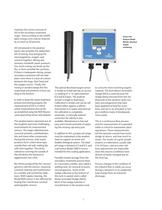
maintain the correct amount of DO in the secondary treatment stage. And according to the USEPA, plant energy costs may be reduced by as much as 50 percent. DO introduced in the aeration basins also provides the added benefit of mixing, thus bringing the microorganisms, oxygen, and nutrient together. Mixing also removes metabolic waste products. Too much mixing can break up the floc or form unstable floc particles. If there is inadequate mixing, proper secondary treatment will not take place since there is a lack of contact between the bugs, their food and the oxygen source. Finally, the mixing...
Open the catalog to page 7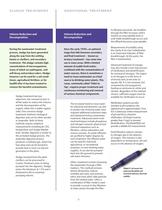
SLUDGE TREATMENT ADDITIONAL TREATMENT Volume Reduction and Decomposition Volume Reduction and Decomposition During the wastewater treatment process, sludge has been generated along the way from the settling basins or clarifiers, and secondary treatment. This sludge contains high concentrations of microorganisms, many of which are pathogenic, and will decay and produce odors. Sludge however can be used for a soil conditioner, agricultural fertilizer, or for landfill after it has been treated to remove the harmful contaminants. Since the early 1970's, an optional stage that falls between secondary...
Open the catalog to page 8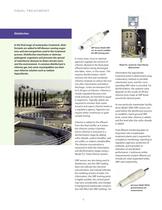
FINAL TREATMENT Disinfection In the final stage of wastewater treatment, disinfectants are added to kill disease-causing organisms and microorganisms used in the treatment process. Disinfection inactivates or destroys pathogenic organisms and prevents the spread of waterborne diseases to down-stream users and the environment. A common disinfectant is chlorine gas, but some municipalities use their own chlorine solution such as sodium hypochlorite. ORP Sensor Model 396P can be used to establish the ORP starting point. In many areas, local or national agencies regulate the amount of chlorine allowed...
Open the catalog to page 9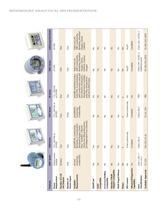
10 No NA Yes NA No FOUNDATION fieldbus Compatible Wireless THUM Adaptor compatible Multi-lingual Menus Relays PID Control Timer control only 4 Yes Yes No Yes Class 1, Div. 1 FM, CSA, CE, UL CE, CSA Yes HART Compatible Yes Available Approvals Yes SMART pH pH/ORP/ISE, Conductivity, Resistivity, % Concentration, Dissolved Oxygen, Ozone, Flow, Turbidity, Chlorine * * (Total, Free, Monochloramine, pH Independent Free Chlorine) Class I, Div 2 pH and contacting conductivity Available Measurements Two (future option) One Number of Sensor Inputs Two Area Classifications Wireless Number of 4-20 mA Outputs...
Open the catalog to page 10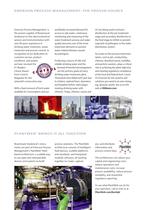
EMERSON PROCESS MANAGEMENT: THE PROVEN SOURCE Emerson Process Management is the proven supplier of Rosemount Analytical on-line electrochemical sensors and instrumentation with over 60 years experience in drinking water treatment, waste treatment and process control. In recognition of our dedication to customer service, product excellence, and quality we have received the #1 Readers Choice Award from Control Magazine for the sixteenth consecutive year. With a fixed amount of fresh water available for consumption and our worldwide increased demand for access to safe water, continuous monitoring...
Open the catalog to page 11All Emerson Automation Solutions - ROSEMOUNT catalogs and technical brochures
 VPS 53 Vapor Pressure Sensor
2 Pages
 EasyHeat™ XD Cable Kits
2 Pages
 FRL Accessories
14 Pages
 TankRadar Pro
32 Pages
 Rosemount™ 2140 Level Detector
22 Pages
 Roxar subsea PIG
2 Pages
 Roxar subsea Sand monitor
2 Pages
 Roxar subsea CM10K
2 Pages
 Roxar PTPT15K
2 Pages
 Rosemount TankRadar OFC
2 Pages
 SW-300
4 Pages
 DL8000
12 Pages
 DeltaV Analyze
8 Pages
 AMS Machine Works
4 Pages
 DeltaV Executive Portal
7 Pages
 1500XA Gas Chromatograph
8 Pages
 Rosemount 975UR
4 Pages
 Rosemount 975HR
4 Pages
 Rosemount 975UF
4 Pages
 Rosemount 975MR
4 Pages
 CT5400 Process Gas Analyzer
4 Pages
 CT2211 Leak Detection System
4 Pages
 Desalination of Seawater
2 Pages
 700XA Process Gas Chromatograph
12 Pages
 SafeGuard Alarm Controller
2 Pages
 Safety Monitoring
6 Pages
 AMS Suite
16 Pages
 Drinking Water Sht 2V2
2 Pages
 Line Card
2 Pages
 Drinking Water Industry
16 Pages
 Explosion Proof Video Camera
2 Pages
 Net Safety UV Flame Detector
4 Pages


Archived catalogs
 UV/IRS Flame Detector
4 Pages
 UVS Flame Detector
4 Pages

- Flowmeter
- Volume flow monitor
- Liquid flow monitor
- Gas analyzer
- Concentration analyzer
- Rosemount pressure transmitter
- Liquids analyzer
- Pressure gauge
- Calibration system
- Rosemount analog pressure transmitter
- Gas flow monitor
- Benchtop analyser
- Stainless steel flow monitor
- Industrial flow monitor
- Analog pressure gauge
- Process analyzer
- Gas detector
- Pressure probe
- Waterproof pressure transmitter
- Portable analyzer