
- Catalogs
- Emerson Automation Solutions - ROSEMOUNT
- The new standard for combustion flue gas analysis

- Products
- Catalogs
- News & Trends
- Exhibitions
The new standard for combustion flue gas analysis

The new standard for combustion flue gas analysis
Catalog excerpts
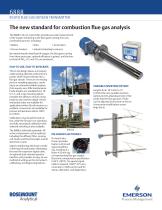
6888 IN SITU FLUE GAS OXYGEN TRANSMITTER The new standard for combustion flue gas analysis The 6888 in situ O2 transmitter provides accurate measurement of the oxygen remaining in the flue gases coming from any combustion process, including: > Boilers > Industrial Heating Furnances By maintaining the ideal level of oxygen, the flue gases coming from these processes, optimal efficiency is gained, and the lowest level of NOX, CO, and CO2 are produced. EASY TO USE. EASY TO INTEGRATE. This in situ design places a zirconium oxide sensing element at the end of a probe, which inserts directly into a flue gas stream. There are no moving parts or sampling apparatus, resulting in an extremely reliable analyzer that requires very little maintenance. Probe lengths are available from 18" to 12', and a slip mounting option provides the ability to mount a long probe at any insertion depth. Heavywall probe tubes are available for applications where fly-ash erosion is a problem. Accessories are available for process temperatures above 700°C to 1050°C. VARIABLE INSERTION OPTION Calibrations may be performed online, while the furnace is in operation, and fully automated calibration with solenoid switching is also available. The 6888 is fully field repairable. All active components can be replaced, including the diffuser/ filter, sensing cell, heater and thermocouple, and all electronics cards. Signal conditioning electronics reside in the head of each probe, eliminating the need for expensive signal cable. An optional dual-channel operator interface unit provides an easy-to-use method of setting up the instrument, calibrating, and diagnosing failures. ON-BOARD ELECTRONICS On-board electronics provides heater control and signal conditioning, resulting in a linear 4-20 mA signal representing flue gas oxygen. Electronics temperature specification is 85°C (185°F). No special signal cable is required. HART® 475 communicator or AMS can be used for setup, calibration, and diagnostics. Lengths from 18" (.9m) to 12' (3.65m) the new variable insertion option permits ideal placement of the probe into the flue gas duct. Probe can be adjusted at any time on-line to characterize stratification across large ducts.
Open the catalog to page 1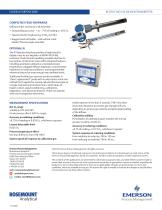
IN SITU FLUE GAS OXYGEN TRANSMITTER COMPLETELY FIELD-REPAIRABLE Diffusion Filter and Sensor Cell Assembly > Outstanding accuracy– + or - .75% of reading or .05% O2 > Special cells for tough service in SO2 and HCL > Rugged steel cell holder – cells will not crack Heater/Thermocouple assembly OPTIONAL Xi The Xi Operator Interface provides a bright back-lit display, easy-to-use keypad in a NEMA 4X (IP 66) enclosure. Dual channel capability provides interface to two probes. Xi Electronics also offers advanced features, including automatic calibration, extended process temperature, plugged diffuser...
Open the catalog to page 2All Emerson Automation Solutions - ROSEMOUNT catalogs and technical brochures
 VPS 53 Vapor Pressure Sensor
2 Pages
 EasyHeat™ XD Cable Kits
2 Pages
 FRL Accessories
14 Pages
 TankRadar Pro
32 Pages
 Rosemount™ 2140 Level Detector
22 Pages
 Roxar subsea PIG
2 Pages
 Roxar subsea Sand monitor
2 Pages
 Roxar subsea CM10K
2 Pages
 Roxar PTPT15K
2 Pages
 Rosemount TankRadar OFC
2 Pages
 SW-300
4 Pages
 DL8000
12 Pages
 DeltaV Analyze
8 Pages
 AMS Machine Works
4 Pages
 DeltaV Executive Portal
7 Pages
 1500XA Gas Chromatograph
8 Pages
 Rosemount 975UR
4 Pages
 Rosemount 975HR
4 Pages
 Rosemount 975UF
4 Pages
 Rosemount 975MR
4 Pages
 CT5400 Process Gas Analyzer
4 Pages
 CT2211 Leak Detection System
4 Pages
 Desalination of Seawater
2 Pages
 700XA Process Gas Chromatograph
12 Pages
 SafeGuard Alarm Controller
2 Pages
 Safety Monitoring
6 Pages
 AMS Suite
16 Pages
 Drinking Water Sht 2V2
2 Pages
 Line Card
2 Pages
 Drinking Water Industry
16 Pages
 Explosion Proof Video Camera
2 Pages
 Net Safety UV Flame Detector
4 Pages


Archived catalogs
 UV/IRS Flame Detector
4 Pages
 UVS Flame Detector
4 Pages

- Flowmeter
- Volume flow monitor
- Liquid flow monitor
- Gas analyzer
- Concentration analyzer
- Rosemount pressure transmitter
- Liquids analyzer
- Pressure gauge
- Calibration system
- Rosemount analog pressure transmitter
- Gas flow monitor
- Benchtop analyser
- Stainless steel flow monitor
- Industrial flow monitor
- Analog pressure gauge
- Process analyzer
- Gas detector
- Pressure probe
- Waterproof pressure transmitter
- Portable analyzer