


Compressor Application Manual
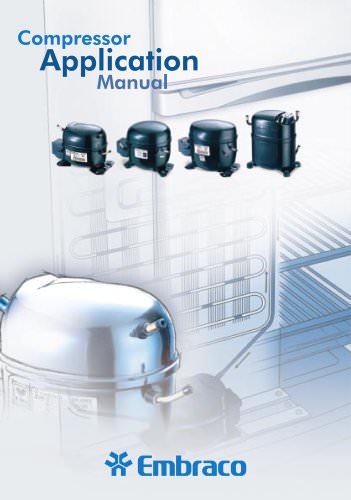
Compressor Application Manual
Embraco, founded in 1971, aims to support refrigeration professionals by providing technical information to enhance their expertise. This manual focuses on diagnosing refrigeration system issues, emphasizing that compressor replacement is often unnecessary. It offers guidance on compressor substitution and tips for extending compressor life.
The manual describes the basic operation of a refrigeration system, highlighting the compressor's role in circulating refrigerant. Key components include the compressor, condenser, evaporator, and control device. The refrigerant undergoes pressure changes to facilitate heat absorption and release.
Compressor selection depends on factors like control device, evaporation temperature, and refrigerant type. Embraco provides compressors for various refrigerants, including R 12, R 134a, and R 600a, with labels indicating suitable refrigerants.
Accurate diagnosis is crucial before replacing parts. The manual includes a table of common refrigeration problems, their causes, and corrective actions, stressing the importance of proper diagnosis to avoid unnecessary replacements.
Detailed procedures for replacing a hermetic compressor are provided, including safety precautions and best practices for successful installation and operation.
Recommendations include regular maintenance, adherence to specifications, and compliance with safety warnings. Consulting Embraco's technical bulletins is advised for further guidance.
- Voltage Issues: Discusses problems related to voltage and recommends using stabilizers and correct capacitors.
- Electrical Parts: Addresses issues like interrupted cables and faulty components, providing methods for correction.
- Thermostat Problems: Covers thermostat issues with solutions including adjustments and replacements.
- Thermal Protector and Start Relay: Instructions for checking and replacing faulty protectors and relays.
- Refrigerant Fluid Problems: Discusses issues like excess or lack of refrigerant and solutions for leak repairs.
- Compressor Issues: Includes problems like incorrect installation and guidance on testing and replacing compressors.
- Noise and Vibration: Solutions to minimize noise from components and improper leveling.
- Location and Humidity: Advises on proper refrigerator placement to avoid performance loss.
- Usage Practices: Recommends practices to avoid frequent door opening and ensure proper air circulation.
- Pipes and Components: Solutions for issues like condenser fixation and tube blockages.
- Door Sealing: Importance of proper door sealing and solutions for gasket adjustments.
Compressor Issues: Discusses issues like compressor lock and high amperage, with replacement procedures ensuring compatibility with system specifications.
Hygroscopicity and Miscibility: Ester oils used with R 134a are highly hygroscopic, requiring special oils for miscibility.
Catalog excerpts

This manual may not be reproduced in whole or partwithout prior permission from EMBRACO. >
Open the catalog to page 2
Filter drierSuperheatedrefrigerant fluidin gaseous form(high pressure) Refrigerant fluid inliquidand/or blendedformMainevaporator Cold plate orSecondary evaporatorCondenserSuction lineRefrigerant fluid ingaseous form (low pressure)Capillary tube Compressor Figure 1 - Operation of a basic refrigeration system Discharge line > 4 Compressor Application Manual >
Open the catalog to page 5
The compressor is a very important item in therefrigeration circuit. Its function is to circulate the refrigerant fluid inside the circuit. > The choice of a compressor for certain refrigerationequipment depends on the following factors: 1.1 - Control Device As mentioned above, every refrigerationsystem needs a control device. This may be an expansion valve or capillary tube.In capillary-equipped circuits, thepressures on the suction and discharge sides are equal when the compressor is stopped. In this kind of circuit, the compressor is equipped with a low starting torque motor.In an expansion...
Open the catalog to page 7
The compressor motors appropriate forthese two systems are called:LST Low Starting Torqueused in capillary systems.HST ֖ High Starting Torque, used inexpansion valve systems. > ClassificationControlSystemExample ofApplication CompressorsIndicated All EmbracocompressorsHSTExpansion valve(or Capillary)Onlycompressors withthe letter X in thecode of model Refrigerators, freezersand drinking fountains LSTCapillary Commercial foodcounters, softdrink machines,Refrigeratedfood counters anddisplays andwalk-in refrigerators e.g.: FFI 12BX,FFI 12HBX etc... 1.2 - Evaporation temperature HST compressors may...
Open the catalog to page 8
? Dehumidifier that works at an evaporatortemperature of over 0 > o C (32 > o F).Heat absorption by the refrigerant willdepend on the evaporator temperature.A certain pressure corresponds to acertain temperature in the evaporator. The gas density is higher at low temperatures and, therefore, only a small quantity of heat may be absorbed during evaporation. If there is evaporation at a higher temperature, for instance, 0 > o C(32 > o F), the pressure and density willincrease and more heat will be absorbed.For this reason, we can conclude thatthe work required by the motor in acompressor for a...
Open the catalog to page 9
F to +59 F)Freezers &RefrigeratorsRefrigerated foodcounters and drinkingfountainsDehumidifiers, soft drinkmachines and drinkingfountains > Compressor Application Manual > 9 size="-1">
Open the catalog to page 10
To facilitate identification, there arespecial labels on the compressor informing the refrigerant fluid used. Since September 1997, Embraco hasapproved some refrigerant blends to be used in its compressors and only those with the respective label will be suitable for the blends.The blends approved to beused in the Embraco compressors are FX 56, MP 39, MP 66 and ISCEON 49. > Figure 2 - Compressor labelFigure 3 - Compressor label forR 600a refrigerant fluidFigure 4 - Compressor label for R 134arefrigerant fluid Figure 5 - Label for Compressors that can use blends Attention > Blends approved only...
Open the catalog to page 11
Before changing any part of the refrigerationsystem, the good refrigeration professional undertakes a full diagnosis to identify the real cause of the problem.The following table shows the most frequent failuresin a refrigeration system and their possible causes. For each problem presented, you will find itspossible causes marked with a ( ? ). The problemsare listed in the upperpart of the table. Follow thearrows and you will find a ( ? ) on each possiblecause. In the same line as each cause you will find the number of the item related to the necessary actions to correct the problem. Look inthe...
Open the catalog to page 12
The refrigerator refrigerates too much(1st column in Table of Main RefrigeratorProblems - Part 1). POSSIBLE CAUSE Wrong connection in connection box(first ( ? ) in 1st column). STEPS Item 2.2. When looking for this item in theManual you will find:Check the connections with the help ofthe refrigerator's electrical diagram. If the connections are correct, go back to the table and you will find another ( ? ) in the1st column.This will be another possible cause of theproblem:Thermostat does not switch off. You willfind the step to take in the same line (item 4.3). Look in the Manual under this item...
Open the catalog to page 13
EXCESSIVE REFRIGERATIONINSUFFICIENT REFRIGERATIONELECTRICAL SHOCKNOISESEXTERNAL SWEATING OF THE CABINETINTERNAL SWEATING OF THE CABINETHIGH POWER CONSUMPTIONDOES NOT WORK COMPRESSOR DOES NOT SWITCH ON/OVERLOAD PROTECTOR NOT WORKINGDOES NOT WORK COMPRESSOR DOES NOT SWITCH ON/OVERLOAD PROTECTOR WORKINGDOES NOT WORK COMPRESSOR SWITCHES ON/OVERLOAD PROTECTOR WORKING See item in Chap. IV No voltage at power supplyVery low voltage at power supplyVery high voltageInterrupted electric cable or wiringWrong connection at the terminal boardWiring or electrical components touchingmetal partsElectrical components...
Open the catalog to page 14
EXCESSIVE REFRIGERATIONINSUFFICIENT REFRIGERATIONELECTRIC SHOCKNOISESEXTERNAL SWEATING OF THE CABINETINTERNAL SWEATING OF THE CABINETHIGH POWER CONSUMPTIONDOES NOT WORK COMPRESSOR DOES NOT SWITCH ON/OVERLOAD PROTECTOR NOT WORKINGDOES NOT WORK COMPRESSOR DOES NOT SWITCH ON/OVERLOAD PROTECTOR WORKINGDOES NOT WORK COMPRESSOR SWITCHES ON/OVERLOAD PROTECTOR WORKING See item in Chap. IV Condenser improperly fixed - metal tubes touching8.1Partial blockage in tubes8.2Capillary blockage due to water / wax / paraffin8.3Dirty/covered condenser or no air circulation8.4Incorrect leveling of refrigerator or...
Open the catalog to page 15
1.1 - Voltage 1.1.1 - No voltage at power supply 1.1.3 - Very high voltage Check using a voltmeter or testlamp. To eliminate the problem ofvoltages above 132 V (115 V nominal) and 240 V (220 V nominal) we recommend the use of a voltage stabilizer. 1.1.2 - Very low voltage at power supply To eliminate problems of voltagesbelow 103 V (115 V nominal) and 198 V (220 V nominal), at the end of the Manual we recommend the use of a voltage stabilizer. When the compressor does not start, the problem can be solved most often by using the right starting capacitor. > 2.1 - Interrupted electric cable or wiring...
Open the catalog to page 16All EMBRACO catalogs and technical brochures
 Ice Machine (X Generation)
5 Pages
 COMPRESSORS EUROPE
61 Pages
Archived catalogs
 BIOMA
BIOMA23 Pages
 Scroll Installation Instructions
35 Pages
 Condensing Units_2017
47 Pages
 Aftermarket Line of Products
16 Pages
 Scroll Compressors
37 Pages
 Heat Exchangers
2 Pages
 A B G Product Line for R 22
6 Pages
 Condensing Units_2008
26 Pages
 A B G Product Line for R 22
6 Pages
 Gemini
8 Pages
 A and B Product Line
6 Pages
 Embraco Condensing Units
3 Pages
 Heat Exchangers
2 Pages
 Cooling Solutions
2 Pages
 Electrical Components Aspera
20 Pages
 Compressor Handbook
100 Pages
 Embraco Company and Products
6 Pages


- Electromotor
- EC motor
- Process software
- Digital temperature control
- Compact electromotor
- Industrial software
- Temperature controller
- Digital temperature controller
- Optimization software
- Fan motor
- Variable-speed motor
- EMBRACO refrigeration compressor
- ERP software solution
- ATEX motor
- IP65 temperature controller
- EMBRACO hermetic refrigeration compressor
- Food motor
- 240 V motor
- Temperature controller with LED display
- EMBRACO R134a refrigeration compressor