
- Catalogs
- Eltex-Elektrostatik-GmbH
- Brochure ESA

Brochure ESA
Brochure ESA
The document discusses the necessity and benefits of Electrostatic Printing Assist (ESA) systems in gravure printing, particularly for packaging and decorative purposes. ESA systems enhance ink transfer, resulting in higher-quality printed images with improved ink and color density.
Need for ESA Systems
ESA systems are essential in gravure printing to improve ink transfer, especially at high speeds, ensuring high print quality and competitive advantage by preventing 'missing dots'.
Primary Issue
The rough surface of paper, when viewed microscopically, poses challenges in ink transfer. Mechanical contact alone often fails to ensure complete ink transfer, leading to missing dots.
Solution
ESA systems generate an electric field that pulls ink from cells onto the substrate, ensuring precise ink transfer without excessive pressure. This results in optimal printing, consistent ink density, and improved print quality on various substrates.
Principle
The ESA system operates on the principle of a plate-type capacitor, creating a homogeneous electric field that facilitates even ink transfer across the web width, regardless of speed.
Structure
The ESA POWER TOP GNH63 system includes components like discharging bars and impression roller bars to manage electrostatic charges and ensure precise ink transfer. It uses a two- or three-layer impression roller for even charge distribution.
Safety
The system employs controlled high voltage with safety circuits to ensure safe operation, even in hazardous areas, achieving performance level d for functional safety.
Components
The ESA system comprises high voltage generators, discharging bars, and charging components, all managed via Eltex Connected Control ECC software for easy configuration and monitoring.
Project Engineering
Installation involves precise measurements and project engineering to ensure proper setup. Eltex technicians handle commissioning, ensuring system safety and functionality.
Variability and Retrofitting
The ESA POWER TOP GNH63 system is modular and can be tailored to specific needs. Existing systems can be upgraded to the GNH63 model with minor modifications.
Conclusion
Eltex offers customized solutions and support for ESA systems, ensuring integration, maintenance, and service for optimal performance in gravure printing.
Catalog excerpts

ESA PRINTING ASSIST SYSTEM electrostatic innovations Electrostatic Printing Assist ESA POWER TOP GNH63
Open the catalog to page 1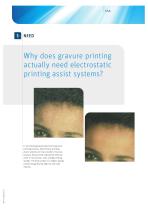
Why does gravure printing actually need electrostatic printing assist systems? In most packaging and decorative gravure printing presses, electrostatic printing assist systems are now a matter of course, because they provide substantial improvement in ink transfer, even at high printing speeds. The final product is a higher-quality printed image having high ink and color density.
Open the catalog to page 2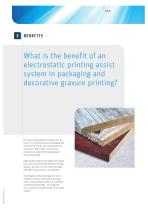
BENEFITS What is the benefit of an electrostatic printing assist system in packaging and decorative gravure printing? The use of electrostatic printing assist systems is a virtual necessity in packaging and decorative printing. The competitiveness of products often relies on the visual impression created by the packaging or decorative design. High quality design needs high print quality. This can best be achieved with electrostatic support, because it is the only technology that effectively prevents “missing dots“. A packaging or decorative gravure press optimized with an electrostatic printing...
Open the catalog to page 3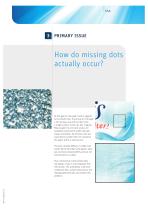
PRIMARY ISSUE At first glance, the paper surface appears to be smooth. But, if you look at it through a microscope, you will see that it has a rough surface. In the nip, this irregular “fiber jungle" (in a 70 l/cm screen, for example) is faced with 4,900 cells per square centimeter. All of those cells are expected to transfer their ink content to the paper within a split second. This task, already difficult, is made even harder by the fact that some papers have poor surface compressibility and are not exactly elastic or pliant. Thus, mechanical contact alone does not always result in a missing...
Open the catalog to page 4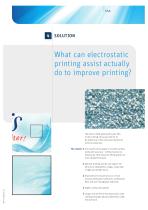
The electric field generated by the ESA in the printing nip causes the ink to be pulled out of the cells and transferred onto the substrate. The results > Ink transfer to the paper or the film surface with point accuracy - without excessive impression roller pressure. Missing dots are now a thing of the past. > Optimal printing results and regular ink density in all gradation ranges, especially in light and middle tones. > Improved print results also on critical to be printed paper substrates, cardboards, films and pre-impregnated materials. > Higher production speeds > Longer service life of...
Open the catalog to page 5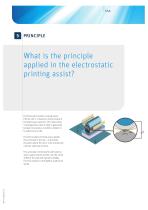
What is the principle applied in the electrostatic printing assist? The Eltex electrostatic printing assist, ESA for short, is based on the principle of the plate-type capacitor. This means that a homogeneous electric field is generated between two plates, in which a dielectric is pulled to one side. The electrostatic printing assist applies this principle in the nip – at precisely the point where the ink is to be transferred onto the substrate surface. This principle of ink transfer with electrostatic support works evenly over the entire width of the web and operates reliably from the slowest...
Open the catalog to page 6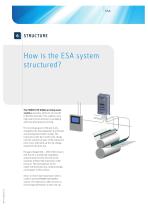
The POWER TOP GHN63 printing assist system guarantees optimum ink transfer to flexible materials. This enables a very high quality to be achieved in packaging and decorative gravure printing. The incoming paper or film web is discharged by the discharging bar to eliminate any existing electrostatic charge. The impression roller bar transfers the charge onto the conductive layer of the impression roller cover and builds up the nip voltage required in the print nip. The gap voltage (300 ... 900 V DC) ensures that the ink is transferred completely and precisely from the ink cells to the substrate...
Open the catalog to page 7
Isn’t high voltage dangerous? The Eltex high voltage generator supplies targeted and controlled high voltage. This guarantees the highest level of safety. Two safety circuits must be noted. First is the safety of the system for use in hazardous areas. Furthermore, the switching of the ESA must be carried out according to the prescribed safety circuit. Consideration of these circuits ensures optimum safety. The safety of the POWER TOP GNH63 system is further improved with performance level d.
Open the catalog to page 8
How does the ESA printing assist system reach Performance Level d? The ESA POWER TOP GNH63 system In gravure printing, the ESA electrostatic printing assist ensures complete and precise ink transfer to the paper, cardboard or film surface. This avoids missing dots, which occur particularly in the light and mid-tone range. The Eltex POWER TOP GNH63 system is available in hazardous area in gas groups IIA and IIB and can be used in water-based gravure printing. Risk reduction through increased functional safety With the POWER TOP generator PCTL, the ESA GNH63 printing assistance system achieves...
Open the catalog to page 9
What components does ESA system consist of? an Visualisation with Eltex Connected Control ECC Software for CAN bus communication for managing and controlling the ESA system POWER TOP GNH63 and additional Eltex components for installation on a Windows PC. Also available as panel PC with installed software. Advantages > easy configuration of the functions > current display of all relevant system statuses > display and output of available process data > individual grouping of the single devices > high security through three password levels > industry 4.0 compliant The High voltage generators The...
Open the catalog to page 10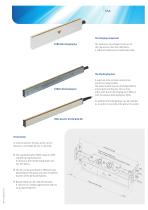
The charging component EXR130A3 charging bar The necessary nip voltage is built up via the impression roller bar EXR130A3 – a safe and maintenance-friendly electrode. The discharging bars A substrate to be printed naturally has electrical charge profiles. The material web must be discharged before entering the printing nip. This is done either with the AC discharging bar EXR50 or with the passive discharging bar RG52. An additional discharging bar can be installed as an option to neutralise the web at the outlet. The brackets In order to position the bars at the correct distances, one holder...
Open the catalog to page 11
[l0 PROJECT ENGINEERING How is the ESA GNH63 system engineered and installed? The project engineering Project engineering includes the following work based on technically clear specifications from drawings or measured data: > determining the length of the bars > positioning of the bars, fixing of the perforated plates/adapter plates for installation in the press > clarification of all cable lengths > creating the system parts list and definition of all variant specifications Taking measurements In order to obtain the necessary information for planning the installation of the ESA POWER TOP GNH63...
Open the catalog to page 12All Eltex-Elektrostatik-GmbH catalogs and technical brochures
 Brochure Cable reels
2 Pages
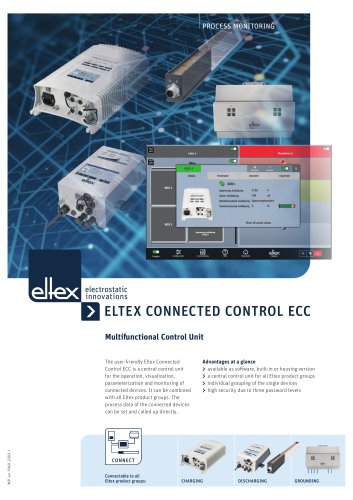 ELTEX CONNECTED CONTROL ECC
3 Pages
 Technical information GNH63
56 Pages
 Operating Manual TERRALIGHT
36 Pages
 Brochure TERRALIGHT
3 Pages
 Brochure Power Charger
5 Pages
 POWER IONIZER - power supply
8 Pages
 Technical information SDS
4 Pages
 Brochure SDS
4 Pages
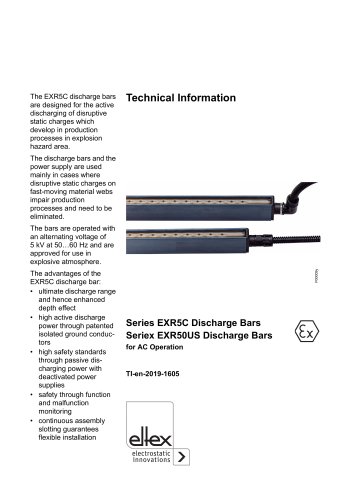 Technical information EXR5C
2 Pages
 Technical information R45
2 Pages
 Technical information RG52
4 Pages
 Brochure flexION
4 Pages
 Technical information CB
4 Pages
 Brochure STATICJET RX22
3 Pages
 Technical information RX3
4 Pages
 Brochure RX3
3 Pages
 Technical information ES24
4 Pages
 Technical information WM3000
12 Pages
 Brochure WM3000
15 Pages
 Technical information SCC
3 Pages
 Brochure Discharging
7 Pages
 Brochure SCC
3 Pages
 Technical information DM1500
8 Pages
 Brochure DM1500
2 Pages
 Brochure RX11
3 Pages
 Technical information R23ATR
8 Pages
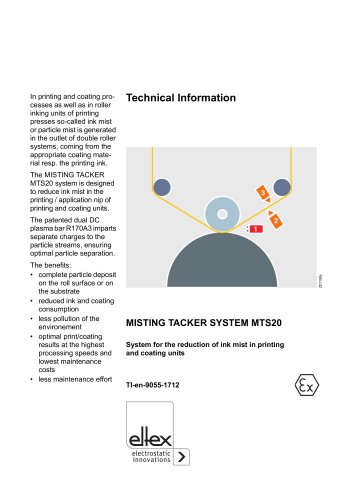 Technical information MTS
12 Pages
 Brochure MTS
3 Pages
 Brochure Grounding General
4 Pages
 Technical information PGT120
4 Pages
 Technical information GHH36
20 Pages
 Brochure GHH36
2 Pages
 Technical information ES53
4 Pages
 Technical information ES51
4 Pages
 Technical information R36
8 Pages
 Brochure Terrapharm General
2 Pages
 Brochure Terracap General
2 Pages
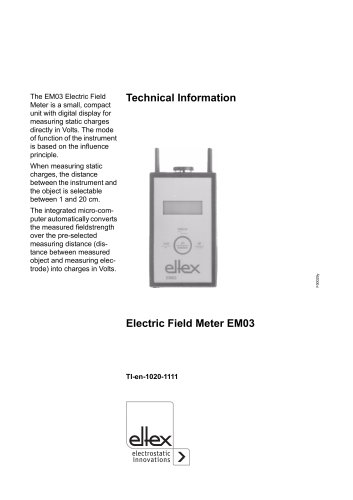 Technical information EM03
2 Pages
 Brochure Charging bars
5 Pages
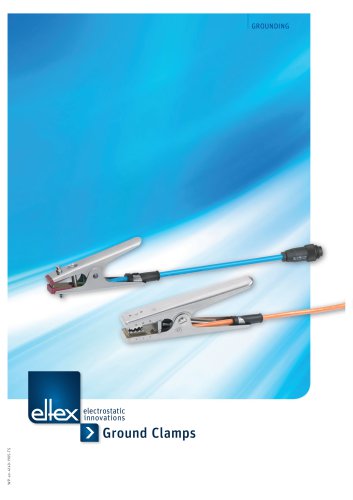 Brochure Ground clamps
4 Pages







Archived catalogs
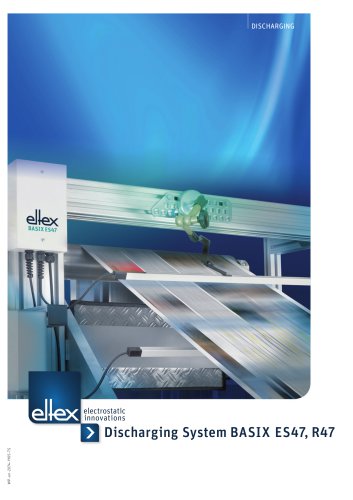 Brochure BASIX ES47,R47
4 Pages
 Technical information R55
8 Pages
 Brochure Ion Blower
5 Pages

- Power supply unit
- DC power supply
- Electrical cable
- AC/DC power supply
- Power cable
- Touch screen display panel
- Compact power supply
- Control display system
- Tabletop power supply
- Cleaning nozzle
- Air nozzle
- High-voltage power supply
- Air gun
- Stabilized power supply
- Rewinder-winder
- Blow-off nozzle
- Antistatic bar
- Cleaning air blow gun
- Hermetic electrical cable