
- Catalogs
- ElringKlinger Kunststofftechnik
- Spring-energized seals PTFE

Spring-energized seals PTFE

Spring-energized seals PTFE
- Excellent dry-running characteristics and low wear.
- Low friction adaptable to variable conditions through spring selection.
- Minimal breakaway forces and no stick-slip at low speeds.
- High dimensional stability and resistance to chemicals and temperature.
- No volumetric changes due to swelling or shrinkage.
- Compact design suitable for standard O-ring spaces.
- Good cost-benefit ratio with dimensions ranging from Ø 2 to Ø 3000 mm.
- Effective wiping with abrasive media.
These seals are single-acting elements used for sealing pistons and rods, as well as in rotary, swiveling, and static applications. They consist of a high-strength plastic outer element and an integrated spring. The spring pre-energizes the seal, ensuring performance even at low pressures. The sealing effect increases with system pressure, and the spring compensates for wear, maintaining contact pressure throughout the seal's life.
- Automotive: Fuel injection systems.
- Manufacturing: CNC machines, compressors.
- Aerospace: Landing gear systems.
- Food Processing: Packaging machines.
- Medical: Chromatography and endoscopy.
- Painting: Paint valves.
- Adhesives: Needle valve seals.
- Hydraulics: Valves and pumps.
- Offshore: Petroleum and gas seals.
- Chemical: Equipment engineering.
The seals operate on the principle of pre-loading pressure from the plastic casing and spring force. This ensures effective sealing even without system pressure, with increased contact pressure under additional pressure.
- URI – Rod Seal: For fluids, operating from -75°C to +300°C, up to 250 bar, and 15 m/s speed.
- URA – Piston Seal: For fluids, similar operating limits as URI.
- URF – Shaft and Rod Seal: For rotary applications, up to 200 bar.
- URS – Piston and Rod Seal: For gaseous media, up to 250 bar.
- CRS – Static Seal: For high pressures, up to 700 bar.
Seals require metal spring elements for consistent contact pressure. Different spring types (U, V, C) are used based on application needs, influencing sealing performance and wear behavior. Spring materials include stainless steel, Hastelloy®, and Elgiloy®.
Catalog excerpts
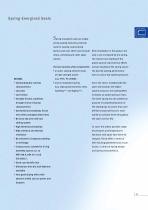
Spring-energized seals are singleacting sealing elements primarily used for sealing reciprocating pistons and rods. Other uses include rotary, swiveling and static applications. The seal consists of two components: • an outer sealing element made of high-strength plastic (e.g. PTFE, PE-UHMW) • and an integrated spring (e.g. high-grade/stainless steel, Hastelloy®(3) and Elgiloy®(3)) Benefits • Outstanding dry-running characteristics • Low wear • Low friction • Variable friction conditions through choice of spring characteristics • Extremely low breakaway forces even after prolonged down times •...
Open the catalog to page 2
Application Examples Piston pump in liquid chromatography equipment up to 300 bar for different chemical media and substances. High-pressure axial piston pump for cleaning equipment up to 280 bar of water pressure and cleaning additives. Spring-energized seals are used in a wide range of industrial applications: • Automotive industry, e.g. direct fuel injection systems • General manufacturing/ mechanical engineering, e.g. CNC machines, compressors and vacuum pumps as well as tank systems • Aerospace industry, e.g. in landing gear systems • Food processing industry, e.g. in packaging machines...
Open the catalog to page 3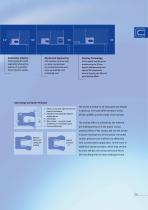
Automotive Industry Mechanical Engineering Painting Technology Piston pump for media separation of gasoline/ engine oil in gasoline direct injection system. CNC machine turret serving as rotary transmission for coolant/lubricant pressures up to 80 bar and as bearing seal. Valve needle seal for paint pressures up to 20 bar; special seal geometry and special PE compounds ensure long service life and good wiping effect. Seal Design and Action Principle 1 � Plastic casing with high thermal and chemical resistance � Stainless steel spring for defined sealing forces � Sealing lips � Back of seal –...
Open the catalog to page 4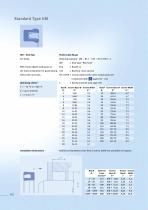
Preferential Range With sharp-edged sealing lip on = Seal type “Rod Seal“ the internal diameter for good wiping 332 effect with rod seals. HS 21059 = Casing material (for other compounds see compound table Installation Dimensions Additional diameters/sizes from 2 mm to 3000 mm available on request.
Open the catalog to page 5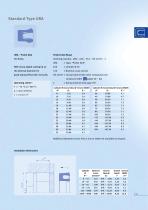
Preferential Range = Type, “Piston Seal” With sharp-edged sealing lip on good wiping effect with rod seals. HS 21037 = Casing material (for other compounds see compound table = Spring material (see page 29) Additional diameters/sizes from 2 mm to 3000 mm available on request. Installation Dimensions
Open the catalog to page 6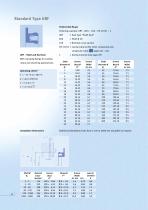
Standard Type URF Preferential Range Ordering example: URF – B20 – 108 – HS 21037 – C URF = Seal type “Shaft Seal“ HS 21037 = Casing material (for other compounds see compound table URF – Shaft and Rod Seal = Spring material (see page 29) With clamping flange for sealing rotary and swiveling applications. Operating Limits (1) T = –75 °C to +300 °C p = up to 200 bar v = 15 m/s � m Installation Dimensions Additional diameters/sizes from 2 mm to 3000 mm available on request. Flange Ø Groove Lead-In Chamfer F H 11 Width G1 min G2–0.1 K Ø B + 6,5 2,4 0,70 0,6 Ø B + 8,5 3,6 0,85 0,8 Ø B + 12,0 4,7...
Open the catalog to page 7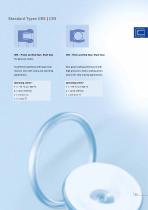
URS – Piston and Rod Seal | Shaft Seal CRS – Piston and Rod Seal | Static Seal For gaseous media. Chamfered sealing lip with large wear Very good sealing performance with reserve; even with rotary and swiveling high pressures. Static sealing action and/or for slow-moving applications.
Open the catalog to page 8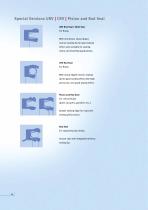
URV Rod Seal | Shaft Seal For fluids. With shortened, sharp-lipped interior sealing lip for good wiping effect; also suitable for sealing rotary and swiveling applications. CRV Rod Seal For fluids. With sharp-edged interior sealing lip for good sealing effect with high pressures; very good wiping effect. Piston and Rod Seal For critical fluids (paint, lacquers, gasoline, etc.). Double sealing edge for improved sealing performance. Rod Seal For separating two media. Groove seal with integrated memory sealing lip.
Open the catalog to page 9
For extra-large installation dimensions. Rod Seal | Shaft Seal With O-ring as static seal. Very good static sealing effect at the external diameter and/or with rough housing surfaces. Piston and Rod Seal For high pressure loads with special design and reinforced back of seal. Rod Seal (Could also be designed as a piston seal.) For separating two media. Complete Piston/Complete Package Benefits: Solution • One-part piston Design available on request. • Replaces metal piston by plastic piston • Ready-/easy-to assemble versions with favorable cost-benefit ratio • No damage to seals during assembly...
Open the catalog to page 10
Standard Version UAI for internal pressure (left). UAA for external pressure (right). Rotary seal for rotating and swiveling motions. Operating Limits T = -75 °C to +300 °C p = up to 250 bar v = 2.5 m/s (X Standard Version CAI for internal pressure (left). CAA for external pressure (right). Rotary seal for rotating and swiveling motions. Operating Limits1 T = -95 °C to +300 °C p = up to 700 bar v = 0.5 m/s Special Version Internal pressure (left). External pressure (right). Rotary seal for rotating and swiveling motions.
Open the catalog to page 11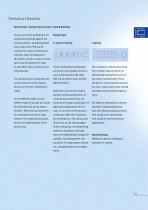
To assure that the sealing lips are permanently pressed against the contact surfaces, spring-energized seals made from PTFE and PE compounds require metal spring elements that are integrated in the plastic casings. In special cases, these may be elastomer O-rings as well. Most seals, however, have metal springs. The spring assures constantly even contact pressure of the sealing lip across the entire temperature range. For the different types of seals different types of springs are available with particular spring characteristics. These spring characteristics and properties have a major influence...
Open the catalog to page 12
Technical Details Spring Characteristics This map shows the various spring characteristics Purpose-manufactured special springs for related to the individual nominal cross-sections, clearly friction-optimized seals assure minimum contact revealing the differences between U-, V- and/or pressures with large rates of spring travel. C-springs. This data based on a 20 mm length of spring. This enables us to make pinpoint calculations and proposals for seals offering high wear reserves and thus prolonged service life. Vergleich U-Federn mit C-Federn U-Spring compared to C-Spring (2) spring force [N]...
Open the catalog to page 13All ElringKlinger Kunststofftechnik catalogs and technical brochures
 Immersion Heaters
4 Pages
 Thermoplastic Tubes
8 Pages
 PTFE-Tubes
1 Page
 Tubes for Medical Application
12 Pages
 Rollcovers
14 Pages
 Hetragon™ PTFE honey combs
6 Pages
 V-Packings
3 Pages
 Composite Seals PTFE
7 Pages
 PTFE Piston and Guide Rings
9 Pages
 Memory Packings PTFE
11 Pages
 PTFE Rotary Shaft Seals
13 Pages
 Industry Special: Automotive
12 Pages
 Moldflon™ PTFE
24 Pages
 PTFE Pipes Rods Sheets Foils
44 Pages
 PTFE Seals and Guides
64 Pages


- Piping
- Plastic hose
- Structure hose
- Flexible hose
- Semi-rigid tube
- Abrasion-resistant hose
- Heat exchanger unit
- Smooth piping
- Polymer conduit
- Liquid/liquid heat exchanger
- Smooth hose
- Chemical product hose
- Oil-resistant hose
- Tubular sleeve
- Weather-resistant hose
- Polymer pipe
- Plate heat exchanger
- Tubular heat exchanger
- UV-resistant hose