
- Catalogs
- Elproma Elektronika Sp.z o.o.
- Elproma-Advanced-Security-Sync-Technology

Elproma-Advanced-Security-Sync-Technology

Elproma-Advanced-Security-Sync-Technology
This document provides an overview of advanced synchronization security technologies used in time servers, focusing on Elproma's innovations in smart antenna technology, jamming/spoofing protection, enhanced time server security, clock accuracy, and SafeTime audit management software.
Elproma has developed a Smart Antenna where the GNSS receiver board is integrated into the antenna itself, rather than the time server. This design offers several advantages, including built-in jamming/spoofing detection, modular design for easy updates and replacements, and the use of cost-effective CAT5+ cables for connections up to 700 meters. The Smart Antenna supports dual GNSS antenna ports for improved coverage and high availability.
Elproma's time servers provide multi-level cybersecurity protection against jamming and spoofing attacks. The protection includes geographical distance risk diversification, anti-jamming/spoofing RF filters, and a time firewall with GNSS emulation output. The system can switch to internal holdover clocks during an attack, ensuring continuous operation.
Elproma's time servers feature autonomous NTP/PTP modules with private PTP and IP stacks, ensuring 100% isolation between LAN interfaces. This design enhances security by preventing breaches in one network from affecting others. The servers support expansion with additional modules, each operating independently.
Elproma improves clock accuracy by using TCXO low-noise chips in conjunction with OCXO, enhancing the standard OCXO holdover. This approach reduces noise errors and improves the accuracy of clock input signals, ensuring reliable time distribution even when GNSS signals are unavailable.
NMS-STAS is a synchronization management and reporting tool that supports multiple NTP/PTP time servers across geographical regions. It allows for real-time monitoring, centralized audit logs, and graphical reporting, aiding in the analysis and management of timing synchronization infrastructure.
Catalog excerpts

“Better Safe Than Sorry” Advanced Sync Security NTP/ PTP/ IRIG-B IEEE1588 ePRTC GNSS Time Servers Smart Antenna Technology Jamming/ Spoofing Protection Enhanced Time Server Security Clock Accuracy SafeTime Audit Management Software (NMS-STAS
Open the catalog to page 1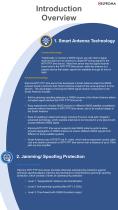
Introduction Overview 1. Smart Antenna Technology Current technology Traditionally, to receive a GNSS signal, you will need a signal receiver board and an antenna to obtain RF timing signal for the NTP/ PTP time server. Most time server has the signal receiver board built-in the NTP/ PTP time server, while the antenna is a passive device that obtain signal from satellites through its line-ofsight. Advanced technology Elproma NTP/ PTP time server has developed a Smart Antenna where the GNSS receiver board is built into their Smart Antenna instead of the usual approach in time servers. The advantages...
Open the catalog to page 2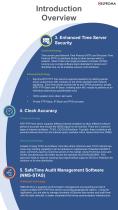
Introduction Overview 3. Enhanced Time Server Security Current technology Time server uses Network Time Protocol (NTP) and Precision Time Protocol (PTP) to distribute timing to other devices within a network. Most of them are single processor computer (FPGA) running over a single software stack dedicated to receive and distribute time via all available network LAN interfaces. Advanced technology • Elproma NTP/ PTP time servers supports expansion by adding special server autonomous NIC modules on top of the standard main network appliance. Each time server module has its own FPGA processor, private...
Open the catalog to page 3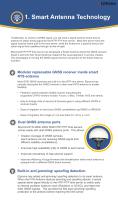
1. Smart Antenna Technology Traditionally, to receive a GNSS signal, you will need a signal receiver board and an antenna to obtain timing signal for the NTP/ PTP time server. Most time server have the signal receiver board built-in the time server, while the Antenna is a passive device that obtain signal from satellites through its line-of-sight. Elproma NTP/ PTP time server has developed a Smart Antenna where the GNSS receiver board is built into their Smart Antenna instead of the usual approach in servers chassis. The advantages of moving the GNSS signal receiver component to the Smart Antenna...
Open the catalog to page 4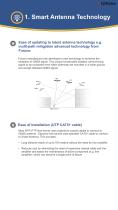
1. Smart Antenna Technology Ease of updating to latest antenna technology e.g. multi-path mitigation advanced technology from Furuno Furuno manufacturer has developed a new technology to enhance the reception of GNSS signal. This unique functionality enables correct timing signal to be computed even when antennas are mounted in a lower ground and accept reflected GNSS signal. Ease of Installation (UTP CAT5+ cable) Most NTP/ PTP time server uses expensive coaxial cables to connect to GNSS antenna. Elproma time severs uses standard CAT5+ cable to connect to Smart Antenna. This provides: • Long...
Open the catalog to page 5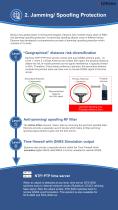
2. Jamming/ Spoofing Protection Being a key global player in timing technologies, Elproma has invested many years of R&D into jamming/ spoofing protection. As jamming/ spoofing attacks come in different levels, Elproma has developed a comprehensive process of jamming/ spoofing protection which consists of 3 Levels. “Geographical” distance risk diversification Elproma NTP/ PTP time servers comes with dual GNSS antenna ports. At Level 1, when 2 x Smart Antenna are at least 50m apart, the physical distance deters the risk of mobile jammers as the signal interference is typically limited to 50m....
Open the catalog to page 6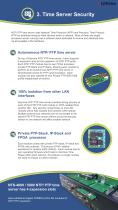
3. Time Server Security NTP/ PTP time server uses Network Time Protocols (NTP) and Precision Time Protocol (PTP) to distribute timing to other devices within a network. Most of them are single processor server running over a software stack dedicated to receive and distribute time via all available LAN interfaces. Autonomous NTP/ PTP time server On top of Elproma NTP/ PTP time server, it also supports 4 expansion slots for the expansion of NTP/ PTP ports. Each NTP/ PTP module has its own FPGA processor, private PTP-Stack and IP-Stack, allowing each module to perform as an autonomous NTP/ PTP time...
Open the catalog to page 7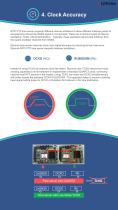
4. Clock Accuracy NTP/ PTP time server supports different internal oscillators to allow different holdover period of accurate time should the GNSS signal is not received. There are 3 common types of internal oscillators: TCXO, OCXO & Rubidium. Typically, these oscillators will provide holdover from the quartz oscillator received from GNSS. Elproma time server improves clock input signal accuracy by reducing its low noise error. Elproma NTP/ PTP time server supports holdover oscillators: Instead of using TCXO as holdover clock like others, Elproma uses TCXO internal low-noise clocking capability...
Open the catalog to page 8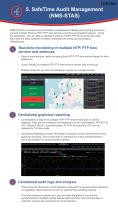
5. SafeTime Audit Management (NMS-STAS) NMS-STAS is a powerful synchronization management software and reporting tool which support multiple Elproma NTP/ PTP time servers according geographical regions. Using the application, you are able to manage hundreds of NTP/ PTP time severs and audit them with the data collected, to better understand the timing synchronization infrastructure. Real-time monitoring of multiple NTP/ PTP time servers and antennas • Ease of monitoring as users can group their NTP/ PTP time servers based on their preference • Quick visibility of multiple NTP/ PTP time servers'...
Open the catalog to page 9
Your Trusted Cyber Security & Network Solutions Partner Elproma Value-Added Distributor
Open the catalog to page 10All Elproma Elektronika Sp.z o.o. catalogs and technical brochures
 RBVND-Lite
2 Pages
 RBMTX-Viper
4 Pages
 TFD-100 series
6 Pages
 NTS-Smart-Antenna
2 Pages
 NTS-Pico3
2 Pages
 NTS-4000
2 Pages
 NTS-5000
7 Pages
 NTS-3000
2 Pages
 RBMTX-Lite IO
2 Pages
 RBMTX-Lite 4G
2 Pages
 RB900-PRO
2 Pages
 RB900SG
2 Pages
 RB900L3
2 Pages
 RB800
RB8002 Pages
- Ethernet communication router
- Industrial communication router
- Cellular communication router
- Communication router with VPN
- Omnidirectional antenna
- DIN rail communication router
- LAN communication router
- Data communication router
- 3G UMTS communication router
- WiFi communication router
- LTE communication router
- Wireless communication router
- M2M application communication router
- 4G LTE communication router
- RS232 communication router
- Communication router for IoT applications
- Industrial modem
- RS485 communication router
- Dual SIM communication router