
- Catalogs
- Elettronica Conduttori
- Foil Shielded Halogen free multicore cables Class T4 ISO 6722 Class D

Foil Shielded Halogen free multicore cables Class T4 ISO 6722 Class D

Foil Shielded Halogen free multicore cables Class T4 ISO 6722 Class D
- Temperature Range: Operating temperature is from -40°C to +150°C, with a lifespan of 3000 hours.
- Conductor: Made from stranded bare copper (Cu-ETP1) compliant with ISO 6722 and Fiat specification 9.91107. Available cross-sectional areas range from 0.22 mm² to 2.5 mm².
- Insulation: Uses a special flame-retardant thermoplastic elastomer compound that is lead-free and resistant to oil and fuel, compliant with ISO 6722 and Fiat specification 9.91107. The insulation is available in various colors.
- Shielding: Composed of an Aluminium/Polyester tape with a stranded bare copper drain wire.
- Jacket: Made from the same flame-retardant thermoplastic elastomer as the insulation, colored black.
- Bending Radius: 10 times the overall diameter of the cable.
- Operating Voltage: 300 V.
- Flame Retardant Test: Compliant with ISO 6722 and Fiat specification 9.91107.
Catalog excerpts
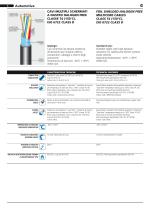
Automotive CAVI MULTIPLI SCHERMATI A NASTRO HALOGEN FREE CLASSE T4 (150°C), ISO 6722 CLASS D FOIL SHIELDED HALOGEN FREE MULTICORE CABLES CLASS T4 (150°C), ISO 6722 CLASS D Impiego: Cavi schermati ad elevata resistenza all’abrasione per impianti elettrici, componenti, cablaggi e sistemi degli autoveicoli. Temperatura di esercizio: -40°C +150°C (3000 ore). Standard Use: Shielded cables with high abrasion resistance for cabling and electric systems inside vehicles. Operating temperature: -40°C +150°C (3000 hrs). CARATTERISTICHE TECNICHE TECHNICAL FEATURES Flessibili in rame rosso (Cu-ETP1) sec. ISO 6722, Cap.Fiat 9.91107. Sezioni (mm2): da 0,22 a 2,5. Stranded bare copper (Cu-ETP1) conductors ISO 6722, Fiat Procurement specification 9.91107 Cross sect. area (mm2): from 0,22 to 2,5. Elastomero termoplastico “Lead free”, ritardante la fiamma per temperatura di esercizio fino a 150°C (classe T4, ISO 6722 class D) resistente a oli e carburanti sec. ISO 6722, Cap.Fiat 9.91107, 91107/06. Codici colori: diversamente colorati. Special flame retardant thermoplastic elastomer compound “Lead free” temperature rating up to 150°C (class T4, ISO 6722 class D) oil and fuel resistant ISO 6722, Fiat Procurement specification 9.91107, 91107/06. Colour code: differently coloured. Nastro di Alluminio/Poliestere con conduttore flessibile di continuità in rame rosso. Aluminium/Polyester tape with stranded bare copper drain wire. Elastomero termoplastico “Lead free”, ritardante la fiamma per temperatura di esercizio fino a 150°C (classe T4, ISO 6722 class D) resistente a oli e carburanti sec. ISO 6722, Cap.Fiat 9.91107, 91107/06. Colore: Nero. Special flame retardant thermoplastic elastomer compound “Lead free” temperature rating up to 150°C (class T4, ISO 6722 class D) oil and fuel resistant ISO 6722, Fiat Procurement specification 9.91107, 91107/06. Colour code: Black. RAGGIO DI CURVATURA BENDING RADIUS 10 volte il diametro del cavo. 10 times overall diameter of cable. TENSIONE DI ESERCIZIO OPERATING VOLTAGE ISO 6722, Fiat Procurement specification 9.91107. CONDUTTORI CONDUCTORS ISOLAMENTO INSULATION CONDUTTORE DI CONTINUITA’ DRAIN WIRE SCHERMO SHIELD GUAINA JACKET CONDUTTORI CONDUCTORS ISOLANTE INSULATION SCHERMATURA SHIELD GUAINA JACKET TEMPERATURA DI ESERCIZIO OPERATING TEMPERATURE
Open the catalog to page 1All Elettronica Conduttori catalogs and technical brochures
 LSZH FIRE RESISTANT
2 Pages
 Automation
31 Pages
 Security
60 Pages
 Automotive
36 Pages


- Electrical cable
- Copper cable
- Copper electrical cable
- Power cable
- Multi-strand cable
- Multi-wire electrical cable
- Electrical data cable
- Flexible cable
- Flexible electrical cable
- IEC electrical cable
- PVC-sheathed cable
- PVC-sheathed electrical cable
- Industrial cable
- Halogen-free cable
- Switch electrical cable
- Flame-retardant cable
- Halogen-free electrical cable
- Flame-retardant electrical cable
- Single-conductor cable
- Solid electrical cable