
- Catalogs
- Elektror airsystems
- Radial Low Pressure Blowers, explosionsprotected ND-ATEX


Radial Low Pressure Blowers, explosionsprotected ND-ATEX

Radial Low Pressure Blowers, explosionsprotected ND-ATEX
The ATEX-ND series of low-pressure radial blowers are designed to comply with directive 94/9 EC for explosion protection. Operators must assess explosion risk areas and categorize them into zones, implementing necessary protection measures. Manufacturers classify devices into categories suitable for these zones.
Zones are defined by EN 1127-1 based on the presence of explosive atmospheres. Zones 0, 1, and 2 are for gases, while Zones 20, 21, and 22 are for dusts. Elektror blowers are available for Zones 1, 2, and 22.
Devices are categorized by the highest permissible surface temperatures, ranging from T1 (450°C) to T6 (85°C). Elektror supplies equipment in temperature class T3 or higher as standard.
Types 'e' (increased safety) and 'de' (flameproof enclosure) are used to prevent ignition in explosive atmospheres. Standard supply is type 'e', with 'de' available on request.
Suitable for conveying large air volumes, gas and vapor extraction, cooling machinery, room ventilation, biogas plant solutions, and more.
Features include compact design, high efficiency, low noise, robust casings, and variable speed control.
Elektror ATEX low-pressure blowers are radial blowers with stainless steel impellers, directly driven by motors tailored for blower operations. The housings are made of cast aluminum, ensuring efficient flow properties. The blowers are designed for long service life and low operating costs, with explosion-protected motors meeting EN 60079 standards. Both 50 Hz and 60 Hz versions are available based on technical feasibility.
Radial blowers draw in air axially, accelerate it radially, and expel it tangentially. The blower's ability to generate pressure decreases with increasing flow volume. Performance is depicted through pressure difference and volumetric flow rate curves. System resistances typically change quadratically with volumetric flow changes.
Noise from blowers is caused by flow and turbulence within the impeller and housing. It is influenced by blower type, size, operating point, and revolution speed. Noise is measured in dB(A), considering frequency dependency in noise perception. Doubling the distance from the noise source can reduce sound pressure by up to 5 dB(A).
Characteristic curves for total and static pressure as a function of volumetric flow rate are measured and may exceed technical data values. Measurements are taken with a protective grating at the intake end. For safety, blowers should not operate left of the maximum pressure increase-volume flow characteristic to prevent impeller pumping.
After determining the necessary pressure difference, the usable static pressure difference is calculated. If the duct cross-section increases gradually, dynamic pressure converts to static pressure, allowing for pressure recovery. This can help overcome system resistances or enable the use of a smaller blower.
The document outlines the specifications for ATEX low-pressure blowers, emphasizing their suitability for environments with stable operating conditions. It highlights the adaptability of ATEX models to specific customer requirements through special equipment. The permissible ambient temperature for drive motors is between -20°C and +40°C, and the conveyed media temperature for ND ATEX blowers ranges from -20°C to +60°C.
The document discusses the influence of air density on total pressure increase, dynamic pressure, static pressure, and power requirements, which change proportionally with the density of the conveyed medium. It provides a formula for calculating density changes due to temperature variations.
Standard blowers are equipped with 2-pole motors, and changes in blower speed affect total pressure increase, volumetric flow rate, and power consumption. The document specifies voltage and frequency requirements, including options for 60 Hz motors. Motor protection is crucial, with guidelines for using monitoring devices and motor circuit breakers to prevent overheating.
ATEX blowers are equipped with closed deep groove ball bearings that do not require lubrication. Regular checks and cleaning are necessary to maintain operational safety and performance. The document advises against using blowers for transporting solid materials and emphasizes the importance of using original spare parts.
Details required for ordering include blower type, flow volume, pressure difference, voltage, frequency, ambient and conveyed medium temperature, and other specifications. The document also provides guidelines for explosion protection and ignition protection types.
A conversion table is provided for various units of measurement, including pressure, volumetric flow rate, electric power, length, and weight, with examples for converting between European and US units.
This document provides detailed specifications for various types of ATEX blowers, including dimensions, performance data, and weight. It highlights that dimensions may vary based on special motor specifications and that technical and constructional changes are subject to modification. The document also notes that 60 Hz variations are available upon request.
The document includes tables listing the volumetric flow rate, total pressure difference, voltage, frequency, current consumption, motor revolutions, motor rating, and approximate weight for different blower models. It specifies that the version shown relates to ignition protection type Ex e and temperature class T3.
Graphs illustrate the relationship between volumetric flow rate, pressure increase, and sound pressure level for various blower models. These graphs help in understanding the performance characteristics of the blowers under different conditions.
The document lists various accessories such as intake and discharge connectors, along with their dimensions and article numbers. It also mentions the availability of further accessories for specific applications upon request.
The document describes the ATEX fine filters designed for the intake side of the blowers. These filters are adapted to the maximum flow volume of the blowers and have a small pressure loss. The filters are made of synthetic fibers, providing high filtration efficiency and corresponding to filter class G4 according to DIN EN 779. Regular cleaning of the filters is essential to maintain blower performance.
The document concludes with an overview of the product range, including low, medium, and high-pressure blowers, as well as ATEX-specific blowers and side channel blowers.
Catalog excerpts

ND Niederdruckventilatoren Low pressure blowers Explosionsgeschützte Ausführung Explosion protected design
Open the catalog to page 1
INHALTSVERZEICHNIS TABLE OF CONTENTS Elektror-ATEX-Niederdruckventilatoren bieten: • Sinnvolle Leistungsabstufung • Einbaufertige Ausfuhrung mit Drehstrommotor • Hohes Leistungsvermogen bei kompakter Bauweise • Lange Nutzungsdauer bei niedrigeren Betriebskosten • Gute Wirkungsgrade • Gunstiges Gerauschverhalten • Stabile Gehauseausfuhrung • Drehzahlstellbare Ausfuhrungen • ZweckmaBiges Zubehor Elektror-ATEX-low pressure blowers offer: • Reasonable performance graduation • Ready-to-install design with three phase a.c. motors • High performance at compact design • Long service life with low operation...
Open the catalog to page 2
ATEX-NIEDERDRUCKVENTILATOREN ATEX LOW PRESSURE BLOWERS Die Einsatzgebiete unserer ATEXNiederdruckventilatoren sind vielfältig: Our low pressure ATEX blowers are suitable for a wide range of applications: • Förderung großer Luftmengen bei kleinen und mittleren Anlagenwiderständen • Absaugung von Gasen und Dämpfen • Kühlung von Apparaten und Maschinenteilen • Be- und Entlüftung von Räumen • Lösungen für Membranen in Biogas-Anlagen • Luftzuführung bei Gas-, Öl- und Kohlefeuerungen • Trocknung von Teilen verschiedener Art • Fremdbelüftung von elektrischen Maschinen • Conveying large air volumes in...
Open the catalog to page 3
Btechnische hinweise TECHNICAL INFORMATION Die EN 1127-1 definiert nach AusmaB und Auspragung verschiedene explosionsgefahrdete Zonen, in denen explosionsfahige Atmospharen in Gefahr drohender Menge vorliegen oder auftreten konnen. Eine explosionsfahige Atmosphare ist ein Gemisch aus Luft und brenn-baren Gasen, Dampfen, Nebeln oder Stauben. Wegen unterschiedlicher Zundgefahren und erforderli-cher SchutzmaBnahmen sind unterschiedliche Zonen fur Gase (auch fur Dampfe, Nebel) und fur Staube definiert. Die folgende Tabelle zeigt die verschiedenen Zonen mit den entsprechenden Gerate-Kategorien nach...
Open the catalog to page 4
Fur die Zonen 0, 20 und 21 sind keine Elektror-Gerate verfugbar. Diese Angaben beziehen sich auf Betriebs-mittel der Gerategruppe II, d.h. Gerate, die nicht fur den Schlagwetter- oder Untertagebetrieb geeignet sind. In Verbindung mit Motoren der Zundschutzart EEx de liefert Elektror ATEX-Ventilatoren fur die Unterzundgruppe IIB, diese schlieBt Gruppe IIA mit ein. Wir empfehlen Ihnen, uns Ihre Anfragen an das Elekt-ror-Produkt und den von uns umzusetzenden Explosions-schutz in unserer ATEX-Selbstauskunft fur Kunden zu benennen. Sie konnen das Formular unter www.elektror.de herunterladen. No Elektror...
Open the catalog to page 5
Etechnische hinweise TECHNICAL INFORMATION Glimmtemperaturen Der Betreiber eines Gerates oder Betriebsmittels ist dazu verpflichtet, Zund- oder Glimmtemperaturen in seinem Explosionsschutzdokument festzuschreiben und diese Elektror bei Bestellung zu benennen. Zundschutzart e: Erhohte Sicherheit (s. EN 60079-7) Hier sind MaBnahmen getroffen, mit einem erhohten Grad an Sicherheit unzulassig hohe Temperaturen, sowie das Entstehen von Funken und Lichtbogen im Inneren oder an ausseren Teilen elektrischer Betriebsmittel zu verhindern, an denen diese im Normalbetrieb nicht auftreten. Zundschutzart de: Druckfeste...
Open the catalog to page 6
TECHNISCHE HINWEISE TECHNICAL INFORMATION Elektror-Niederdruckventilatoren der Baureihe ND-ATEX Elektror ATEX low pressure blowers are radial blowers sind Radialventilatoren mit Laufrädern aus Edelstahl. Sie with impellers made of stainless steel. The are directly werden von besonders auf die Ventilatorbelange abge- driven by well dimensioned motors which have been espe- stimmten, gut dimensionierten Motoren direkt angetrieben. cially adapted to the operation of the Die formschönen, den strömungstechnischen Erfordernis- blowers. The well-shaped housings are made of cast sen entsprechenden Gehäuse...
Open the catalog to page 7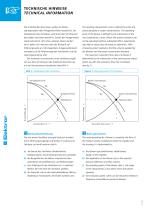
TECHNISCHE HINWEISE TECHNICAL INFORMATION Die entstehenden Kennlinien werden als Wider- The resulting characteristic curve is referred to as the resi- standsparabeln oder Anlagenkennlinien bezeichnet. Der stance parabola or system characteristics. The operating Arbeitspunkt des Ventilators wird durch den Schnittpunkt point of the blower is defined by the intersection of the der beiden Kennlinien bestimmt. Soweit der Anlagenwider- two characteristic curves. Where the system resistance can- stand rechnerisch nicht ohne weiteres erfasst werden not be calculated without substantial effort, experiments...
Open the catalog to page 8
TECHNISCHE HINWEISE TECHNICAL INFORMATION Die abgestrahlten Geräusche sind nicht über den gesamten The noise emission is not constant across the entire per- Leistungsbereich konstant. Ventilatorgehäuse und -laufrad formance range. Blower housing and impeller are desi- sind den strömungstechnischen Erfordernissen entspre- gned to offer the required flow properties. Therefore, the chend konstruiert, so dass die Geräuschentwicklung im noise emission largely depends on the required flow volu- wesentlichen von den Anforderungen an Fördermenge me and pressure difference as well as the corresponding...
Open the catalog to page 9
TECHNISCHE HINWEISE TECHNICAL INFORMATION Blower selection Nutzbare Druckdifferenz Usable pressure difference Hat man rechnerisch oder durch Versuche die benötigte Once the necessary pressure difference has been deter- Druckdifferenz für die gewünschte Fördermenge ermittelt, mined by computation or experiments, the amount of the so ist zu prüfen, wieviel von der Totaldruckerhöhung des total pressure increase of the blower must be checked Ventilators als statische Druckdifferenz genutzt werden which may be used as static pressure difference. If the duct kann. Hat der druckseitig angeschlossene...
Open the catalog to page 10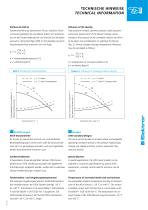
TECHNISCHE HINWEISE TECHNICAL INFORMATION Totaldruckerhöhung, dynamischer Druck, statischer Druck Total pressure increase, dynamic pressure, static pressure und Leistungsbedarf des Ventilators ändern sich proportio- and power requirement of the blower change propor- nal mit der Fördermediendichte und sind bei der Ventilator- tionally to the pressure of the conveyed medium and have auswahl zu berücksichtigen (Bild 3). Dichteänderung durch to be taken into consideration on selecting the blower Temperatureinflüsse errechnen sich wie folgt: (Fig. 3). Density changes through temperature influences...
Open the catalog to page 11All Elektror airsystems catalogs and technical brochures
 Broschüre Wassertechnik
8 Pages
 Brochure Plastic Industry
8 Pages
 Radial Conveying Blowers RDF
36 Pages
 Radial High Pressure Blowers HRD
72 Pages
 Product overview
20 Pages
 AirKnife
4 Pages
 Radial Low Pressure Blowers ND
48 Pages


- Radial fan
- Propeller fan
- Air circulation fan
- Industrial fan
- Extraction fan
- Air blower
- Centrifugal blower
- Single-stage blower
- Steel fan
- Cooling fan
- Aluminum fan
- PBT fan
- Fan with rear-angled blades
- Wall-mounted fan
- Exhaust fan
- Side-channel blower
- Corrosion-resistant fan
- Galvanised steel fan
- Stainless steel fan
- Direct-drive fan