- Catalogs
- Elektro Mechanik
- FAULT INDICATOR TYPE FLA3.1

- Products
- Catalogs
- News & Trends
- Exhibitions
FAULT INDICATOR TYPE FLA3.1

FAULT INDICATOR TYPE FLA3.1
The FLA3.1 fault indicator is designed for use in overhead lines of a network. It can be installed under live conditions using an adapter and hot stick. The device is self-sustained from a current flow of 20A and features six flashing LEDs for nighttime visibility and three red display areas for daytime visibility. It supports remote communication via a bidirectional wireless connection, allowing settings adjustments without removal from the line. The FLA3.1 can distinguish between permanent and temporary faults and is adaptable to network auto-reclosers.
- Trip Current: Selectable between 40 and 1500 A in standard mode; automatic setting in automatic mode.
- Response Delay: Adjustable between 40 and 300 ms.
- Indication: 6x LED with 360° visibility, >3000 mcd each; red flag indication.
- Reset Options: By recovering service current, remote control, or time (30 min to 12 hours).
- Dimensions: Diameter 80mm, height 184mm.
- Protection Class: IP67.
- Material: ABS HI100-NP, Carbotex K20 UVR.
- Weight: 0.610kg.
- Type Tests: IEEE 495-2007, EN 60068-2-11 2000-02, ASTM G44-99 (2005).
- Operating Temperature: -20°C to +85°C.
- Accuracy: +/- 10%.
- Cable Diameter Ranges: 6-15mm, 10-28mm, 25-42mm.
- Power Supply: Lithium battery (LiSOCl2) 3.6V / 3600 mAh.
- Fault Indication Hours: 800 hours.
- Flashing Frequency: 60 per minute.
- Max Operating Voltage: <= 46kV.
- Current Withstand: 25 KA / 170ms Sym. RMS.
- Communication: 433MHz bidirectional radio interface.
Catalog excerpts

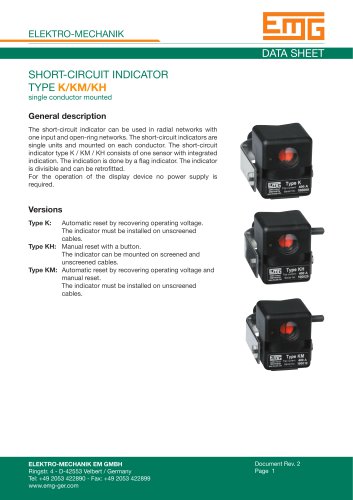
DATA SHEET FAULT INDICATOR TYPE FLA3.1 for overhead lines General description The fault indicator type FLA3.1 is used in overhead lines of a network. The indicator can be mounted under live conditions with the help of an adapter and a hot stick. The FLA3.1 is completely self-sustained by the monitored network from a current flow of 20A upwards. The indication is done by six flashing LEDs for a clear nighttime visibility and three red display areas for a clear daytime visibility. The FLA3.1 can communicate to a remote control via a bidirectional wireless connection. In this way all settings of the indicator can be adjusted at any time without removing the indicator from the powered line. The FLA3.1 stands out for the great flexibility of the adjustments that can be done. Beside the basic settings of the indicator like trip current, response delay, reset time, etc., the FLA3.1 can be adapted to auto-reclosers in the network. This provides for an optimized fault indication and also allows the indication of different fault types. Permanent and temporary faults can be distinguished and indicated separately. The bidirectional connection between the remote control and the fault indicator allows to read out the present current of the monitored network with the remote control at any time. The fault indicator type FLA3.1 can be connected to the remote indication interface type RIS. This allows an easy-to-install remote indication solution for the overhead line indicators. ELEKTRO-MECHANIK EM GMBH Ringstr. 4 - D-42553 Velbert / Germany Tel: +49 2053 422890 - Fax: +49 2053 422899 www.emg-ger.com
Open the catalog to page 1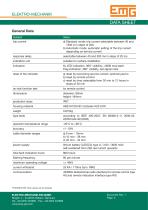
Subject Value ELEKTRO-MECHANIK EM GMBH Document Rev. 7 Ringstr. 4 - D-42553 Velbert / Germany Page 2
Open the catalog to page 2
DATA SHEET bottom view side view ELEKTRO-MECHANIK EM GMBH Document Rev. 7 Ringstr. 4 - D-42553 Velbert / Germany Page 3
Open the catalog to page 3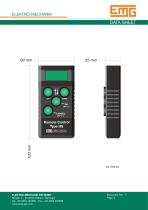
ELEKTRO-MECHANIK EM GMBH Document Rev. 7 Ringstr. 4 - D-42553 Velbert / Germany Page 4
Open the catalog to page 4All Elektro Mechanik catalogs and technical brochures
 VOLTAGE INDICATOR TYPE SPA
4 Pages