
- Catalogs
- ELECTROLUBE
- Polyurethane & Epoxy Resins


- Company
- Products
- Catalogs
- News & Trends
- Exhibitions
Polyurethane & Epoxy Resins

Polyurethane & Epoxy Resins
Encapsulation resins are essential for protecting and insulating printed circuit boards (PCBs) and electronic components from harsh environments such as moisture, vibration, thermal or physical shock, and contamination. They form a complete barrier, offering superior performance under extreme conditions and providing excellent mechanical protection.
The Electrolube product range includes epoxy, polyurethane, and silicone resin systems, each with specific applications:
- Epoxy Resins: Known for hardness and chemical resistance.
- Polyurethane Resins: Valued for flexibility and variable shore hardness.
- Silicone Resins: Ideal for high-temperature applications.
Electrolube offers a variety of resins for different applications:
- General Purpose Protection: Products like ER2188 (Epoxy), SC2001 (Silicone), and UR5604 (Polyurethane) are suitable for standard atmospheric conditions.
- LED Applications: Optically clear compounds like ER2220 (Epoxy) and SC3001 (Silicone) are used for protecting LEDs and dissipating heat.
- RF Applications: Resins like ER1451 (Epoxy) and UR5118 (Polyurethane) are designed to not interfere with RF signal transmission.
- Marine Environments: Products such as UR5041 (Polyurethane) offer excellent water resistance.
Electrolube resins can be tailored for specific needs, including:
- Flame Retardancy: UL94 approved products like ER2165 (Epoxy).
- Thermal Conductivity: Products like ER2220 (Epoxy) provide accurate thermal conductivity measurements.
- Chemical Resistance: Resins like ER2223 (Epoxy) offer protection against prolonged chemical exposure.
- Re-workability: Soft resins like SC2001 (Silicone) allow for flexibility and reworking.
Before applying encapsulation resins, it is crucial to ensure the PCB is free from contaminants that could affect adhesion and protection. Electrolube provides cleaning products to remove residues. The mixing and dispensing process is vital for successful application, with both manual and automatic processes available. Proper mixing ensures no air inclusion, which could lead to voids and reduced protection.
Resins should be allowed to gel at room temperature before heat curing to avoid excessive heat generation. The exotherm during curing must be considered to ensure compatibility with all components.
To prevent moisture ingress and ensure proper curing of resins, containers should be kept closed when not in use. Molecular sieve towers should be fitted to automated equipment, and the relative humidity of the environment should be monitored and ideally kept below 70%. Surfaces and equipment must be clean to avoid contamination that could inhibit curing.
Care should be taken to avoid introducing air during mixing. Automatic mixing equipment is recommended for accurate mixing without air introduction. Containers of resin and hardener should be sealed when not in use, and bulk materials must be thoroughly mixed before use to ensure complete curing.
- Silicone Resins: Includes products like SC2001, SC2001FD, SC2003, SC2006, and SC3001, each with specific properties such as flexibility, chemical resistance, and thermal conductivity.
- Epoxy Resins: Products like ER1122, ER1426, ER1451, ER2183, and ER2220 offer properties like excellent adhesion, thermal conductivity, and chemical resistance.
- Polyurethane Resins: Includes UR5041, UR5044, UR5083, and UR5634, known for properties like water resistance, toughness, and thermal conductivity.
Additional products include machine and resin removers, peelable coating masks, and cleaning solvents designed for maintenance and preparation before encapsulation.
Tables provide detailed specifications for each resin type, including viscosity, mix ratios, cure times, thermal conductivity, temperature ranges, dielectric strength, and compliance with standards like RoHS and UL94.
Contact details for Electrolube's UK and China headquarters are provided for further inquiries and support.
Catalog excerpts

Encapsulation Resins Solutions for challenging environments ELECTROLUBE THE SOLUTIONS PEOPLE
Open the catalog to page 1
Encapsulation Resins • UL approved • Cable jointing • Potting / encapsulating • Coloured and optically clear Resin systems are designed to protect and insulate printed circuit boards (PCBs) and electronic components from the threats of harsh and challenging environments, including; moisture, vibration, thermal or physical shock and general contamination. By encapsulating the entire device, resins can form a complete barrier against such environments offering superior performance under extreme conditions. Potting and encapsulation resins also offer excellent mechanical protection. Mechanical protection...
Open the catalog to page 2
Resin Types The extensive Electrolube product range consists of epoxy, polyurethane and silicone resin systems available for general purpose and customer specific applications. Typically, polyurethanes are used for their flexibility, variable shore hardness and short pot life. In general, epoxy resins are much harder materials, offering superior chemical resistance and physical protection to the polyurethane type. Silicone resins are typically used for high temperature applications and offer excellent protection in extremely harsh conditions. Epoxy Resins Polyurethane Resins • Very tough systems...
Open the catalog to page 3
Comparison of Shore Hardness vs. Temperature — General Purpose Epoxy — General Purpose Polyurethane — General Purpose Silicone -40 -30 -20 -10 0 10 20 30 40 50 60 70 80 90 100 110 120 130 * Shore A and D run from 0-100 Shore A10 is very soft and flexible Shore D90 is very hard and rigid Shore A95 = Shore D45 Comparison of Typical Operating Temperature Ranges 200 150 100 50 0 ■ Epoxy ■ Polyurethane ■ Silicone Lower Temperature Range Upper Temperature Range
Open the catalog to page 4
Product Choice The electronics industry is one of the most rapidly expanding industries to date, with new applications seemingly endless. Printed circuit boards (PCBs) are found in many domestic, industrial, automotive and military devices, to name but a few. In order to ensure reliability of these critical devices it is essential that the PCBs are protected to prevent reduced performance or in the worst case, complete failure. Electrolube offer a comprehensive range of resins to meet the increasing demands of the electronics industry. Examples of a few applications and suitable product choices...
Open the catalog to page 5
RF Applications Applications where RF signals are transmitted require encapsulation resins that will not interfere with the information transfer. Such applications are rapidly increasing and the automotive industry is just one example; an increase in intelligent systems has resulted in information being transferring from various sensors positioned on a car to the dashboard display. The key property to refer to in this case is the dielectric constant or permittivity. High frequency devices, for example, would require a low dielectric constant of 3-3.5. These systems may include specialist fillers...
Open the catalog to page 6
Marine Environments Applications in marine environments require excellent resistance to immersion in salt water; there are often other application requirements that must also be considered, however. Typical applications may include under-water cable jointing, protection of LED lighting on ship decks and protection of various sensor devices. In such cases, clear or coloured resins may be needed and must offer high adhesion and low dielectric constant throughout the lifetime of the device operating in harsh conditions. • UR5041 – Highly Water Resistant Polyurethane Resin • UR5083 – Recoverable...
Open the catalog to page 7
Specific Properties There are also a number of specialist properties that may be required for certain applications. Electrolube offer a range of products to cover a wide variety of requirements, some of which are listed below: Flame Retardant A product may be UL94 approved, with V-0 being the highest level of flame retardancy. In addition, Electrolube offer in-house testing to this standard in order to grade non-approved products. Highly Chemically Resistant Most encapsulation resins in the Electrolube Range will offer protection against short-term exposure to chemicals such as solvents, oils...
Open the catalog to page 8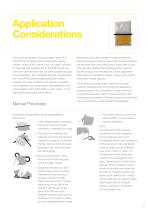
Application Considerations Prior to the application of encapsulation resins it is important to consider what contaminants may be present on the PCB or device. In a ‘no-clean’ process for example, the residues left on the PCB will be noncorrosive however there may be other possible sources of contamination. Any potentially harmful contaminants left on the PCB before encapsulating with a resin material can result in failure of the device. In addition, some residues may cause issues with adhesion of the encapsulation resin to the PCB or outer casing, in turn, reducing the protection level offered. Manual...
Open the catalog to page 9
Application Considerations Bulk Mixing When mixing, care must be taken to avoid the introduction of excessive amounts of air. Automatic mixing equipment is available which will not only mix both the resin and hardener accurately in the correct ratio but do this without introducing air. Containers of Part A (Resin) and Part B (Hardener) should be kept sealed at all times when not in use to prevent the ingress of moisture. Bulk material must be thoroughly mixed before use. Incomplete mixing will result in erratic or partial curing. Electrolube work closely with equipment suppliers to ensure the...
Open the catalog to page 10
ER1122 (Clear Amber) • Excellent adhesion to a wide variety of substrates • Mix ratio can be altered to vary flexibility • Good electrical properties • Can be used as an adhesive or encapsulant ER1426 (Water white) • Excellent clarity • Very low viscosity • Long useable life • Ideal for impregnation applications ER1451 (Clear) and ER1450 (White) • High water resistance • Excellent adhesive properties • Low dielectric constant • Very low viscosity ER2162 (Black) • Exceptional chemical resistance • Ideal for applications where frequent immersion in fuels may occur • Good electrical properties •...
Open the catalog to page 11All ELECTROLUBE catalogs and technical brochures
 Thermal Management
20 Pages
 Conformal Coatings
20 Pages
 Maintenance & Service Aids
16 Pages
 Electrolube Company
8 Pages


Archived catalogs
 Electrolube Product Selector
8 Pages
 Contact Lubricants
16 Pages
 Product Selector Chart
6 Pages
 New products
2 Pages
 Automotive lubricants
4 Pages
 Thermal management
6 Pages
 Electrolube Product Catalogue
36 Pages

- Synthetic lubricant
- High-performance lubricant
- High-temperature lubricant
- Toroidal seal
- Metal lubricant
- Protective coating
- High-temperature oil
- High-temperature grease
- Metal spray
- Synthetic grease
- Lithium grease
- Plastic spray
- Grease for industrial applications
- Hard cleaning job detergent
- Cleaning detergent
- Protective oil
- Grease for the automotive industry
- High-performance grease