
- Catalogs
- ELECTROLUBE
- Electrolube Product Selector


- Company
- Products
- Catalogs
- News & Trends
- Exhibitions
Electrolube Product Selector

Electrolube Product Selector
Overview
This document serves as a comprehensive product selector guide for electro-chemical solutions, focusing on various types of conformal coatings, polyurethane and epoxy resins, silicone compounds, thermal management materials, lubricants, and cleaning agents. It provides detailed specifications, performance parameters, and application recommendations for each product category.
1. Single-Part Conformal Coatings
These coatings are designed for protection of electronic components with a variety of formulations including aromatic-free acrylic, modified alkyd, silicone, urethane, and UV cure types.
- Key Properties: Viscosity ranges from 150 to 550 mPa·s; solids content varies between 2% and 100%; dielectric strength ranges from 17 to 90 kV/mm; temperature operating ranges from -70°C to +200°C depending on product.
- Drying and Curing: Touch dry times vary from 5 to 55 minutes at 20°C; cure times typically 24 hours at 20°C, with some UV cure options offering faster curing.
- Resistance: Good solvent, humidity, and mold resistance; thinners specified per product.
- Approvals: Many products meet IPC-CC-830, UL746, IEC61086, MIL-I-46058C, and BMW GS95011-5 standards.
2. Two-Part Conformal Coatings
These coatings offer enhanced performance such as high temperature resistance, flame retardancy, abrasion resistance, and UV cure capabilities.
- Key Properties: All have 100% solids; viscosity is sprayable; dielectric strength consistently 90 kV/mm; temperature ranges from -65°C to +150°C.
- Curing: Typically cured at 80°C for 10 minutes; touch dry times around 240 minutes at 20°C, except UV cure which is faster.
- Approvals: Some meet BMW GS95011-5 and IPC-CC-830; UL94 V-0 flame retardancy achieved by select products.
3. Polyurethane and Epoxy Resins
These resins provide excellent adhesion, optical clarity, thermal conductivity, and chemical resistance for various applications.
- Properties: Mixed viscosities range from 100 to 30,000 mPa·s; cure times vary from 2 to 48 hours depending on temperature; thermal conductivity ranges from 0.20 to 1.54 W/m·K.
- Temperature Range: Operating temperatures from -70°C up to +210°C (short term max up to +245°C).
- Flame Retardancy: Some products achieve UL94 V-0 rating.
- Specialist Properties: Options include soft, low stress, water resistance, and UL approved formulations.
4. Silicone Compounds for Thermal Management
These compounds are designed for heat transfer applications with varying thermal conductivities and viscosities.
- Thermal Conductivity: Ranges from 0.90 to 3.40 W/m·K.
- Density: Between 2.10 and 3.10 g/ml.
- Temperature Range: -50°C to +230°C depending on product.
- Dielectric Strength: 12 to 42 kV/mm.
- Curing: RTV types require moisture to cure; others are ready to use.
5. Lubricants
Various lubricants are listed with properties tailored for electrical performance, plastic compatibility, and thermal management.
- Temperature Range: From -70°C to +300°C depending on product.
- Penetration and Drop Point: Penetration values around 280-330; drop points mostly at 200°C or higher.
- UV Trace and Oil Versions: Some lubricants have UV traceability and oil variants.
6. Thermal Management Materials
Includes thermal phase change materials, gap pads, and 2-part epoxy/polyurethane/silicone resins designed for heat dissipation.
- Thermal Conductivity: From 1.20 to 5.50 W/m·K.
- Temperature Range: -50°C to +200°C.
- Cure Times: Vary from 1 hour to 24 hours depending on material and temperature.
7. Cleaning Agents
Two categories: aqueous and solvent cleaning agents designed for removal of flux, grease, and other contaminants.
- Aqueous Cleaners: Various formulations with ultrasonic compatibility, pressure wash, spray under immersion, and stencil cleaning capabilities.
- Solvent Cleaners: Include hexane-free, lead-free flux removers, non-flammable solvents, and electronic cleaning solvents with flashpoints ranging from -48°C to >60°C.
- Properties: Density ranges from 0.78 to 1.33 g/ml; evaporation rates and vapor pressures vary widely.
8. General Notes and Contact Information
All data are provided as guidelines without warranty. Testing is recommended prior to production use. Contact details for UK, China, and India manufacturing sites are provided for technical support and orders.
Catalog excerpts

Product Selector Your electro-chemical problems solved
Open the catalog to page 1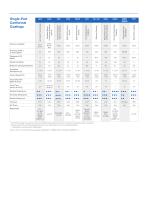
Application and Geometry Dependent. UVCL, AFA, LTC and DCA have passed qualification to BMW Group Standard GS95011-5 The SCC3 range may also be cured at ambient temperature however the solvent resistance will be reduced.
Open the catalog to page 2
For exact calculated ratios please see the technical data sheet.
Open the catalog to page 4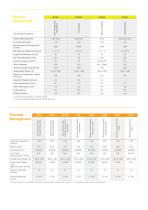
•Requires moisture to cure, elevated temperatures not recommended unless moisture is present. **This information should be used as a guideline only.
Open the catalog to page 5
India Manufacturing No: 73, 6th Main, 3rd Phase Peenya Industrial Area Peenya Bangalore 560058 India T +91 80 2972 3099 E [email protected] China Headquarters / Manufacturing Building No2, Mauhwa Industrial Park, Caida 3rd Street, Caiyuan Industrial Zone, Nancai Township, Shunyi District Beijing, 101300 Peoples Republic of China T +86 (10) 89475123 F +86 (10) 89475123 E [email protected] UK Headquarters / Manufacturing Ashby Park Coalfield Way Ashby de la Zouch Leicestershire LE65 1JR United Kingdom T +44 (0)1530 419600 F +44 (0)1530 416640 E [email protected] www.electrolube.com A...
Open the catalog to page 8All ELECTROLUBE catalogs and technical brochures
 Thermal Management
20 Pages
 Conformal Coatings
20 Pages
 Maintenance & Service Aids
16 Pages
 Polyurethane & Epoxy Resins
16 Pages
 Electrolube Company
8 Pages


Archived catalogs
 Contact Lubricants
16 Pages
 Product Selector Chart
6 Pages
 New products
2 Pages
 Automotive lubricants
4 Pages
 Thermal management
6 Pages
 Electrolube Product Catalogue
36 Pages

- Synthetic lubricant
- High-performance lubricant
- High-temperature lubricant
- Toroidal seal
- Metal lubricant
- Protective coating
- High-temperature oil
- High-temperature grease
- Metal spray
- Synthetic grease
- Lithium grease
- Plastic spray
- Grease for industrial applications
- Hard cleaning job detergent
- Cleaning detergent
- Protective oil
- Grease for the automotive industry
- High-performance grease