

documentation générarale ang
documentation générarale ang
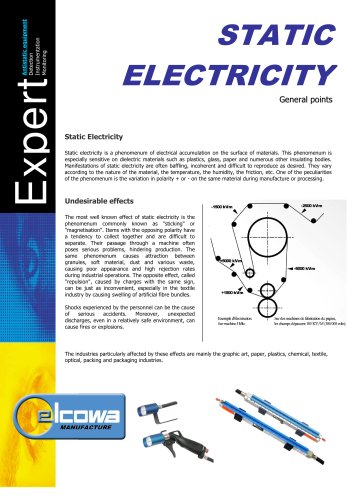
Static electricity refers to the accumulation of electrical charges on the surface of materials, particularly dielectric materials like plastics, glass, and paper. This phenomenon is influenced by factors such as material type, temperature, humidity, and friction. A unique aspect of static electricity is the variation in polarity on the same material during manufacturing or processing.
Static electricity can cause "sticking" or "magnetisation," where items with opposite polarities attract and become difficult to separate, disrupting production. It can also lead to "repulsion," where like charges cause materials to repel each other, problematic in industries like textiles. Additionally, static shocks can cause accidents, and unexpected discharges may lead to fires or explosions. Industries affected include graphic arts, paper, plastics, chemicals, textiles, optics, and packaging.
Neutralizing static charges involves ionizing ambient air to release ions and electrons, which stabilize the material's atoms. The tip effect method, involving a high voltage applied to a tip opposite an earth electrode, is effective for air ionization. Key factors include the number, shape, and layout of electrodes, and the distance between the tip and the earth electrode.
The process is effective for materials in ribbons, sheets, etc., but not for piles or loose quantities. Key installation requirements include:
- Maintaining the correct distance between the electrode and material.
- Treating material after friction occurs, positioning electrodes near problem areas.
- Avoiding contact with machine earth during treatment.
- Ensuring good earth connections for the system's efficiency.
- Using the MCE measuring device to find the ideal electrode position.
Catalog excerpts
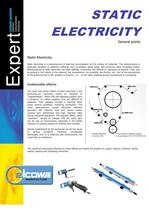
General points Static Electricity Static electricity is a phenomenum of electrical accumulation on the surface of materials. This phenomenum is especially sensitive on dielectric materials such as plastics, glass, paper and numerous other insulating bodies. Manifestations of static electricity are often baffling, incoherent and difficult to reproduce as desired. They vary according to the nature of the material, the temperature, the humidity, the friction, etc. One of the peculiarities of the phenomenum is the variation in polarity + or - on the same material during manufacture or processing. Undesirable effects The most well known effect of static electricity is the phenomenum commonly known as "sticking" or "magnetisation". Items with the opposing polarity have a tendency to collect together and are difficult to separate. Their passage through a machine often poses serious problems, hindering production. The same phenomenum causes attraction between granules, soft material, dust and various waste, causing poor appearance and high rejection rates during industrial operations. The opposite effect, called "repulsion", caused by charges with the same sign, can be just as inconvenient, especially in the textile industry by causing swelling of artificial fibre bundles. Shocks experienced by the personnel can be the cause of serious accidents. Moreover, unexpected discharges, even in a relatively safe environment, can cause fires or explosions. Exemple d'élecmsation I Sur des machines de fabrication du papier, fes champs dépassent 100 KV/M (100 000 volts) The industries particularly affected by these effects are mainly the graphic art, paper, plastics, chemical, textile, optical, packing and packaging industries.
Open the catalog to page 1
Anti-static electricity process In theory, as negative charges are caused by an excess of electrons (negative ions) and positive charges by a lack of them (positive ions), neutralisation of the charges should theoretically be obtained by disposing of an external source of the ions and electrons necessary to stabilise the atoms in the material. This external source of ionic elements can be achieved by causing the ionisation of the ambient air resulting in the freeing of ions and electrons that can be used to neutralise the charges. Of the various air ionisation methods, the one operating by the...
Open the catalog to page 2All ELCOWA catalogs and technical brochures
 ECOVAC 6
2 Pages
 TISP-N
2 Pages
 SC 11
SC 112 Pages
 ECA 11 B
2 Pages
 ECOBLOWER 351-C
2 Pages


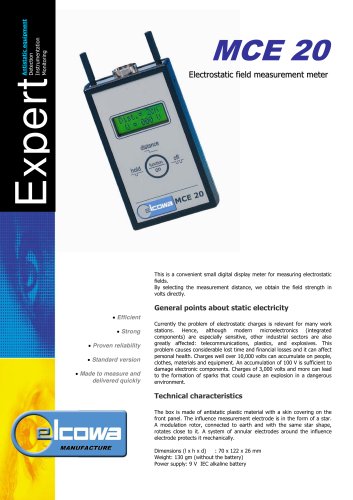




- Measuring device
- Air blower
- Single-stage blower
- Dust collector
- Generator
- Portable gauge
- Air nozzle
- Manual cleaning system
- Air gun
- Blow-off nozzle
- Compact blower
- Compressed air nozzle
- Antistatic bar
- Field measuring instrument
- Analog gauge
- Dust collector for the food industry
- High-voltage generator
- Ionizing nozzle
- Ionizing air blower
- Ionizing air knife