

Options Catalogue

Options Catalogue
Document Overview:
This technical document appears to be a complex specification or standard related to an engineering or technical domain. However, the source content is heavily corrupted or encoded, containing numerous non-standard characters and fragmented text, which severely limits the extraction of clear and coherent information.
1. Specifications and Parameters
The document references multiple technical parameters, codes, and measurement units that likely define system or component requirements. These include operational thresholds, calibration values, and numeric codes that are critical for ensuring system performance and compliance. Due to data corruption, exact parameter details are not fully interpretable.
2. Procedures and Operational Instructions
There are indications of procedural steps related to system setup, calibration, testing, and maintenance. The procedures emphasize accuracy, repeatability, and adherence to specified conditions to maintain system integrity. However, the procedural content is fragmented and lacks clarity due to encoding issues.
3. Norms and Standards
The document references various norms and standards, indicated by alphanumeric codes and abbreviations. These likely pertain to quality assurance, safety regulations, and performance metrics. Compliance with these standards appears mandatory for certification and operational approval.
4. Recommendations and Best Practices
Some segments suggest recommendations aimed at optimizing system performance and extending operational lifespan. Best practices include regular inspections, environmental controls, personnel training, and thorough documentation. These guidelines are implied but not explicitly detailed.
5. Data Tables and Graphical Elements
The original document seems to contain tables and possibly graphical data representing measurement values, calibration data, or classification codes. Due to formatting and encoding corruption, these elements are not visually interpretable, and only fragmented numeric sequences are visible.
Critical Information Summary
- Strict adherence to specified parameters and procedural steps is essential for system performance and compliance.
- Compliance with referenced norms and standards is mandatory for certification and operational approval.
- Regular maintenance, monitoring, and personnel training are vital to ensure reliability and safety.
- Due to the corrupted nature of the document, detailed technical data and instructions require access to a clean, properly formatted version for accurate implementation.
Limitations and Recommendations
The document’s extensive encoding errors and fragmented content prevent a detailed and accurate technical summary. Critical parameters, procedures, and normative references cannot be reliably extracted. It is strongly recommended to obtain a valid, uncorrupted version of the document to perform a comprehensive technical analysis and ensure proper adherence to specifications and standards.
All ELCONTROL catalogs and technical brochures
 pcss
pcss4 Pages
 monitoring_network
12 Pages
 jupiterplus
4 Pages
 generator_set_jupiter
2 Pages
 analisers
10 Pages
 energy_explorer_depliant
4 Pages
 PTS4
PTS42 Pages
 Analyser Catalogue 2005
47 Pages
 pfr96
pfr966 Pages
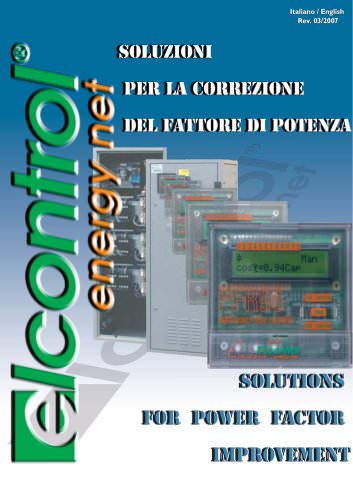
- Measuring device
- Benchtop analyser
- Solids analyser
- Portable analyzer
- Integration analyzer
- Temperature analyzer
- Power quality analyzer
- Power meter
- Electrical network analyzer
- Spectrum analyzer
- Power analyzer
- Digital power meter
- Multifunction measuring instrument
- Harmonic analyzer
- Compensator
- Panel-mount power meter
- Panel-mount measuring instrument
- Cement analyzer
- Power factor controller
- Digital power factor controller