
- Catalogs
- Elatech S.r.l.
- Elatech general catalogue

Elatech general catalogue
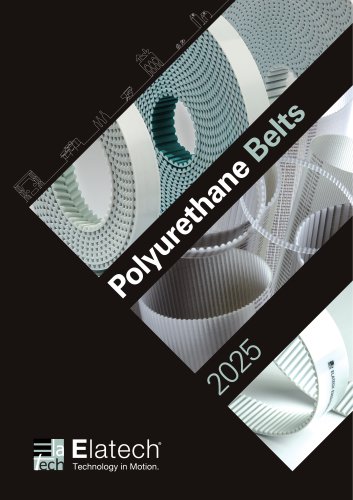
Elatech general catalogue
Materials are categorized based on application suitability, including standard, food contact, high temperature, low temperature, and antistatic applications. Each material type is specified with its belt type, color, hardness, and temperature range.
ELATECH® belts comply with RoHS 2011/65/UE. Options for antistatic properties and special certifications are available upon request. Standard color is white, but other colors can be requested.
Special cords are available to enhance belt performance, including high performance (HPL), high flexibility (HFE), stainless steel, and aramid cords. Each type offers specific benefits such as reduced elongation, increased flexibility, and suitability for aggressive environments.
ELATECH® belts offer excellent dimensional stability, high abrasion resistance, low pretension, and high positioning precision. They are resistant to hydrolysis, ozone, UVA, aging, oils, greases, fats, and gasoline. The standard working temperature range is -10°C to +80°C, with peaks up to 110°C.
ELATECH® timing belts are made of thermoplastic polyurethane with steel tension cords, designed for linear motion, power transmission, and conveying applications. They feature a tooth profile according to ISO 17396 and are available in various pitches and widths.
Includes specifications for tooth shear strength, flexibility, and allowable tensile loads for different belt widths and cord types. Standard tolerances for width, length, and thickness are provided.
Examples are provided for ordering different belt types, including specifications for width, profile, cord type, length, and optional fabric on teeth or back.
The document provides detailed specifications for various types of polyurethane timing belts with steel tension cords. It includes data on belt widths, allowable tensile loads, breaking loads, specific spring rates, and weights for different belt types and materials such as standard steel cord, aramid cord, and stainless steel.
The belts are suitable for linear drives and power transmission applications, offering high axial and angular positioning accuracy. They are available with options for double-sided teeth and negative length tolerance upon request. The document outlines the minimum pulley number of teeth and idler diameters for different drive configurations.
The document provides detailed tables showing the tooth shear strength (FUspez) at various RPMs, indicating how the strength decreases with increasing speed.
The belts offer reduced polygonal effects and drive vibrations. They are particularly suitable for applications requiring high positioning precision. The document also highlights the advantages of using Elatech® M and V belts, such as variable cleat pitch, high shear strength, and quick cleat changes.
The document mentions that other belt widths are available on request and provides information on the allowable tensile load of joined belts, which is 50% of the M - open end.
Standard Tolerances
Width: ±0.5 mm
Length: ±0.5 mm/m
Thickness: ±0.2 mm
Polyurethane timing belts with round tooth profiles and high tensile load tension cords. The tooth profile follows ISO 13050 standards, ensuring uniform load distribution, high performance, and precise tooth engagement. These belts are used in various applications, including linear positioning and power transmission.
- Metric pitch varies (5 mm, 8 mm, 14 mm).
- Double-sided tooth options available on request.
- Standard Steel Cord
- Aramid Cord
- Stainless Steel
- Allowable tensile load (FTzul) and breaking load (FBr) vary by belt width and material.
- Specific spring rate (Cspez) and weight per meter provided for different belt widths.
Data provided for various RPMs, indicating the force per centimeter (FUspez) the belt can withstand.
Minimum pulley teeth and idler diameters specified for drives with and without reverse bending.
High Flexibility (HFE) and High Performance (HPL) options available, with specific load capacities and breaking strengths.
Other belt widths are available upon request, and specific configurations may require consultation with the manufacturer.
- Belt Characteristics The belts feature a round or involute tooth profile according to ISO 13050, with metric pitches of 5 mm, 8 mm, 10 mm, and 14 mm. They are designed for high performance in synchronous lifting, linear positioning, and power transmission applications.
- Materials Options include standard steel cords, aramid cords, and stainless steel cords, each offering different tensile loads and breaking strengths.
- Technical Data The document provides detailed tables of allowable tensile loads (FTzul), breaking loads (FBr), specific spring rates (Cspez), and weights for various belt widths.
- Tooth Shear Strength Data is provided for different RPMs, indicating the force per unit width (FUspez) that the belts can withstand.
- Flexibility and Installation Minimum pulley diameters and the number of teeth required for different drive configurations are specified, with considerations for reverse bending.
- Standard Tolerances Width, length, and thickness tolerances are provided to ensure proper fit and function.
- Special Features Some belts offer self-tracking capabilities, eliminating the need for pulley flanges, and are available in various colors and fabric options for specific applications.
- Belt Construction The belts are made from polyurethane with steel tension cords, featuring different tooth profiles according to ISO standards.
- Dimensions Belt widths range from 32 mm to 180 mm, with specific spring rates and weights provided for each size.
- Performance Allowable tensile loads (FTzul) and breaking loads (FBr) are specified for each belt width, with variations available for standard and aramid cords.
- Flexibility Minimum pulley diameters and number of teeth are specified for both standard and reverse bending drives.
- Tooth Profiles Various profiles such as T5, T10, and AT10 are available, each with specific central guide dimensions to enhance flexibility and performance.
- Standard Tolerances Width, length, and thickness tolerances are provided to ensure precise application and compatibility.
- Special Features Some belts feature self-tracking capabilities, eliminating the need for pulley flanges, and are designed for reduced noise and high torque capacity.
- Conveying and Lifting The belts are suitable for heavy-duty synchronous lifting and conveying applications, offering high operational reliability and precise load distribution.
- Customization Various belt widths and backing options are available upon request, allowing for tailored solutions to specific industrial needs.
- Self-Tracking Timing Belts These belts feature aramid tension cords, a tooth profile according to ISO 17396, and a metric pitch of 10 mm. They are designed for use with small diameter pulleys and do not require pulley flanges.
- Polyurethane Timing Belts Available with steel tension cords, these belts have a metric pitch of 10 mm and are protected against corrosion. They are suitable for corrosive environments and high humidity applications.
- Flat Belts Constructed with polyurethane and steel tension cords, these belts are used in lifting applications without synchronization needs. They allow the use of small diameter pulleys and are maintenance-free.
- Allowable Tensile Load Varies by belt width and type, with specific values provided for different configurations.
- Breaking Load Detailed for each belt type, indicating the maximum load before failure.
- Specific Spring Rate Provided for each belt, indicating the stiffness of the belt under load.
- Weight Specified per meter for each belt type and width.
- Tooth Shear Strength Data provided across a range of RPMs, indicating the strength of the belt teeth under shear forces.
- Flexibility Minimum pulley diameters and number of teeth required for different drive configurations are specified.
- Storage Conditions Belts should be stored in a dry environment with controlled temperature and humidity.
- Installation Guidelines Emphasizes the importance of secure fastening, parallel and rigid shafts, and clean, oil-free components.
- Belt Life Expectancy Following technical specifications can lead to a belt life of 3 million reverse bending cycles over 10 years.
- Total Protection (TP) Belts These belts are designed without tooth gaps to protect against corrosion and are available on demand.
- Heavy Series Belts Developed for the automotive industry, these belts are used for lifting and conveying car bodies.
Elatech® belts are made of polyurethane with steel or aramid tension cords, designed for lifting applications without synchronization needs. They are maintenance-free, allow the use of small diameter pulleys, and come in a standard black color. The belts are available in various widths, with specific tensile load capacities and breaking loads.
The belts have standard width and thickness tolerances, with specific spring rates and weights provided for different belt widths. The allowable tensile load for joined belts is 50% of the open-end belts.
Minimum pulley diameters are specified for drives with and without reverse bending. The belts are designed to reduce pulley diameter and machine room encumbrance, with no lubrication required, low energy consumption, and low noise levels.
The belts are certified according to the Lifts Directive 2014/33/EU and comply with standards EN 81-20:2020 and EN 81-50:2020. The type examination certificate confirms compliance with these standards.
Elatech® belts offer advantages such as abrasion resistance, long service life, and high performance. They are suitable for various industrial applications, including lifting, conveying, and packaging, with options for special cords and coatings.
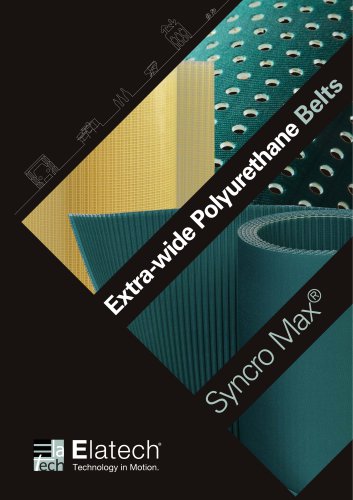
Elatech® offers a range of belt types, including Poly-V belts and SYNCRO MAX® extra-wide belts, with options for different profiles, pitches, and reinforcements. Customizations such as special colors, backings, and perforations are available on request.
The document provides detailed specifications for various types of polyurethane timing belts with steel tension cords. These belts are characterized by their truly endless design, high resistance, low stretch steel cords, and optimized tooth profiles for uniform load distribution and minimal deformation under load. The belts are available in different pitches (10 mm, 15 mm, 20 mm, and imperial pitches) and can transmit power up to 200 kW.
Width tolerance is ±0.5 mm or ±1.0 mm depending on the belt type, and thickness tolerance is ±0.2 mm.
The document includes technical data for different belt widths, including allowable tensile load, weight, and tooth shear strength at various RPMs. The data is presented for different materials such as standard steel cord, aramid cord, stainless steel, and high flexibility options.
The document outlines the minimum pulley number of teeth and minimum idler diameter for drives with and without reverse bending. It also specifies the minimum available length and maximum width for standard executions.
Specialties include options for aramid cord, stainless steel, high flexibility, and high performance, with specific tensile load capacities for each belt width.
For special pulley profiles, it is recommended to contact the Elatech technical department for details. The document also notes the availability of double-sided teeth and dual toothing options on request.
The document outlines specifications for various types of truly endless polyurethane timing belts with high tensile load steel cords and high torque capacity. These belts are designed according to ISO 13050 standards and feature metric pitches of 5 mm, 8 mm, 10 mm, and 14 mm.
The document provides detailed technical data for different belt models, including belt width, allowable tensile load, and weight per meter. For example, the STD5M model has a belt width range from 10 mm to 150 mm, with an allowable tensile load ranging from 1150 N to 16790 N.
Width tolerance is specified as ±0.5 mm to ±1.0 mm, and thickness tolerance is ±0.2 mm to ±0.3 mm, depending on the belt model.
The document specifies the minimum number of teeth and idler diameters required for drives with and without reverse bending for different belt materials such as standard, aramid, stainless, and high flexibility (HFE).
Special cords such as aramid and stainless steel are available, offering different tensile loads. For instance, the ARAMID CORD provides tensile loads ranging from 770 N to 12100 N depending on the belt width.
The document includes tables and graphs showing the relationship between RPM and tooth shear strength (Mspez) and power (Pspez) for different belt models, illustrating how performance varies with speed.
The document suggests using specific belt models for applications requiring reduced noise and compact drive solutions, emphasizing the importance of selecting the right belt width and material for optimal performance.
The document outlines the specifications for various types of polyurethane belts with steel tension cords. Key specifications include width and thickness tolerances, minimum available lengths, and maximum widths. The belts are designed for specific applications such as timing pulleys and conveying systems.
The belts are made from polyurethane and feature steel tension cords. They are self-tracking and have a central guide to enhance flexibility and allow the use of pulleys without flanges. The belts are suitable for applications where side loads are generated, such as loading and unloading processes.
The document provides detailed technical data for different belt widths, including allowable tensile loads and weights. It also includes data on tooth shear strength and power transmission capabilities at various RPMs.
The standard tolerances for width and thickness are specified, ensuring precision in manufacturing and application.
The belts are suitable for a wide range of applications, including power transmission in industrial settings, medical technology, packaging machines, and more. They are designed to operate in environments where cleanliness and chemical resistance are critical.
The iSync® range of belts offers high power transmission capabilities, maintenance-free operation, and superior length stability. They are available with either steel or Kevlar® reinforcement and can operate in temperatures ranging from -10°C to +125°C with special compounds.
The document provides examples of how to order belts based on metric and imperial pitches, including details on length, profile, and width.
The document serves as a comprehensive guide for selecting and utilizing polyurethane belts in various industrial applications, emphasizing their flexibility, strength, and adaptability to different operational requirements.
The document provides detailed specifications for various types of truly endless polyurethane timing belts with steel tension cords. These belts are designed with a tooth profile according to ISO 17396 and are available in metric pitches of 5 mm and 10 mm. They are ideal for applications requiring high flexibility and the use of small diameter pulleys.
The belts are available in different widths, each with specific allowable tensile loads and weights. For example, a belt with a width of 10 mm has an allowable tensile load of 430 N and weighs 24 g/m. The document also provides data on tooth shear strength across various RPMs, indicating the Mspez (Ncm/cm) and Pspez (W/cm) values.
The standard tolerances for belt width and thickness are provided, with width tolerances of ±0.3 mm to ±0.5 mm and thickness tolerances of ±0.15 mm to ±0.2 mm.
The document outlines the minimum number of teeth and idler diameters required for drives with and without reverse bending. For instance, a standard drive without reverse bending requires a minimum of 10 teeth and a 30 mm idler diameter.
ELATECH® belts are highlighted for their suitability in conveying applications, offering a wide range of backings in different materials. The document discusses the importance of selecting the correct backing for temperature resistance and friction coefficient, as well as the possibility of custom colors and chemical resistance.
The document describes various covering materials, including polyamide fabric backings that reduce friction and noise in high-speed drives. It also provides coefficients of static friction for different material combinations, such as polyurethane on steel and polyamide on aluminum.
The document provides comprehensive technical data and guidelines for selecting and using polyurethane timing belts in various industrial applications, emphasizing flexibility, durability, and customization options.
- RPD14M XHPL: Special pulley profile required, with measurements ranging from 389.37 mm to 531.97 mm for da and 392.15 mm to 534.75 mm for dw.
- STD5M: Measurements range from 44.46 mm to 304.20 mm for da and 45.83 mm to 305.57 mm for dw.
- STD8M: Measurements range from 139.88 mm to 531.97 mm for da and 142.59 mm to 534.75 mm for dw.
- EAGLE5M: Measurements range from 49.56 mm to 304.20 mm for da and 50.93 mm to 305.57 mm for dw.
- EAGLE8M: Measurements range from 77.58 mm to 379.96 mm for da and 79.58 mm to 381.96 mm for dw.
- EAGLE10M: Measurements range from 139.88 mm to 531.97 mm for da and 142.59 mm to 534.75 mm for dw.
- TK5 K6: Measurements range from 21.45 mm to 190.21 mm for da and 22.29 mm to 191.04 mm for dw.
The document provides detailed specifications for timing pulleys and belts, including measurements for various diameters (da and dw) and the number of teeth (z). These specifications are crucial for ensuring compatibility and performance in mechanical systems.
This section addresses common issues with belts and pulleys, such as tooth jumping, abnormal noise, side abrasion, and breakage. It provides causes and remedies for each problem, emphasizing the importance of correct tension, alignment, and design modifications to prevent and resolve issues.
The document includes a disclaimer stating that the information is for informational purposes only and subject to change. It also highlights that ELATECH is a registered trademark and that the belts are manufactured in Italy.
Contact details for ELATECH and its global distributors are provided, including addresses, phone numbers, and email addresses for locations in Italy, France, Switzerland, Germany, China, India, and the United States.
Catalog excerpts
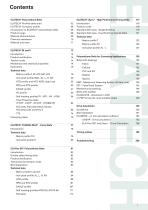
ELATECH® Polyurethane Belts ELATECH® Profiles table chart 02 ELATECH® Company profile 04 Introduction to ELATECH® polyurethane belts 08 Mechanical and chemical properties 14 Technical data • Inch pitch profile MXL, XL, L, H, XH 30 • HTD profile and HTD XHPL high load 35 • Self tracking profilesTK - ATK - HK - ATKK 54 • Total Protection belts • Flat belts, Flat belts Heavy Series, Flat belts (Lift) and Poly-V 66 ELATECH® SYNCRO MAX® - Extra-Wide 77 Technical data • Inch pitch profile H 80 ELATECH® iSync® - High Performance Timing Belts 117 Standard belt sizes - Single Toothing 119 Standard belt...
Open the catalog to page 2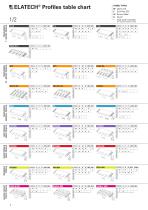
sELATECH® Profiles table chart FAMILY TYPES * Dual tooth available (on request for special cords)
Open the catalog to page 3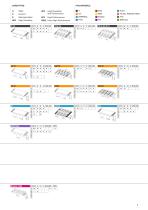
CORD TYPES HPF High Flexibility and Performance HPL High Performance XHPL Extra High Performance
Open the catalog to page 4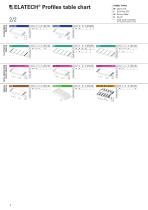
sELATECH® Profiles table chart FAMILY TYPES * Dual tooth available (on request for special cords)
Open the catalog to page 5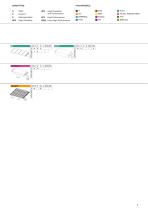
CORD TYPES HPF High Flexibility and Performance HPL High Performance XHPL Extra High Performance ■ STD■ RPD■ EAGLE ■ PG
Open the catalog to page 6
Global Presence With 6 sister Companies on 3 continents and a wide range of qualified distributors, ELATECH® guarantees superior technical and delivery service worldwide. ELATECH® is a Company fully dedicated to the research, development and manufacture of polyurethane belts for industrial applications. The unique manufacturing processes, made possible with the newest generation of technologies, the modern and efficient test and control equipment and a unique team of qualified technicians and engineers, allow ELATECH® to offer superior products with highest flexible service. Constantly growing,...
Open the catalog to page 7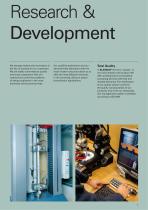
Research & Development We strongly believe that innovation is the key to success for our customers. We are totally committed to quality and close cooperation with our customers to solve the problems of design engineers in the most advanced and economical way. Our qualified technicians and our advanced test laboratory with the most modern resources allow us to offer the most effective solutions in all conveying, lifting or power transmission applications. Total Quality In ELATECH® the term “quality” is not only limited to the product. We offer professional and competent consulting services with...
Open the catalog to page 8
Introduction ELATECH® manufactures polyurethane belts for linear motion, conveying, lifting and power transmission applications. The combination of a polyurethane body reinforced with special steel or aramid tension members, allows the belt to fulfil the most severe requirements in all industrial applications. The unique manufacturing processes developed with the newest generation technologies such as test and control equipment, give us the ability to deliver superior products with the highest flexibility of service. ELATECH® offers the widest range of tooth profile to enable the design engineer...
Open the catalog to page 9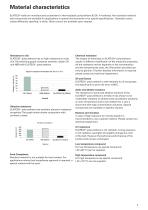
Material characteristics ELATECH® belts are manufactured as standard in thermoplastic polyurethane 92 Sh. A hardness. Non standard material and compounds are available for applications in special environments or for special specifications. Standard colour, unless differently specified, is white. Other colours are available upon request. Resistance to oils ELATECH® polyurethane has an high resistance to most oils. The following graph compares synthetic rubber CR and NBR with ELATECH® polyurethane. Chemical resistance The impact of chemicals on ELATECH® polyurethane results in different modification...
Open the catalog to page 10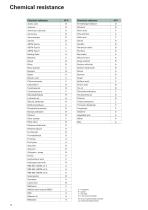
Chemical reference A = excellent B = good C = limited For any request please contact our technical department.
Open the catalog to page 11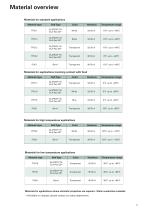
Materials for standard applications Materials for applications where antistatic properties are required - Static conductive materials ^ Available on request, please contact our sales department.
Open the catalog to page 12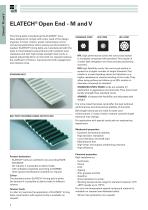
The timing belts manufactured by ELATECH® have been designed to comply with every need of the design engineer in linear motion, power transmission and in conveying applications where precise synchronisation is needed. ELATECH® timing belts are manufactured with the body in thermoplastic polyurethane with excellent wear resistance and with high tensile strength steel cords. A special polyamide fabric on the tooth (on request) reduces the coefficient of friction, improves the tooth engagement and reduces noise. • ELATECH® belts are certified to be according RoHS 2011/65/UE • On request, it is possible...
Open the catalog to page 15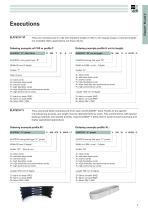
They are manufactured in rolls with standard length of 100 m. On request longer or shorter lengths are available. Main applications are linear drives. Ordering example roll 100 m profile T: ELATECH® “R”- Roll 100 m Ordering example profile H cut to length: T ELATECH® timing belt type “R” ELATECH timing belt type “M” A= steel cords S= stainless steel cords K= aramid cords F= high flexibility cords H= high flexibility and performance cords P= high performance cords A= steel cords S= stainless steel cords K= aramid cords F= high flexibility cords H= high flexibility and performance cords P= high performance...
Open the catalog to page 16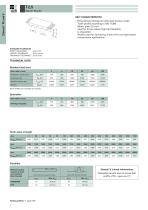
BELT CHARACTERISTICS • Polyurethane timing belt with steel tension cords • Tooth profile according to ISO 17396 • Ideal for drives where high belt flexibility is requested • Widely used for conveying, linear drive and light power transmission applications STANDARD TOLERANCES Standard steel cord Belt width b [mm] Other widths are available on request Specialties Belt width b [mm] Tooth shear strength Flexibility Minimum pulley number of teeth and minimum idler diameter Elatech® V Joined informations Allowable tensile load of joined belt is 50% of M - open end [*] Timing pulleys ^ page 160
Open the catalog to page 17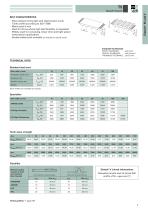
BELT CHARACTERISTICS • Polyurethane timing belt with steel tension cords • Tooth profile according to ISO 17396 • Ideal for drives where high belt flexibility is requested • Widely used for conveying, linear drive and light power transmission applications • Double sided tooth available (on request for special cords) STANDARD TOLERANCES TECHNICAL DATAStandard steel cord Belt width b [mm] Other widths are available on request Specialties Belt width b [mm] Tooth shear strength Flexibility Minimum pulley number of teeth and minimum idler diameter Elatech® V Joined informations Allowable tensile load...
Open the catalog to page 18All Elatech S.r.l. catalogs and technical brochures
 Elatech M and V
63 Pages
 ELA -flex SD
35 Pages
 SYNCRO MAX (2025)
4 Pages
 iSync
iSync12 Pages
 Conveying Applications
19 Pages
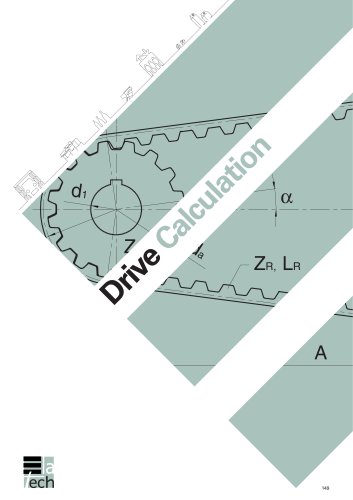 Drive Calculation
61 Pages
 Products Overview
28 Pages
 EAGLE
EAGLE6 Pages
 ELAClean
6 Pages
 Elatech ATF
4 Pages
 Elatech EMF
4 Pages
 Elatech F3 -LIFT
4 Pages
 Elatech TP
4 Pages
Archived catalogs
 Syncro Max
4 Pages
- Elatech transmission belt
- Conveying belt
- Elatech industrial belt
- Plastic conveyor belt
- Rubber strip
- Industrial conveyor belt
- Industrial belt
- Elatech plastic belt
- Timing belt
- Conveyor belt for the food industry
- Sturdy belt
- Elatech synchronous belt
- Food conveyor belt
- Process conveyor belt
- Machines belt
- Flexible power transmission belt
- High-performance belt
- Oil-resistant belt