


UltraFlux Custom
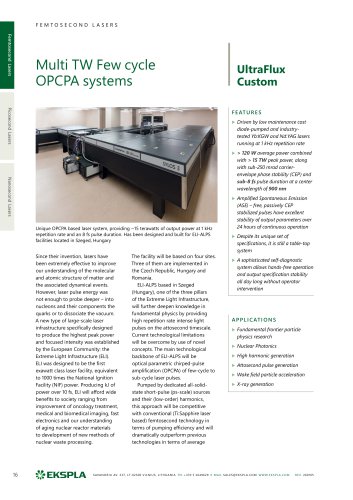
UltraFlux Custom
This document provides an overview of femtosecond lasers, specifically focusing on the Extreme Light Infrastructure (ELI) and its applications in advanced scientific research. The ELI is a large-scale laser infrastructure designed to produce the highest peak power and focused intensity, facilitating advancements in various fields such as oncology, medical imaging, and nuclear waste processing.
Applications
The document highlights several applications of femtosecond lasers, including fundamental frontier particle physics research, nuclear photonics, high harmonic generation, attosecond pulse generation, wake field particle acceleration, and X-ray generation. These applications demonstrate the versatility and importance of femtosecond lasers in advancing scientific knowledge and technology.
Extreme Light Infrastructure (ELI)
ELI is the first exawatt class laser facility, designed to produce kJ of power over 10 fs. It consists of four sites, with three located in the Czech Republic, Hungary, and Romania. ELI-ALPS in Szeged, Hungary, is a key component, focusing on high repetition rate intense light pulses on the attosecond timescale. The facility employs Optical Parametric Chirped-Pulse Amplification (OPCPA) technology to overcome current technological limitations.
Features of ELI-ALPS
The ELI-ALPS laser system features a unique OPCPA-based laser system providing ~15 terawatts of output power at a 1 kHz repetition rate and an 8 fs pulse duration. It is driven by low maintenance cost diode-pumped Yb:KGW and Nd:YAG lasers, offering > 120 W average power and > 15 TW peak power. The system is designed for stability and hands-free operation, with a sophisticated self-diagnostic system.
Specifications
The document provides detailed specifications for two models, FF401k-F8-CEP and FF1201k-F8-CEP, including output energy, peak pulse power, pulse repetition rate, wavelength, pulse duration, and stability parameters. Both models offer high precision and stability, essential for advanced scientific experiments.
Performance and Stability
The ELI-ALPS laser system is noted for its high stability and precision, crucial for experiments requiring high uptime. The system's stability is ensured through industry-tested technologies and components, with design and manufacturing carried out in Vilnius.
Operating Requirements
The document outlines the operating requirements for the laser systems, including electrical power, water supply, ambient temperature, and room cleanliness. These requirements ensure optimal performance and longevity of the laser systems.
Conclusion
The ELI-ALPS laser system represents a significant advancement in laser technology, offering unparalleled power and precision for scientific research. Its applications in various fields highlight its potential to drive future technological developments.
Catalog excerpts

FEMTOSECOND LASERS Femtosecond Femtosecond Lasers Lasers Multi TW Few cycle OPCPA systems Picosecond Lasers Nanosecond Lasers Unique OPCPA based laser system, providing ~15 terawatts of output power at 1 kHz repetition rate and an 8 fs pulse duration. Has been designed and built for ELI-ALPS facilities located in Szeged, Hungary Since their invention, lasers have been extremely effective to improve our understanding of the molecular and atomic structure of matter and the associated dynamical events. However, laser pulse energy was not enough to probe deeper – into nucleons and their components the quarks or to dissociate the vacuum. A new type of large-scale laser infrastructure specifically designed to produce the highest peak power and focused intensity was established by the European Community: the Extreme Light Infrastructure (ELI). ELI was designed to be the first exawatt class laser facility, equivalent to 1000 times the National Ignition Facility (NIF) power. Producing kJ of power over 10 fs, ELI will afford wide benefits to society ranging from improvement of oncology treatment, medical and biomedical imaging, fast electronics and our understanding of aging nuclear reactor materials to development of new methods of nuclear waste processing. UltraFlux Custom The facility will be based on four sites. Three of them are implemented in the Czech Republic, Hungary and Romania. ELI-ALPS based in Szeged (Hungary), one of the three pillars of the Extreme Light Infrastructure, will further deepen knowledge in fundamental physics by providing high repetition rate intense light pulses on the attosecond timescale. Current technological limitations will be overcome by use of novel concepts. The main technological backbone of ELI-ALPS will be optical parametric chirped-pulse amplification (OPCPA) of few-cycle to sub-cycle laser pulses. Pumped by dedicated all-solidstate short-pulse (ps-scale) sources and their (low-order) harmonics, this approach will be competitive with conventional (Ti:Sapphire laser based) femtosecond technology in terms of pumping efficiency and will dramatically outperform previous technologies in terms of average Driven by low maintenance cost diode-pumped and industrytested Yb:KGW and Nd:YAG lasers running at 1 kHz repetition rate > 120 W average power combined with > 15 TW peak power, along with sub-250 mrad carrierenvelope phase stability (CEP) and sub-8 fs pulse duration at a center wavelength of 900 nm Amplified Spontaneous Emission (ASE) – free, passively CEP stabilized pulses have excellent stability of output parameters over 24 hours of continuous operation Despite its unique set of specifications, it is still a table-top system A sophisticated self-diagnostic system allows hands-free operation and output specification stability all day long without operator intervention Fundamental frontier particle physics research Nuclear Photonics Attosecond pulse generation X-ray generation High harmonic generation Wake field particle acceleration
Open the catalog to page 1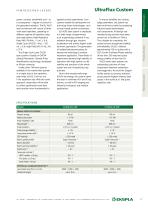
FEMTOSECOND LASERS power, contrast, bandwidth, and - as a consequence - degree of control of the generated radiation. The ELI-ALPS laser architecture will consist of three main laser beamlines, operating at different regimes of repetition rates and peak powers: High Repetition Rate (HR): 100 kHz, > 5 mJ, < 6 fs, Single Cycle (SYLOS): 1 kHz, > 120 mJ, < 8 fs, High Field (HF): 10 Hz, 34 J, < 17 fs. The Single Cycle Laser SYLOS laser system is based on OPCPA (Optical Parametric Chirped-Pulse Amplification) technology, developed at Vilnius university. Unlike other TW-level systems available in the...
Open the catalog to page 2
FEMTOSECOND LASERS Model FF401k-F8-CEP FF1201k-F8-CEP Picosecond Lasers Nanosecond Lasers specifications are subject to change without notice. The parameters marked 'typical' are indications of typical performance and will vary with each unit we manufacture. Presented parameters can be customized to meet customer's requirements. 2) Central wavelength is calculated as the power-weighted mean frequency from measured spectrum in frequency domain. 3) Under stable environmental conditions, normalized to average pulse energy (RMS, averaged from 30 s). 4) Measured over 8 hours period after 30 min warm-up...
Open the catalog to page 3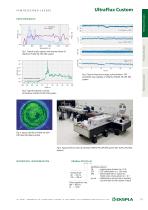
Strehl ratio Fig 1. Typical output spectra and spectral phase of UltraFlux FF401k-F8-CEP-DM system 10⁰ Autocorrelator noise level Fig 3. Typical long-term energy, pulse duration, CEP and Strehl ratio stability of UltraFlux FF401k-F8-CEP-DM system Picosecond Lasers Fig 2. Typical temporal contrast of UltraFlux FF401k-F8-CEP-DM system Nanosecond Lasers Spectrum Phase Femtosecond Femtosecond Lasers Lasers UltraFlux Custom FEMTOSECOND LASERS Fig 4. Typical UltraFlux FF401k-F8-CEPDM near field beam profile Fig 5. Typical external view of UltraFlux FF401k-F8-CEP-DM system (ELI-ALPS, SYLOS2A system)...
Open the catalog to page 4All EKSPLA catalogs and technical brochures
 Scanning SFG Spectrometer
14 Pages
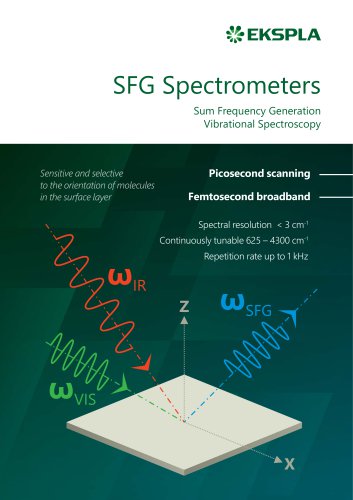 Broadband SFG Spectrometer
14 Pages
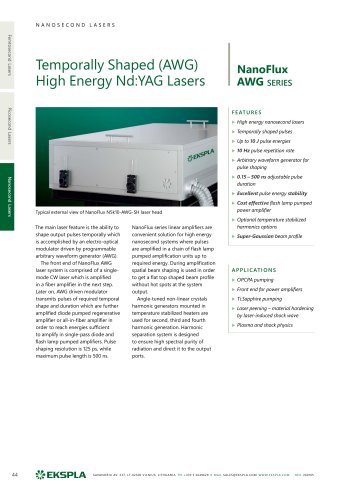 NanoFlux AWG series
4 Pages
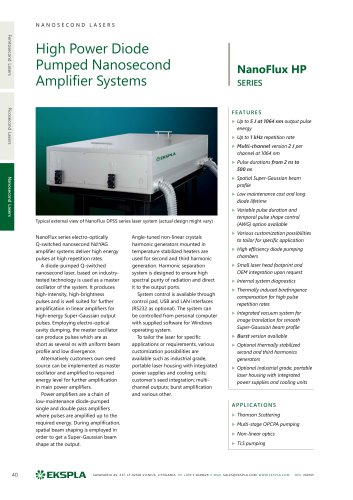 NanoFlux HP series
4 Pages
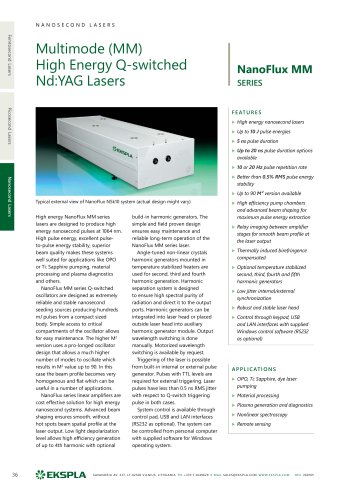 NanoFLux MM series
4 Pages
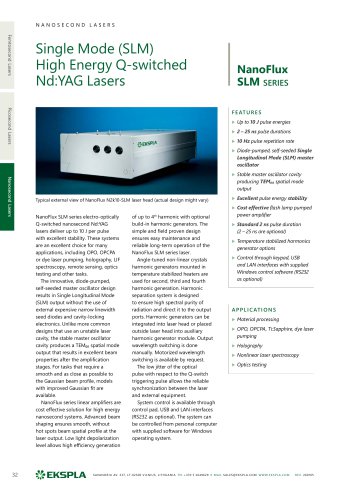 NanoFlux SLM series
4 Pages
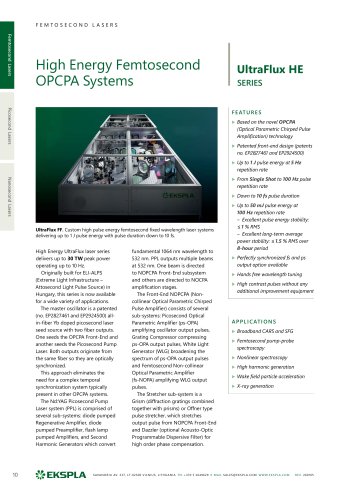 UltraFlux HE series
6 Pages
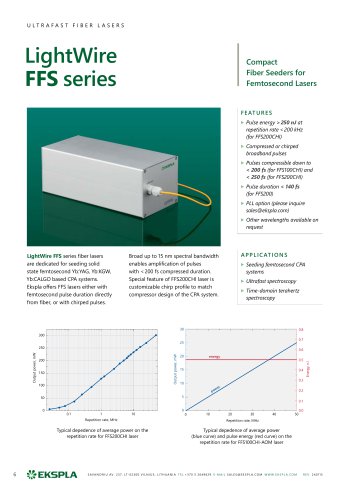 LightWire FFS series
4 Pages
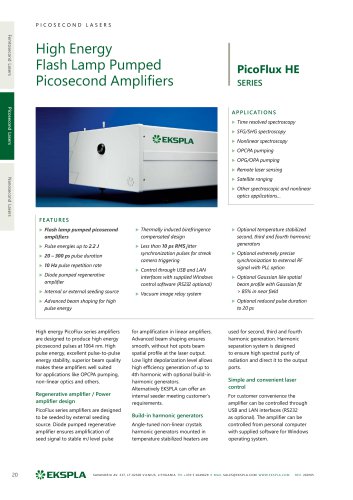 PicoFlux HE series
4 Pages
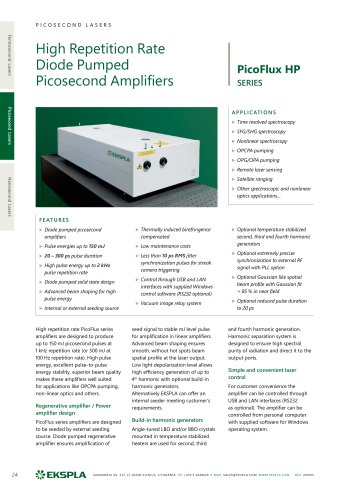 PicoFlux HP series
4 Pages
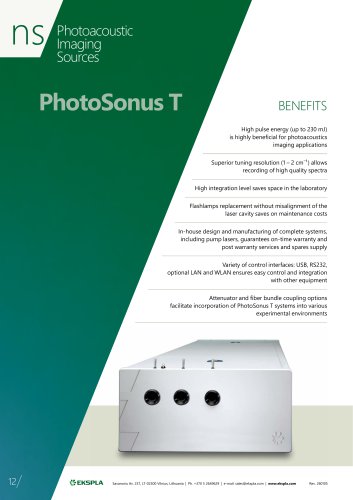 PhotoSonus T
4 Pages
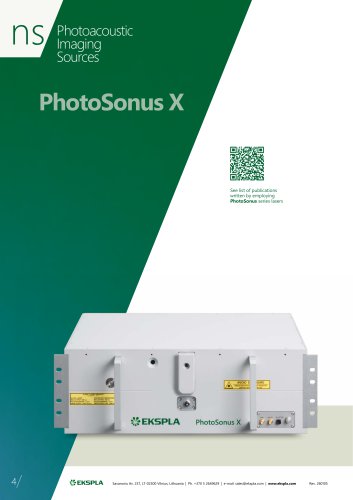 PhotoSonus X
4 Pages
 FemtoLux
20 Pages
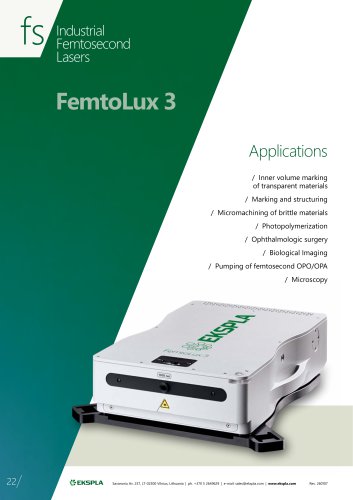 FemtoLux 3
6 Pages
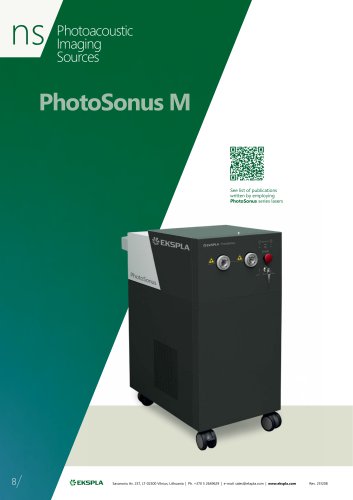 PhotoSonus M
4 Pages
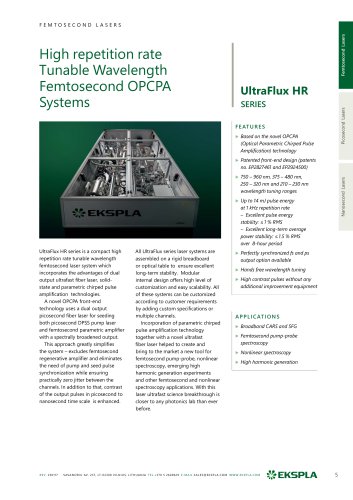 UltraFlux HR SERIES
5 Pages
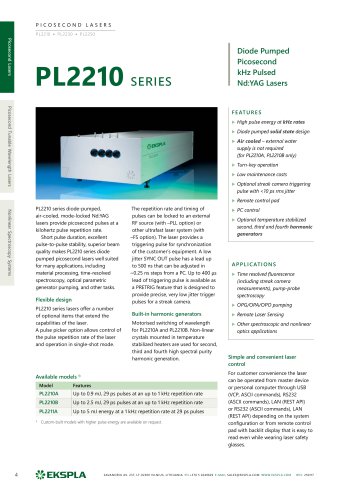 PL2210 series
3 Pages
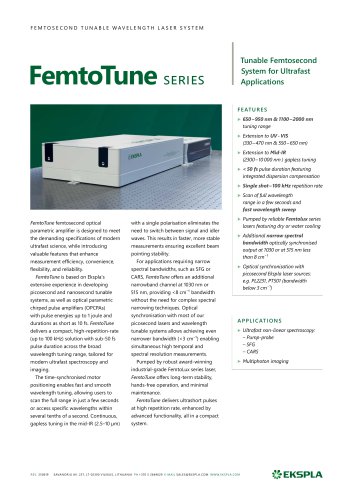 FemtoTune series
4 Pages
 Material processing examples
16 Pages
- Kiln
- Chamber kiln
- Electric furnace
- Spectrometer
- Signal amplifying integrated circuit
- Generator
- High-temperature oven
- Automatic kiln
- Digital oven
- Benchtop spectrometer
- Custom-made oven
- Benchtop oven
- High-resolution spectrometer
- High-sensitivity spectrometer
- Laser module
- Digital generator
- Laser source
- Analysis oven
- Spectrometer for scientific applications
- Laboratory generator