


PL2210 series
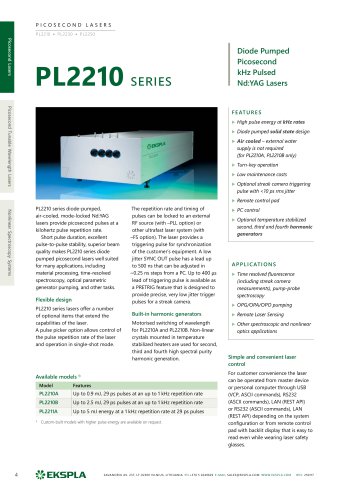
PL2210 series
The document provides detailed information about the PL2210 series of diode-pumped, air-cooled, mode-locked Nd:YAG lasers, which are designed for generating picosecond pulses at kilohertz repetition rates. These lasers are suitable for various applications including time-resolved spectroscopy, optical parametric generator pumping, and material processing.
Features
- High pulse energy at kilohertz rates.
- Diode-pumped solid-state design with air cooling, eliminating the need for external water supply (for PL2210A and PL2210B models).
- Turn-key operation with low maintenance costs.
- Optional streak camera triggering pulse with less than 10 ps rms jitter.
- Remote control pad and PC control capabilities.
- Optional temperature-stabilized harmonic generators for second, third, and fourth harmonics.
Applications
- Time-resolved fluorescence and pump-probe spectroscopy.
- OPG/OPA/OPO pumping.
- Remote laser sensing and other spectroscopic and nonlinear optics applications.
Specifications
- Output energy varies by model and wavelength, with maximum energy at 1064 nm being 5 mJ for the PL2211A model.
- Pulse duration is 29 ± 5 ps with a repetition rate of 1 kHz.
- Beam characteristics include close to Gaussian spatial mode, less than 1 mrad beam divergence, and linear polarization greater than 100:1.
- Physical dimensions and power requirements are specified for different models.
Options
- PRETRIG feature for low jitter pulse synchronization.
- P80 and P20 options for different pulse durations (80 ps and 20 ps respectively).
- PC option for pulse repetition rate control and reduction of low-intensity background.
Safety and Operating Requirements
- Class IV laser product with necessary precautions to avoid exposure to direct or scattered radiation.
- Operating conditions include air cooling, specific humidity, and temperature requirements.
- Continuous connection to mains electricity is required, with a warm-up period needed if disconnected for over an hour.
Ordering Information
Models can be customized with various harmonic generator and pulse duration options, as well as additional features like pulse picker and repetition rate locking.
Catalog excerpts
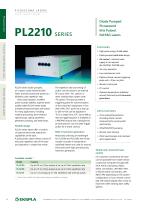
PICOSECOND LASERS Diode Pumped Picosecond kHz Pulsed Nd:YAG Lasers PL2210 SERIES Picosecond Tunable Wavelength Lasers Nonlinear Spectroscopy Systems 1 Custom-built models with higher pulse energy are available on request. ► High pulse energy at kHz rates ► Diode pumped solid state design ► Air cooled - external water supply is not required ► Optional streak camera triggering pulse with <10 ps rms jitter ► Optional temperature stabilized second, third and fourth harmonic generators ► Time resolved fluorescence (including streak camera measurements), pump-probe spectroscopy ► Remote Laser Sensing ► Other spectroscopic and nonlinear optics applications PL2210 series diode-pumped, air-cooled, mode-locked Nd:YAG lasers provide picosecond pulses at a kilohertz pulse repetition rate. Short pulse duration, excellent pulse-to-pulse stability, superior beam quality makes PL2210 series diode pumped picosecond lasers well suited for many applications, including material processing, time-resolved spectroscopy, optical parametric generator pumping, and other tasks. PL2210 series lasers offer a number of optional items that extend the capabilities of the laser. A pulse picker option allows control of the pulse repetition rate of the laser and operation in single-shot mode. The repetition rate and timing of pulses can be locked to an external RF source (with —PLL option) or other ultrafast laser system (with -FS option). The laser provides a triggering pulse for synchronization of the customer's equipment. A low jitter SYNC OUT pulse has a lead up to 500 ns that can be adjusted in ~0.25 ns steps from a PC. Up to 400 ps lead of triggering pulse is available as a PRETRIG feature that is designed to provide precise, very low jitter trigger pulses for a streak camera. Motorised switching of wavelength for PL2210A and PL2210B. Non-linear crystals mounted in temperature stabilized heaters are used for second, third and fourth high spectral purity harmonic generation. For customer convenience the laser can be operated from master device or personal computer through USB (VCP, ASCII commands), RS232 (ASCII commands), LAN (REST API) or RS232 (ASCII commands), LAN (REST API) depending on the system configuration or from remote control pad with backlit display that is easy to read even while wearing laser safety glasses. v EK5PLA 4 SAVANORIU AV. 237, LT-02300 VILNIUS, LITHUANIA PH +370 5 2649629 E-MAIL [email protected] WWW.EKSPLA.COM REV. 2
Open the catalog to page 1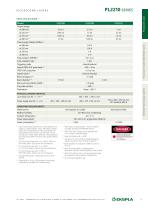
PICOSECOND LASERS PHYSICAL CHARACTERISTICS OPERATING REQUIREMENTS Nonlinear Spectroscopy Systems Picosecond Tunable Wavelength Lasers 7) With respect to optical pulse. <10 ps rms jitter is provided optionally with PRETRIG feature. 8) TRIG1 OUT lead or delay can be adjusted with 0.25 ns steps in specified range. 9) Near field Gaussian fit is >90%. 10) Average of X- and Y-plane full angle divergence values measured at the 1/e1 2 level at 1064 nm. 11) Beam diameter is measured at 1064 nm at the 1/ e2 point. 12) Beam pointing stability is evaluated from fluctuations of beam centroid position in the...
Open the catalog to page 2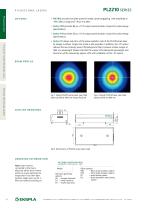
PICOSECOND LASERS Picosecond Picosecond Lasers Picosecond Tunable Wavelength Lasers PRETRIG provides low jitter pulse for streak camera triggering with lead/delay in -400...600 μs range and <10 ps rms jitter. Option P80 provides 80 ps ± 10 % output pulse duration. Inquire for pulse energy specifications. Option P20 provides 20 ps ± 10 % output pulse duration. Inquire for pulse energy specifications. Option PC allows reduction of the pulse repetition rate of the PL2210 series laser by integer numbers. Single shot mode is also possible. In addition, the –PC option reduces the low-intensity quasi-CW...
Open the catalog to page 3All EKSPLA catalogs and technical brochures
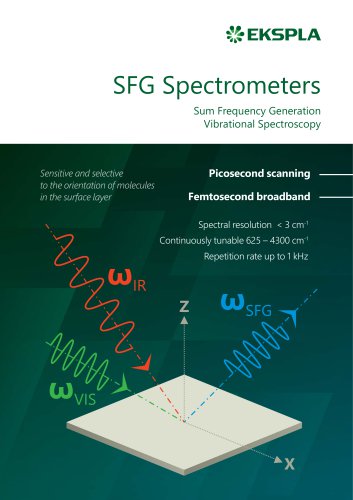 Scanning SFG Spectrometer
14 Pages
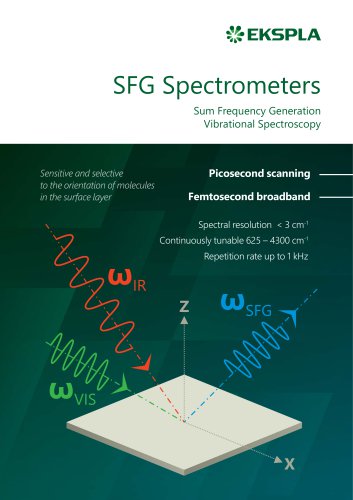 Broadband SFG Spectrometer
14 Pages
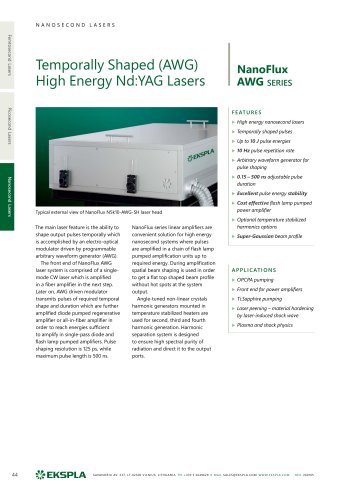 NanoFlux AWG series
4 Pages
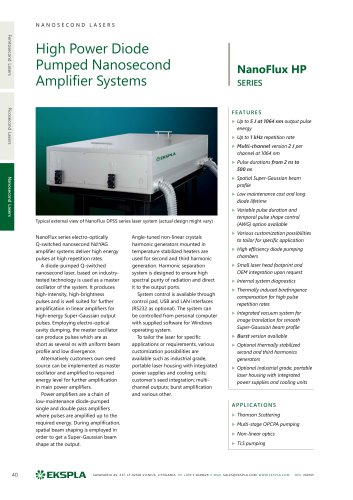 NanoFlux HP series
4 Pages
 NanoFLux MM series
4 Pages
 NanoFlux SLM series
4 Pages
 UltraFlux Custom
4 Pages
 UltraFlux HE series
6 Pages
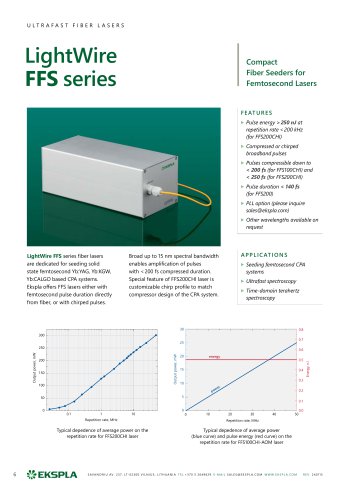 LightWire FFS series
4 Pages
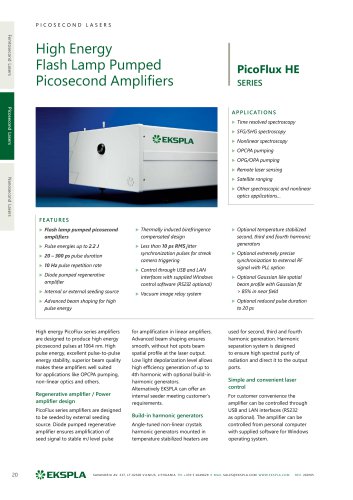 PicoFlux HE series
4 Pages
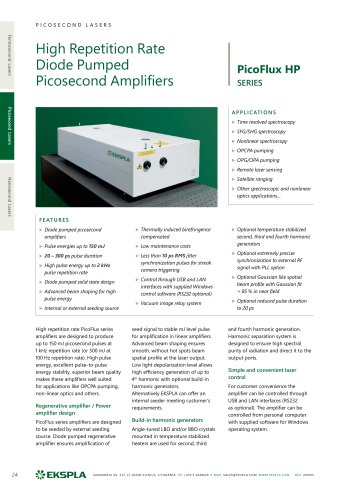 PicoFlux HP series
4 Pages
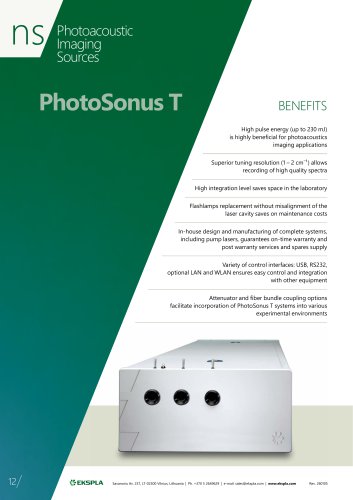 PhotoSonus T
4 Pages
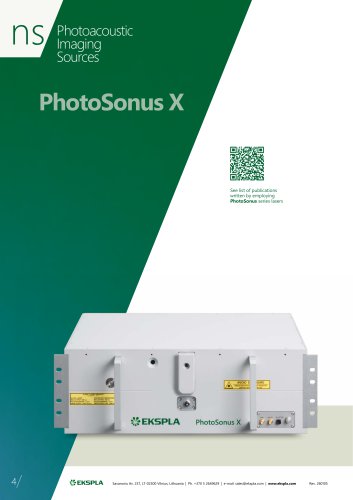 PhotoSonus X
4 Pages
 FemtoLux
20 Pages
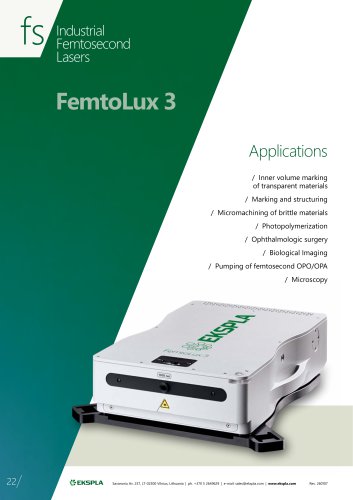 FemtoLux 3
6 Pages
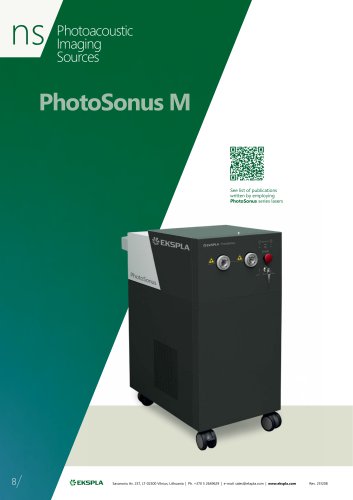 PhotoSonus M
4 Pages
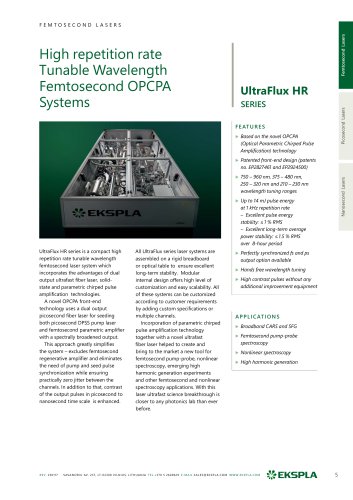 UltraFlux HR SERIES
5 Pages
 FemtoTune series
4 Pages
 Material processing examples
16 Pages
- Kiln
- Chamber kiln
- Electric furnace
- Spectrometer
- Signal amplifying integrated circuit
- High-temperature oven
- Automatic kiln
- Digital oven
- Benchtop spectrometer
- Custom-made oven
- Benchtop oven
- High-resolution spectrometer
- High-sensitivity spectrometer
- Laser module
- Digital generator
- Laser source
- Analysis oven
- Spectrometer for scientific applications
- Laboratory generator