


PhotoSonus T
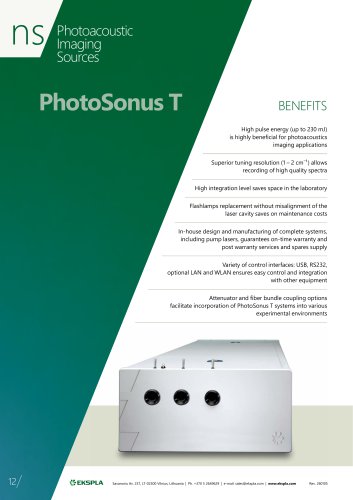
PhotoSonus T
- Wavelength range: 330-2600 nm
- Pulse duration: 3-5 ns
- Beam diameter: 7-9 mm
- Operating temperature: 18-27°C
- Power requirements: 200-240 VAC, single phase
Catalog excerpts

Photoacoustic Imaging Sources BENEFITS High pulse energy (up to 230 mJ) is highly beneficial for photoacoustics imaging applications Superior tuning resolution (1 – 2 cm⁻¹) allows recording of high quality spectra High integration level saves space in the laboratory Flashlamps replacement without misalignment of the laser cavity saves on maintenance costs In-house design and manufacturing of complete systems, including pump lasers, guarantees on-time warranty and post warranty services and spares supply Variety of control interfaces: USB, RS232, optional LAN and WLAN ensures easy control and integration with other equipment Attenuator and fiber bundle coupling options facilitate incorporation of PhotoSonus T systems into various experimental environments Savanoriu Av. 237, LT-02300 Vilnius, Lithuania | Ph. +370 5 2649629 | e-mail: [email protected] | www.ekspla.com
Open the catalog to page 1
High Energy Table-Top Tunable Wavelength Lasers for Photoacoustic Imaging PhotoSonus T series tunable laser seamlessly integrates in a compact housing a nanosecond optical parametric oscillator and Nd:YAG Q-switched laser. Three models with different output pulse energy values and different repetition rates are offered. The most powerful model has more than 230 mJ pulse energy. Narrow linewidth (<10 cm⁻¹) is nearly constant trough almost whole tuning range, which makes laser suitable for many spectroscopy application. The device is controlled from the remote keypad or PC using LabVIEW™ drivers...
Open the catalog to page 2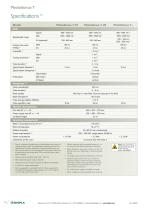
Typical beam diameter 8) 7 mm 7 mm 9 mm Typical beam divergence 9) Signal beam Idler beam Pump laser 10) Pump wavelength Pulse duration "Hat-Top" in near field. Close to Gaussian in far field Beam divergence Pulse energy stability (StdDev) Pulse repetition rate Physical characteristics Unit size (W x L x H) Power supply size (W x L x H) Umbilical length Operating requirements Water consumption (max 20 °C) ' Room temperature Relative humidity Power consumption Due to continuous improvement, all specifications are subject to change without notice. The parameters marked typical are not specifications....
Open the catalog to page 3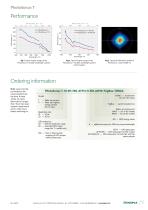
Fig 1. Typical output energy of the PhotoSonus T tunable wavelength systems Fig 2. Typical output energy of the PhotoSonus T tunable wavelength systems with SH option Fig 3. Typical far field beam profile of PhotoSonus T laser at 800 nm Ordering information Note: Laser must be connected to the mains electricity all the time. If there will be no mains electricity for longer that 1 hour then laser (system) needs warm up for a few hours before switching on. energy version (10 Hz only) Repetition rate: range (for T+ model only) FBC fiber or fiber bundle coupling of OPO output without attenuator Water-air...
Open the catalog to page 4All EKSPLA catalogs and technical brochures
 Scanning SFG Spectrometer
14 Pages
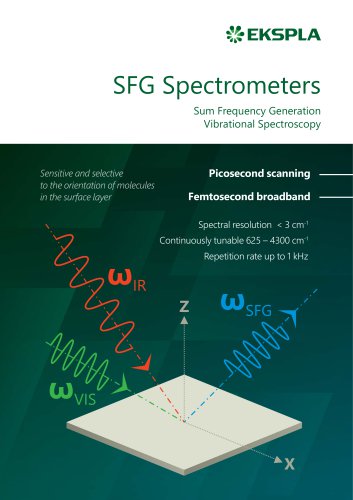 Broadband SFG Spectrometer
14 Pages
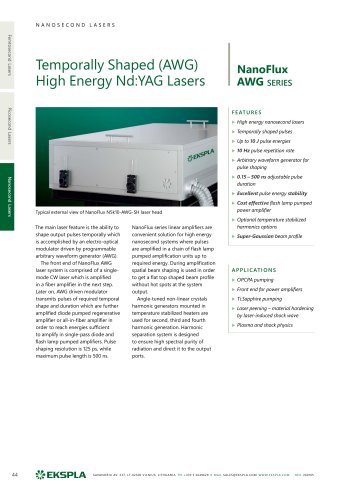 NanoFlux AWG series
4 Pages
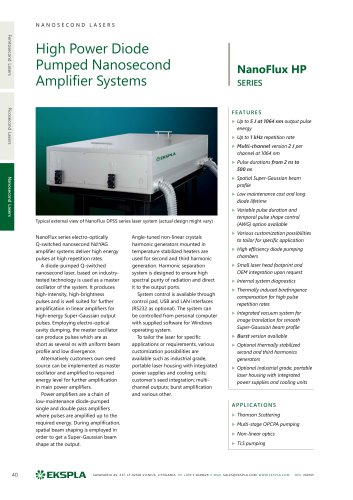 NanoFlux HP series
4 Pages
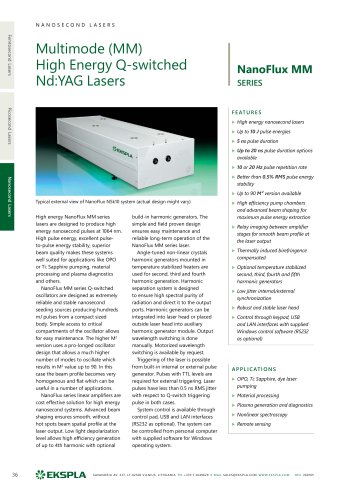 NanoFLux MM series
4 Pages
 NanoFlux SLM series
4 Pages
 UltraFlux Custom
4 Pages
 UltraFlux HE series
6 Pages
 LightWire FFS series
4 Pages
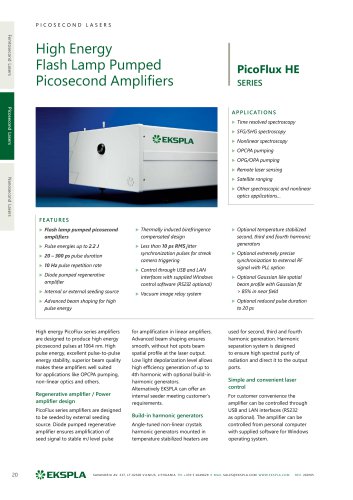 PicoFlux HE series
4 Pages
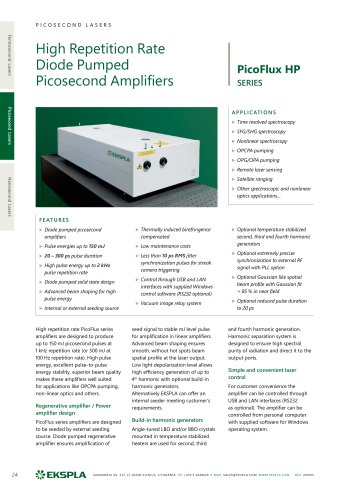 PicoFlux HP series
4 Pages
 PhotoSonus X
4 Pages
 FemtoLux
20 Pages
 FemtoLux 3
6 Pages
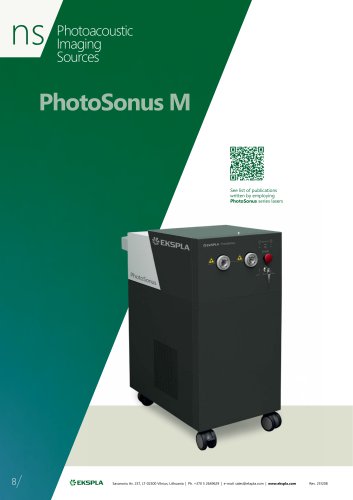 PhotoSonus M
4 Pages
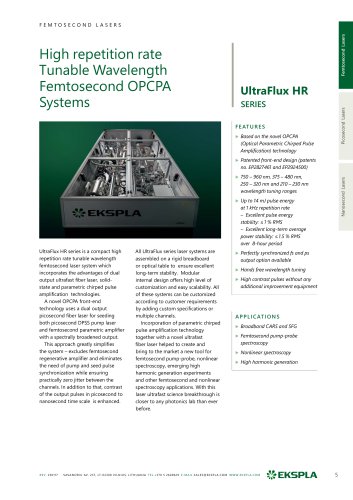 UltraFlux HR SERIES
5 Pages
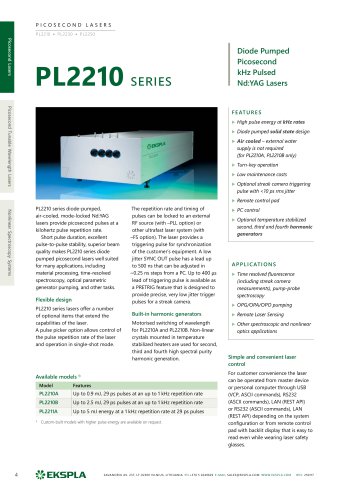 PL2210 series
3 Pages
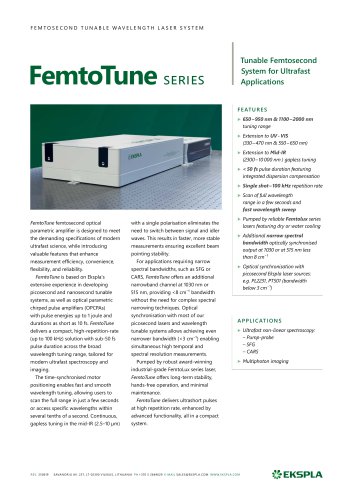 FemtoTune series
4 Pages
 Material processing examples
16 Pages
- Kiln
- Chamber kiln
- Electric furnace
- Spectrometer
- Signal amplifying integrated circuit
- High-temperature oven
- Automatic kiln
- Digital oven
- Benchtop spectrometer
- Custom-made oven
- Benchtop oven
- High-resolution spectrometer
- High-sensitivity spectrometer
- Laser module
- Digital generator
- Laser source
- Analysis oven
- Spectrometer for scientific applications
- Laboratory generator