


NanoFLux MM series
NanoFLux MM series
Catalog excerpts
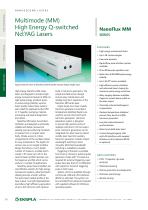
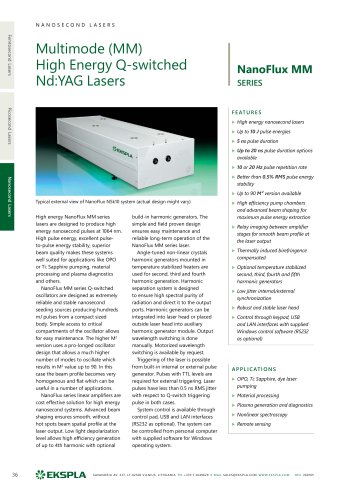
NANOSECOND LASERS Femtosecond Lasers Picosecond Lasers Multimode (MM)High Energy Q-switched Nd:YAG Lasers High energy NanoFlux MM series lasers are designed to produce high energy nanosecond pulses at 1064 nm. High pulse energy, excellent pulse-to-pulse energy stability, superior beam quality makes these systems well suited for applications like OPO or Ti: Sapphire pumping, material processing and plasma diagnostics and others. NanoFlux MM series Q-switched oscillators are designed as extremely reliable and stable nanosecond seeding sources producing hundreds mJ pulses from a compact sized body. Simple access to critical compartments of the oscillator allows for easy maintenance. The higher M2 version uses a pro-longed oscillator design that allows a much higher number of modes to oscillate which results in M2 value up to 90. In this case the beam profile becomes very homogenous and flat which can be useful in a number of applications. NanoFlux series linear amplifiers are cost effective solution for high energy nanosecond systems. Advanced beam shaping ensures smooth, without hot spots beam spatial profile at the laser output. Low light depolarization level allows high efficiency generation of up to 4th harmonic with optional build-in harmonic generators. The simple and field proven design ensures easy maintenance and reliable long-term operation of the NanoFlux MM series laser. Angle-tuned non-linear crystals harmonic generators mounted in temperature stabilized heaters are used for second, third and fourth harmonic generation. Harmonic separation system is designed to ensure high spectral purity of radiation and direct it to the output ports. Harmonic generators can be integrated into laser head or placed outside laser head into auxiliary harmonic generator module. Output wavelength switching is done manually. Motorized wavelength switching is available by request. Triggering of the laser is possible from built-in internal or external pulse generator. Pulses with TTL levels are required for external triggering. Laser pulses have less than 0.5 ns RMS jitter with respect to Q-switch triggering pulse in both cases. System control is available through control pad, USB and LAN interfaces (RS232 as optional). The system can be controlled from personal computer with supplied software for Windows operating system. ► High energy nanosecond lasers ► Up to 20 ns pulse duration options available ► 10 or 20 Hz pulse repetition rate ► Better than 0.5% RMS pulse energy stability ► High efficiency pump chambers and advanced beam shaping for maximum pulse energy extraction ► Relay imaging between amplifier stages for smooth beam profile at the laser output ► Thermally induced birefringence compensated ► Optional temperature stabilized second, third, fourth and fifth harmonic generators ► Low jitter internal/external synchronization ► Robust and stable laser head ► Control through keypad, USB and LAN interfaces with supplied Windows control software (RS232 as optional) ► OPO, Ti: Sapphire, dye laser pumping ► Plasma generation and diagnostics 36 &EKSPLA SAVANORIU AV. 237, LT-02300 VILNIUS, LITHUANIA TEL +370 5 2649629 E-MAIL [email protected] WWW.EKSPLA.COM REV.
Open the catalog to page 1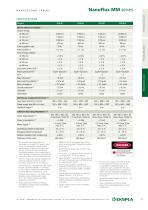
NANOSECOND LASERS NanoFlux MM seriesSPECIFICATIONSModel N3k10 N5k10 N7k10 N10k10MAIN SPECIFICATIONS 1}Output energy at 1064 nm Pulse energy stability 5) Picosecond Lasers Femtosecond Lasers 6) Measured over 8 hours period after 30 min warm-up when ambient temperature variation is less than ±2 °C. 7) Super-Gaussian spatial mode of 6-11th order in near field. 8) M1 2 value of ~5 is standard. Versions with M2 in the range of 20 - 90 can be ordered. 9) Beam diameter is measured at signal output at 1/e2 level for Gaussian beams and FWHM level for Super-Gaussian beams. 10) Beam pointing stability is...
Open the catalog to page 2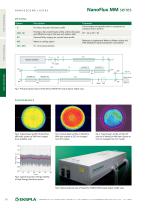
NANOSECOND LASERS Femtosecond Lasers OPTIONS Option Provides a Gaussian-like beam profile Provides a flat, smooth beam profile, without hot spots and diffraction rings in the near and medium field Optional Relay Imaging for smooth beam profile Picosecond Lasers Water-air cooling option Master Oscillator Pulse energies are typically lower in comparison to standard version by 80 % M² > 20 or M² > 90 Replaces or supplements Water-to-Water cooling unit. Heat dissipation equals total power consumption Nanosecond Nanosecond Lasers Fig 1. Principal optical layout of NanoFlux N10k10-SH (actual layout...
Open the catalog to page 3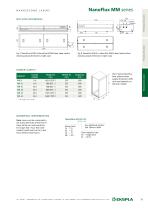
NANOSECOND LASERS OUTLINE DRAWINGS Fig 7. NanoFlux N7k10 or NanoFlux N10k10 laser head outline drawing (actual dimensions might vary) Fig 8. NanoFlux N3k10 or NanoFlux N5k10 laser head outline drawing (actual dimensions might vary) Picosecond Lasers Femtosecond Lasers POWER SUPPLY 'i Full height with wheels. Fig 9. Typical NanoFlux laser system power supply dimensions (MR rack used depends on the laser model) ORDERING INFORMATION Note: Laser must be connected to the mains electricity all the time. If there will be no mains electricity for longer that 1 hour then laser (system) needs warm up for...
Open the catalog to page 4All EKSPLA catalogs and technical brochures
 Scanning SFG Spectrometer
14 Pages
 Broadband SFG Spectrometer
14 Pages
 NanoFlux AWG series
4 Pages
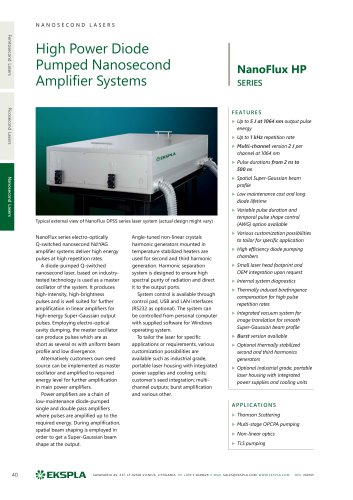 NanoFlux HP series
4 Pages
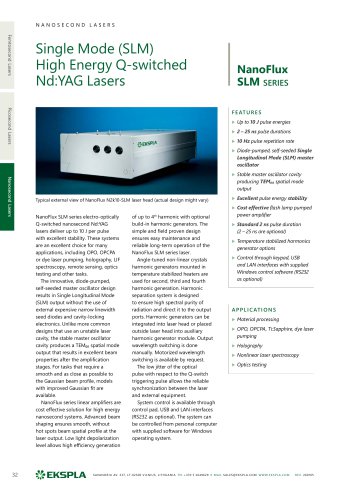 NanoFlux SLM series
4 Pages
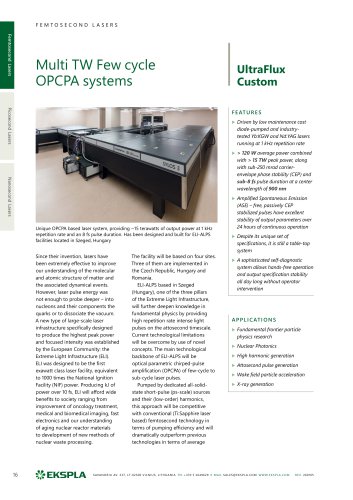 UltraFlux Custom
4 Pages
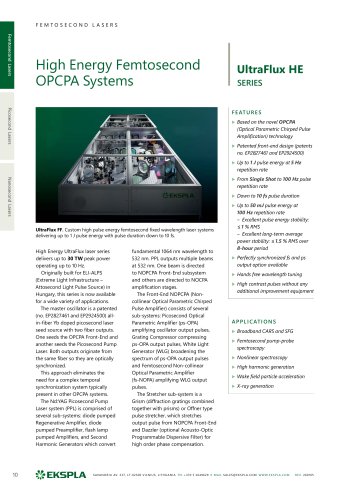 UltraFlux HE series
6 Pages
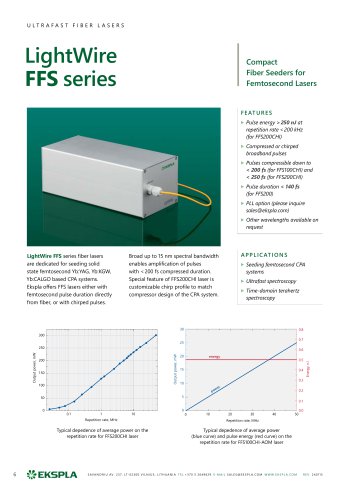 LightWire FFS series
4 Pages
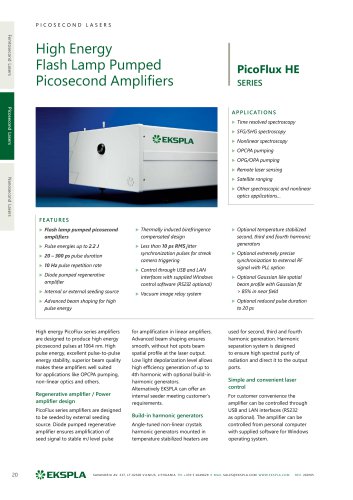 PicoFlux HE series
4 Pages
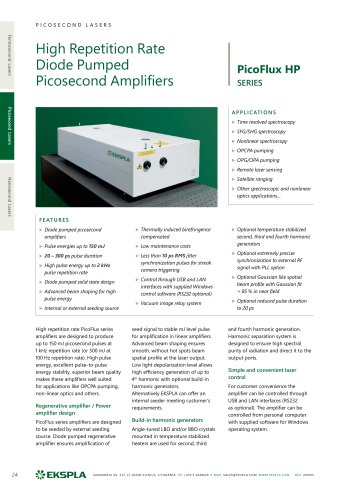 PicoFlux HP series
4 Pages
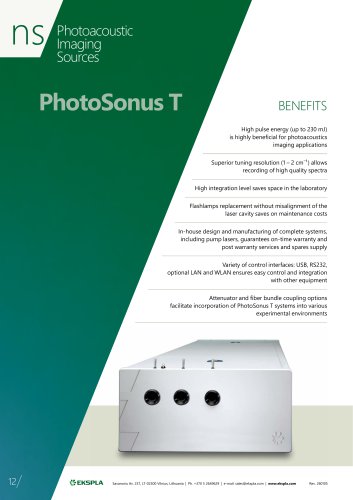 PhotoSonus T
4 Pages
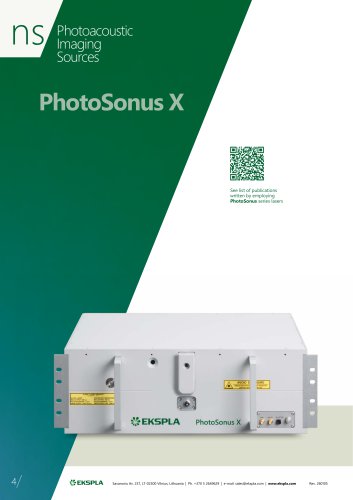 PhotoSonus X
4 Pages
 FemtoLux
20 Pages
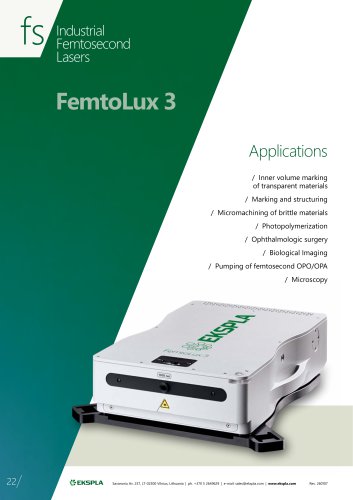 FemtoLux 3
6 Pages
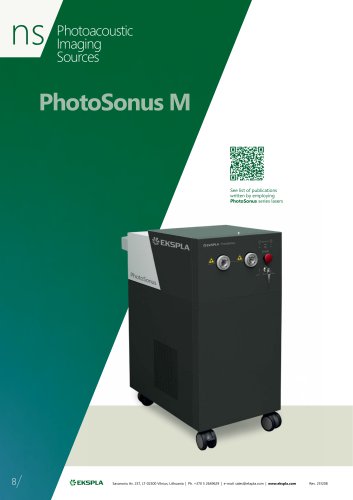 PhotoSonus M
4 Pages
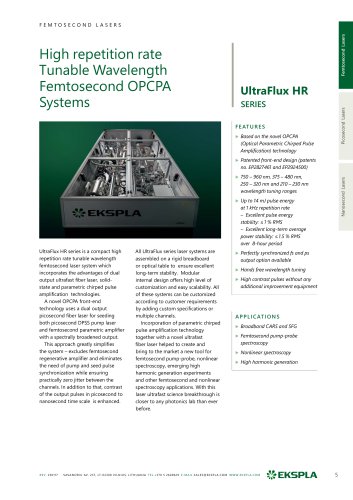 UltraFlux HR SERIES
5 Pages
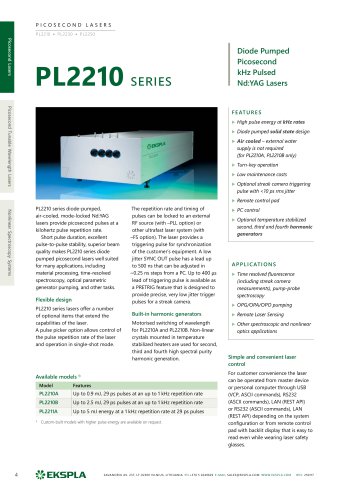 PL2210 series
3 Pages
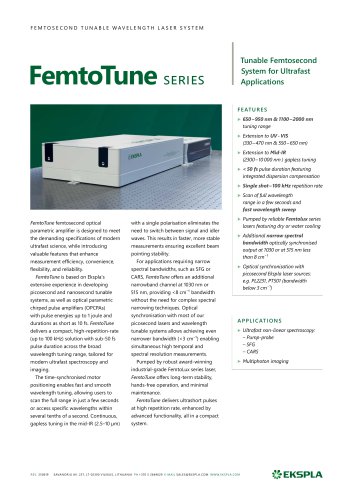 FemtoTune series
4 Pages
 Material processing examples
16 Pages
- Kiln
- Chamber kiln
- Electric furnace
- Spectrometer
- Signal amplifying integrated circuit
- High-temperature oven
- Automatic kiln
- Digital oven
- Benchtop spectrometer
- Custom-made oven
- Benchtop oven
- High-resolution spectrometer
- High-sensitivity spectrometer
- Laser module
- Digital generator
- Laser source
- Analysis oven
- Spectrometer for scientific applications
- Laboratory generator