


Material processing examples

Material processing examples
The document details the FemtoLux femtosecond laser, emphasizing its precision, reliability, and innovative cooling system for material processing across various industries.
The FemtoLux laser offers tunable pulse durations from less than 350 femtoseconds to 1 picosecond, with pulse repetition rates from single shot to 4 MHz. It achieves pulse energies over 300 µJ in single pulses and more than 750 µJ in burst mode. The laser is designed for high precision and minimal thermal impact, suitable for intricate microstructures and surface modifications. It provides a typical power of 45 W (up to 50 W) at 515 nm, with pulse energies exceeding 11 W and 20 W at different frequencies, and over 6 W and 10 W at 343 nm. Pulse energy at 1030 nm is greater than 300 µJ, with options for 1 mJ. Beam quality is characterized by M² < 1.2, and beam pointing thermal stability is < 20 µrad/°C.
- Glass Processing: High-precision machining for optics and electronics.
- Metal Processing: Precise cutting and marking for medical devices and microelectronics.
- Polymer Processing: Precise machining without thermal damage for automotive and consumer electronics.
- Other Materials: Processing of ceramics and silicon for complex 3D structures.
The laser includes a direct refrigerant cooling system, reducing maintenance, and a patent-pending method for ultra-high rate bursts, allowing versatile burst formation and precise pulse control.
Supports integration with external controllers via REST API, offering pulse-on-demand capabilities for precise control and efficiency in micromachining applications. The Ekspla Control Application allows operation control via LAN or RS-232, supporting features like frequency divider, pulse picker, and power attenuation.
Figures show power stability, pulse energy, and beam quality. The FemtoLux 50 demonstrates long-term power stability with an RMS of 0.11%, and the FemtoLux 30 shows pulse-to-pulse energy stability with an RMS of 0.14% over 30,000 pulses.
Classified as a Class 4 laser product, requiring precautions to avoid exposure to direct or scattered radiation.
The FemtoLux femtosecond laser is a versatile and reliable tool for micromachining, offering high precision and minimal thermal impact across a wide range of materials and applications.
Catalog excerpts

Made with FemtoLux laser Material processing examples Micro-lens array fabricated with hybrid laser processing method. Courtesy of FTMC. Savanoriu Av. 237, LT-02300 Vilnius, Lithuania | Ph. +370 5 2649629 | e-mail: [email protected] | www.ekspla.com
Open the catalog to page 1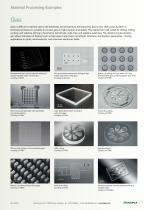
Material Processing Examples Glass Glass is difficult to machine due to the brittleness and sensitivity to thermal stress. Due to very short pulse duration of femtosecond lasers, it’s possible to process glass in high precision and quality. This makes them well-suited for drilling, milling, scribing, and selective etching in fused silica, borosilicate, soda-lime, and sapphire substrates. The ultrashort pulse duration also allows formation of features such as high aspect ratio holes, microfluidic structures, and freeform geometries – finding applications in optics, semiconductor, and consumer...
Open the catalog to page 2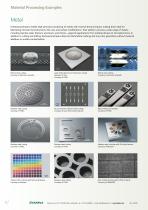
Material Processing Examples Metal Femtosecond lasers enable high-precision processing of metals with minimal thermal impact, making them ideal for fabricating intricate microstructures, fine cuts, and surface modifications. Their ability to process a wide range of metals – including stainless steel, titanium, aluminum, and nitinol—supports applications from medical devices to microelectronics. In addition to cutting and drilling, femtosecond lasers allow for black/white marking and true color generation without chemical additives or surface contamination. Laser milled aluminium Fresnel lens...
Open the catalog to page 3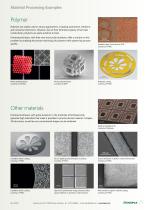
Material Processing Examples Polymer Polymers are widely used in various applications, including automotive, medicine, and consumer electronics. However, due to their inherent property of low heat conductivity, polymers are quite sensitive to heat. Femtosecond lasers, with their very short pulse durations, offer a solution to this problem by enabling the precise machining of polymers while preserving process quality. Insulation layer removal from PCB. Courtesy of FTMC. Photo-polymerization. Courtesy of Femtika. Polymide cutting. Courtesy of FTMC. Other materials Femtosecond lasers, with pulse...
Open the catalog to page 4
Industrial Femtosecond Lasers FemtoLux Reliability Redefined A reliable & versatile tool for micromachining / Glass, sapphire and ceramics micro processing / Microelectronics manufacturing / Glass intra volume structuring / Micro processing of different polymers and metals / LCD, LED, OLED drilling, cutting and repair Savanoriu Av. 237, LT-02300 Vilnius, Lithuania | Ph. +370 5 2649629 | e-mail: [email protected] | www.ekspla.com
Open the catalog to page 5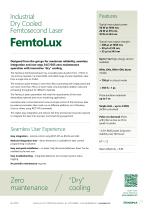
Industrial Dry Cooled Femtosecond Laser Features Typical max output power 50 W at 1030 nm, 20 W at 515 nm, 10 W at 343 nm Typical max output energies > 300 µJ at 1030 nm, > 50 µJ at 515 nm, > 25 µJ at 343 nm Designed from the get-go for maximum reliability, seamless integration and non-stop 24/7/365 zero maintenance operation with innovative ”dry” cooling. The FemtoLux femtosecond laser has a tunable pulse duration from <350 fs to 1 ps and can operate in a broad AOM controlled range of pulse repetition rates from a single shot to 4 MHz. The maximum pulse energy is more than 300 μJ operating with...
Open the catalog to page 6
Direct Refrigerant Cooling System Military-grade reliability The FemtoLux laser employs an innovative cooling system and sets new reliability standards among industrial femtosecond lasers. No additional bulky and heavy water chiller is needed. The chiller requires periodic maintenance - cooling system draining and rinsing and water and particle filter replacement. Moreover, water leakage can cause damage to the laser head and other equipment. Instead of using water for transferring heat from a laser head, the FemtoLux laser uses an innovative Direct Refrigerant Cooling method. The refrigerant...
Open the catalog to page 7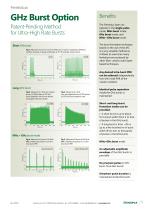
Patent-Pending Method for Ultra-High Rate Bursts The Femtolux laser can operate in the single-pulse mode, MHz burst mode, GHz burst mode, and MHz + GHz burst mode. The burst formation technique based on the use of the AFL is a very versatile method as it allows to overcome many limitations encountered by other fiber- and/or solid-statebased techniques. Short GHz burst Fig 1. Measured 2.2 GHz intra-burst PRR burst of pulses containing a different number of pulses of equal amplitudes at 31.5 W average output power n=5 Long GHz burst Fig 2. Measured 2.2 GHz pre-shaped bursts of 1000 pulses at 233...
Open the catalog to page 8
A new versatile patent-pending method to form ultra-high repetition rate bursts of ultrashort laser pulses. The developed method is based on the use of an all-in-fiber active fiber loop (AFL). A detailed description of the invention can be found on: [1] Andrejus Michailovas, and Tadas Bartulevicius. 2021 Int. patent application published under the Patent Cooperation Treaty (PCT) WO2021059003A1. [2] Tadas Bartulevicius, Mykolas Lipnickas, Virginija Petrauskiene, Karolis Madeikis, and Andrejus Michailovas, (2022), "30 W-average-power femtosecond NIR laser operating in a flexible GHz-burst-regime,"...
Open the catalog to page 9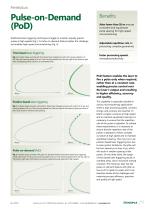
Pulse-on-Demand (PoD) Traditional laser triggering techniques struggle to maintain equally spaced pulses at high speeds (Fig.1, 2). Pulse-on-demand feature tackles this challenge and enables high-speed micromachining (Fig. 3). Time based laser triggering Fig 1. Complex shape scanned with time based laser triggering mode with a pulse repetition of 200 kHz and scanning speed of 6 m/s. The scanning started from the top right to the bottom right area. Overlapping pulses result in an overheated area. Position based laser triggering Fig 2. Complex shape scanned with position based laser triggering...
Open the catalog to page 10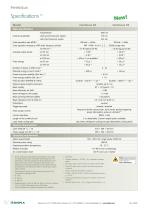
Main specifications Central wavelength with third harmonic option with second harmonic option Pulse repetition rate (PRR) 2) Maximal energy in burst mode 9) Pulse energy stability (Std. dev.) 11) Pulse duration (FWHM) @ 1 MHz Beam pointing thermal stability Triggering mode internal / external frequency divider, pulse picker, burst mode, packet triggering, power attenuation, pulse-on-demand 14) Pulse output control Control interfaces Length of the umbilical cord 3 m, detachable. Custom length option available Laser head cooling type dry (direct refrigerant cooling through detachable cooling plate)...
Open the catalog to page 11All EKSPLA catalogs and technical brochures
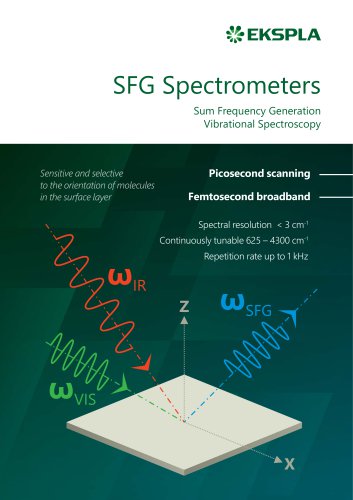
 Scanning SFG Spectrometer
14 Pages
 Broadband SFG Spectrometer
14 Pages
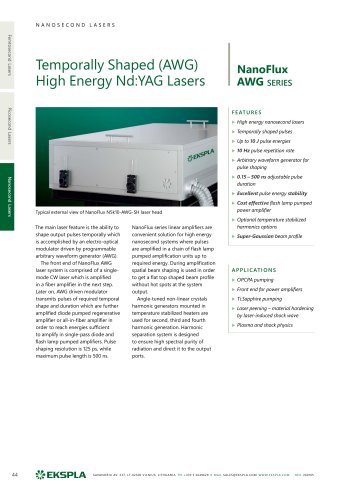 NanoFlux AWG series
4 Pages
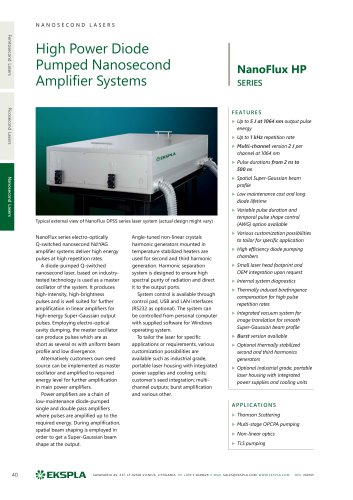 NanoFlux HP series
4 Pages
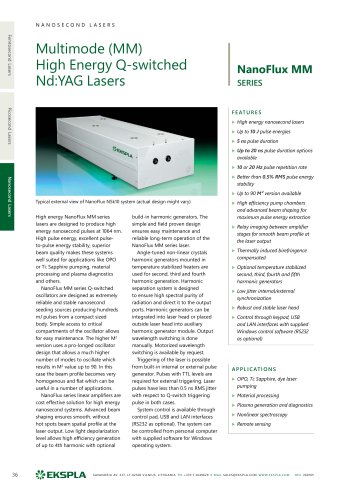 NanoFLux MM series
4 Pages
 NanoFlux SLM series
4 Pages
 UltraFlux Custom
4 Pages
 UltraFlux HE series
6 Pages
 LightWire FFS series
4 Pages
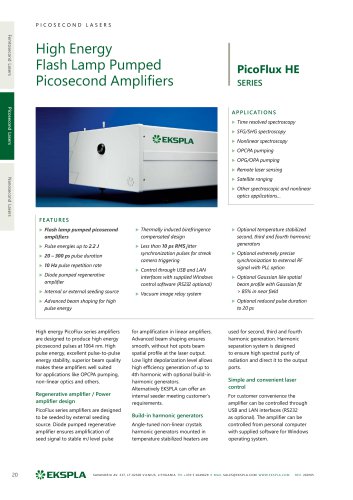 PicoFlux HE series
4 Pages
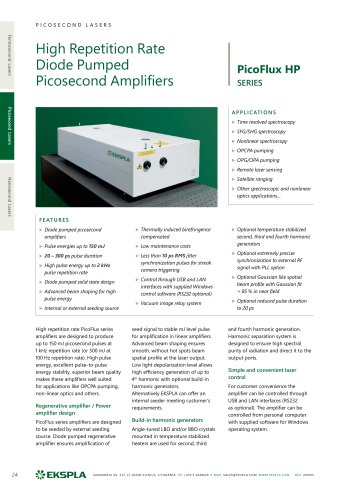 PicoFlux HP series
4 Pages
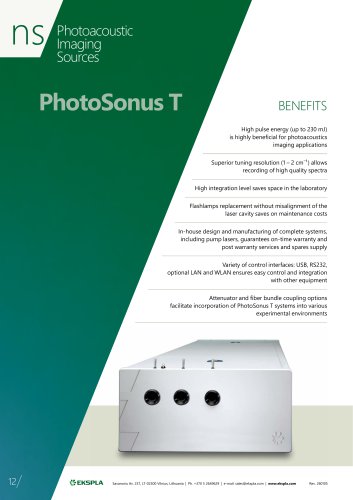 PhotoSonus T
4 Pages
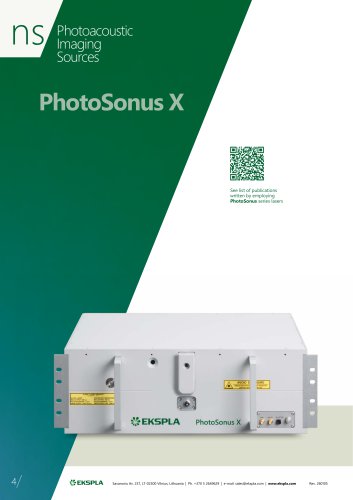 PhotoSonus X
4 Pages
 FemtoLux
20 Pages
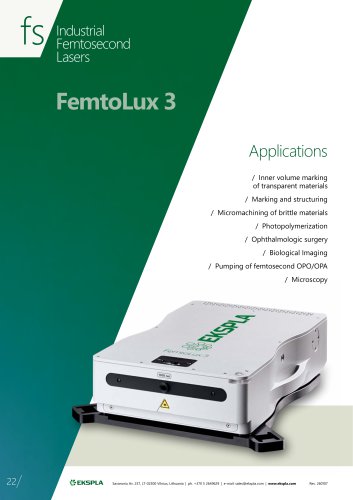 FemtoLux 3
6 Pages
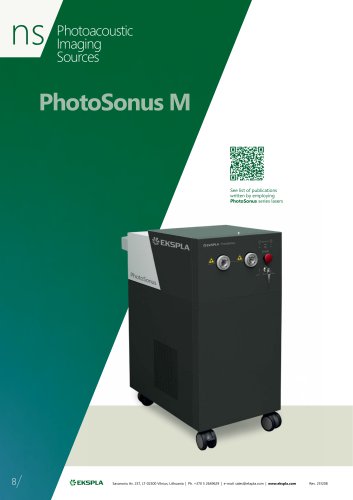 PhotoSonus M
4 Pages
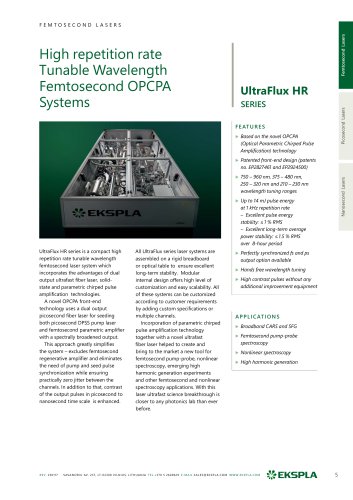 UltraFlux HR SERIES
5 Pages
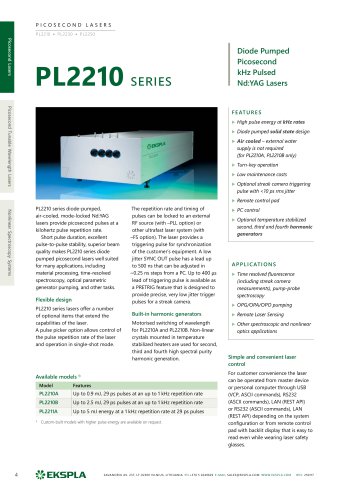 PL2210 series
3 Pages
 FemtoTune series
4 Pages
- Kiln
- Chamber kiln
- Electric furnace
- Spectrometer
- Signal amplifying integrated circuit
- Generator
- High-temperature oven
- Automatic kiln
- Digital oven
- Benchtop spectrometer
- Custom-made oven
- Benchtop oven
- High-resolution spectrometer
- High-sensitivity spectrometer
- Laser module
- Digital generator
- Laser source
- Analysis oven
- Spectrometer for scientific applications
- Laboratory generator