


FemtoLux
FemtoLux
The document provides comprehensive details on the FemtoLux laser, focusing on its applications in industries such as semiconductor, medical, and advanced electronics. It describes laser-based techniques for processing materials like glass, metal, and polymers.
Techniques for glass include selective laser etching (SLE) for through-glass vias, Bessel beam scribing, and GHz burst-assisted percussion drilling, aimed at high precision and efficiency for complex structures like nozzles and micro-lens arrays.
For metals, processes such as nitinol stent cutting, surface structuring, and marking are detailed. Techniques like LIPSS are used for surface texturing, and color marking is applied to metals like stainless steel and titanium.
Polymer processing involves cutting and photopolymerization, with SSAIL technology enabling direct writing of electronic circuits on dielectric materials, supporting trace widths down to 1 µm, suitable for semiconductor applications.
The document also covers processing techniques for ceramics and silicon wafers, showcasing the FemtoLux laser's versatility.
The FemtoLux laser features tunable pulse duration from <400 fs to 1 ps, a broad range of pulse repetition rates, high output power, and innovative control electronics for easy integration.
Innovative "dry" cooling technology offers military-grade reliability and energy efficiency, eliminating the need for water-based cooling.
The laser includes a patent-pending method for ultra-high rate bursts, providing flexibility in pulse repetition rates and maintaining ultrashort pulse durations.
The document introduces the FemtoLux laser systems, focusing on specifications, performance, and applications, highlighting methods for achieving ultra-high repetition rate bursts.
Models like FemtoLux 30, 50, and HE are detailed, with key parameters including central wavelength (1030 nm), pulse repetition rate (200 kHz – 2 MHz), and maximal average output power (≥ 30 W to ≥ 45 W).
Performance graphs for FemtoLux 30 and 50 show output power and pulse energy dependencies on pulse repetition rates at different wavelengths, along with long-term power stability and beam quality measurements.
The Pulse-on-Demand (PoD) feature allows precise pulse control, reducing jitter to less than 20 ns, crucial for high-speed micromachining applications.
The FemtoLux lasers are versatile for various micromachining applications, where high processing speed, constant energy, and accuracy are essential.
The Ekspla Control Application supports routine operation control, adaptable to different systems and communication types like LAN and RS-232.
The FemtoLux series offers advanced laser systems with high precision and control, suitable for demanding industrial applications, enhanced by technologies like AFL and PoD.
Catalog excerpts

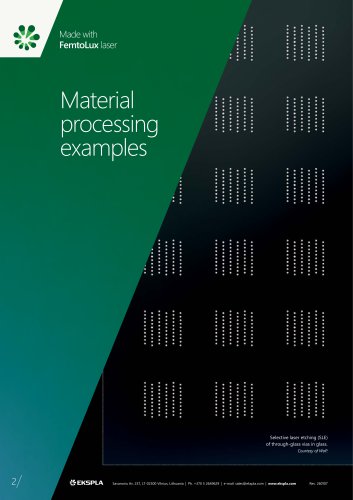
Made with FemtoLux laser Material processing examples Selective laser etching (SLE) of through-glass vias in glass. Courtesy of WoP. Savanoriu Av. 237, Savanoriu LT-02300 Av. 237, Vilnius, LT-02300 Lithuania Vilnius, | ph.Lithuania +370 5 2649629 | Ph. +370 | e-mail: 5 2649629 [email protected] | e-mail: [email protected] | www.ekspla.com | www.ekspla.com
Open the catalog to page 1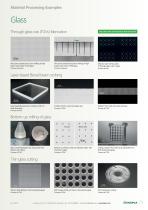
Material Processing Examples Glass Through glass vias (TGVs) fabrication GHz burst assisted percussion drilling of high aspect ratio holes in EXG glass. Courtesy of Akoneer. GHz burst assisted percussion drilling of high aspect ratio holes in EXG glass. Courtesy of Akoneer. TAILORED FOR SEMICONDUCTOR INDUSTRY Selective laser etching (SLE) of through-glass vias in glass. Courtesy of WoP. Laser-based Bessel beam scribing Laser-based Bessel beam scribing of 4.8 mm soda-lime glass. Courtesy of FTMC. Scribed 4.8 mm soda-lime edge view. Scribed 1 mm soda-lime side wall view. Bottom-up milling of 100...
Open the catalog to page 2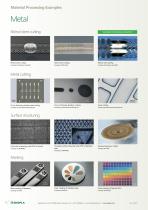
Material Processing Examples Metal Nitinol stent cutting Nitinol stent cutting. Courtesy of Vactronix Scientific. TAILORED FOR MEDICAL INDUSTRY Nitinol stent cutting. Nitinol stent cutting. 125 µm thickness tantalum cutting. Kovar cutting. Triangular surface texturing with LIPSS of stainless steel. Textured aluminum molds. Color marking of stainless steel. Color marking of titanium film. Courtesy of Vactronix Scientific. Metal cutting 50 µm thickness stainless steel cutting. Courtesy of Laser Micromachining Ltd. Courtesy of Laser Micromachining Ltd. Courtesy of Laser Micromachining Ltd. Surface...
Open the catalog to page 3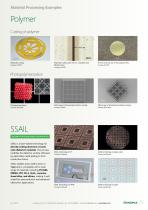
Material Processing Examples Polymer Cutting of polymer Polyimide cutting. Courtesy of FTMC. Polyimide cutting with 515 nm, indicated heat affected zone. 10 mm circle cut out of thin polymer film. SEM image of photopolymerization sample. SEM image of photopolymerization sample. SSAIL technology on glass wafer. SSAIL technology on glass. SSAIL TAILORED FOR SEMICONDUCTOR INDUSTRY SSAIL is a laser-based technology for directly writing electronic circuits onto dielectric materials. The process modifies the dielectric surface, followed by electroless metal plating to form conductive traces. SSAIL...
Open the catalog to page 4
Material Processing Examples Other materials 50 µm depth groove formation in ceramic. Optical 3D profilometer image of formed groove. Optical 3D profilometer image of milled alumina squares in different operational modes. Cutting of FZ-Si wafer. SEM image of processed FZ-Si wafer edge. Need a feasibility test for your samples? Groove formation in GaAs in water environment. Take advantage of EKSPLA’s extensive global partner network. Material processing workshops around the world, supported by highly qualified engineers, enable testing of virtually any process on a wide range of materials. Backed...
Open the catalog to page 5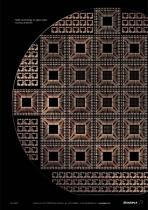
SSAIL technology on glass wafer. Courtesy of Akoneer. e^'inh ttf.VJvS jA'/rfj £W4J^ £*>4^ ^.'4^
Open the catalog to page 6
Reliability Redefined A reliable & versatile tool for micromachining PRISM / Micromachining for advanced packaging solutions / Medical device fabrication / Glass micromachining and intra-volume structuring / Micromachining of different metals and polymers / Solutions for microelectronics fabrication OEKSPLA 8 Savanoriu Av. 237, LT-02300 Vilnius, Lithuania | Ph. +370 5 2649629 | e-mail: [email protected] | www.ekspla.com Rev. 260107
Open the catalog to page 7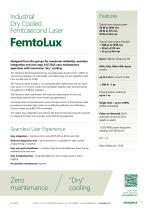
Industrial Dry Cooled Femtosecond Laser Features Typical max output power 50 W at 1030 nm, 20 W at 515 nm, 10 W at 343 nm Typical max output energies > 300 µJ at 1030 nm, > 50 µJ at 515 nm, > 25 µJ at 343 nm Designed from the get-go for maximum reliability, seamless integration and non-stop 24/7/365 zero maintenance operation with innovative ”dry” cooling. The FemtoLux femtosecond laser has a tunable pulse duration from <400 fs to 1 ps and can operate in a broad AOM controlled range of pulse repetition rates from a single shot to 4 MHz. The maximum pulse energy is 1 mJ operating with single pulses...
Open the catalog to page 8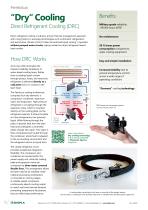
Direct Refrigerant Cooling (DRC) Military-grade reliability >90 000 hours MTBF Direct refrigerant cooling is industry-proven thermal-management approach with a long history in everyday technologies such as domestic refrigeration and automotive climate control. Unlike conventional liquid cooling, it operates without pumped water circuits, relying instead on direct refrigerant-based heat transfer. How DRC Works At its core, DRC eliminates the inherent reliability limitations of water-based cooling loops. Rather than circulating liquid coolant through pumps, hoses, and reservoirs, refrigerant is...
Open the catalog to page 9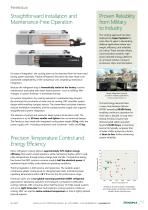
Straightforward Installation and Maintenance-Free Operation Proven Reliability from Military to Industry This cooling approach has been deployed by Aspen Systems for more than 15 years in demanding defense applications where size, weight, efficiency, and reliability are critical. These include military communications systems, highpower directed-energy platforms on armored vehicles, transport enclosures, ships, and helicopters. For ease of integration, the cooling plate can be detached from the laser head during system assembly. Flexible refrigerant lines allow the laser head to be positioned...
Open the catalog to page 10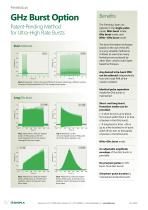
Patent-Pending Method for Ultra-High Rate Bursts The Femtolux laser can operate in the single-pulse mode, MHz burst mode, GHz burst mode, and MHz + GHz burst mode. The burst formation technique based on the use of the AFL is a very versatile method as it allows to overcome many limitations encountered by other fiber- and/or solid-statebased techniques. Fig 1-2. Measured 2.2 GHz intra-burst PRR burst of pulses containing a different number of pulses of equal amplitudes at 31.5 W average output power Identical pulse separation inside the GHz bursts is maintained Fig 4. Measured 2.2 GHz non-pre-shaped...
Open the catalog to page 11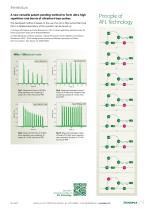
FemtoLux A new versatile patent-pending method to form ultra-high repetition rate bursts of ultrashort laser pulses. The developed method is based on the use of an all-in-fiber active fiber loop (AFL). A detailed description of the invention can be found on: [1] Andrejus Michailovas, and Tadas Bartulevičius. 2021 Int. patent application published under the Patent Cooperation Treaty (PCT) WO2021059003A1. [2] Tadas Bartulevičius, Mykolas Lipnickas, Virginija Petrauskienė, Karolis Madeikis, and Andrejus Michailovas, (2022), "30 W-average-power femtosecond NIR laser operating in a flexible GHz-burst-regime,"...
Open the catalog to page 12All EKSPLA catalogs and technical brochures
 Scanning SFG Spectrometer
14 Pages
 Broadband SFG Spectrometer
14 Pages
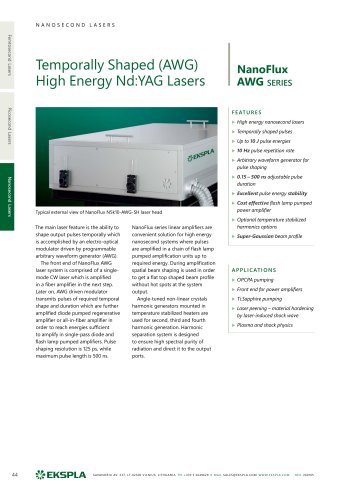 NanoFlux AWG series
4 Pages
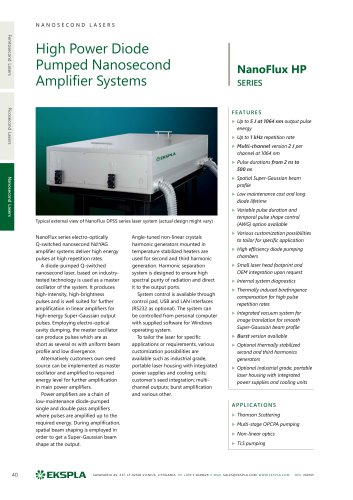 NanoFlux HP series
4 Pages
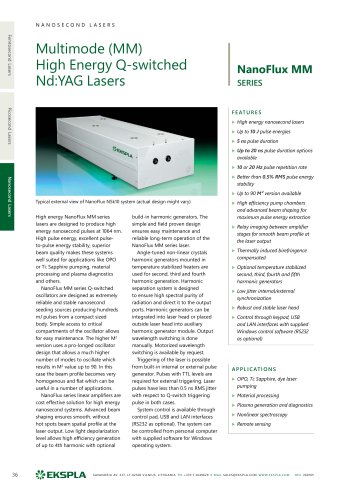 NanoFLux MM series
4 Pages
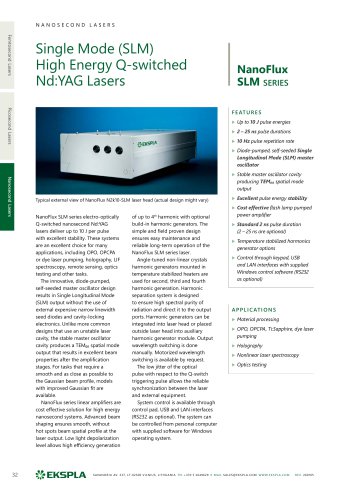 NanoFlux SLM series
4 Pages
 UltraFlux Custom
4 Pages
 UltraFlux HE series
6 Pages
 LightWire FFS series
4 Pages
 PicoFlux HE series
4 Pages
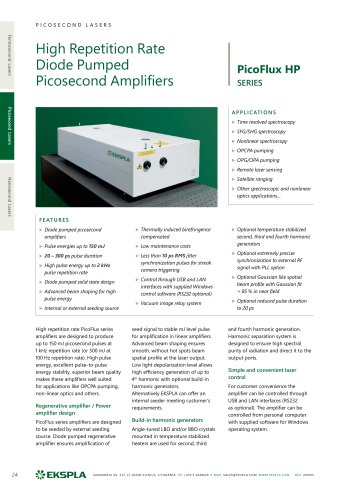 PicoFlux HP series
4 Pages
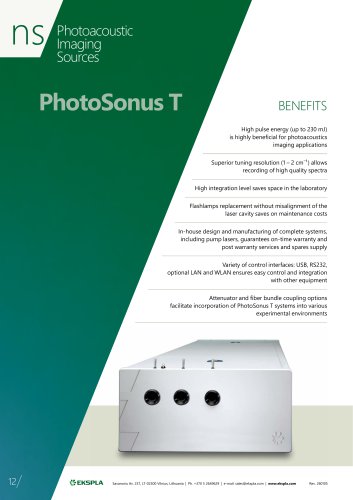 PhotoSonus T
4 Pages
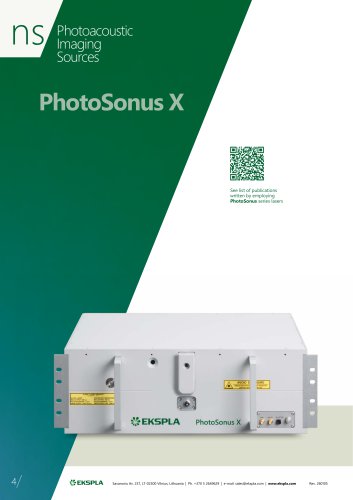 PhotoSonus X
4 Pages
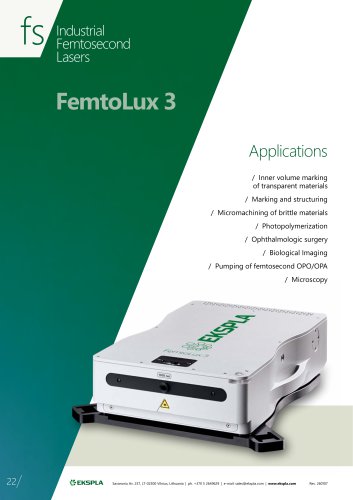 FemtoLux 3
6 Pages
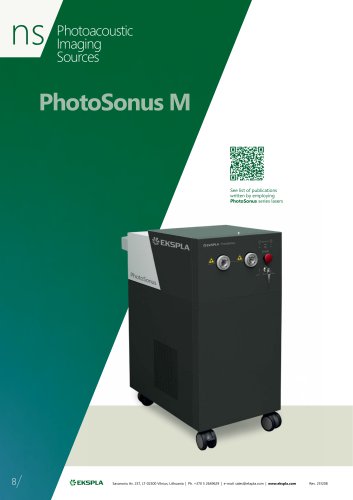 PhotoSonus M
4 Pages
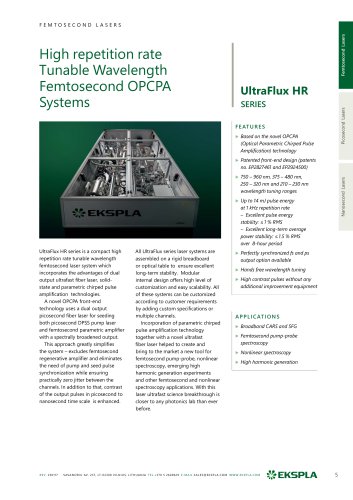 UltraFlux HR SERIES
5 Pages
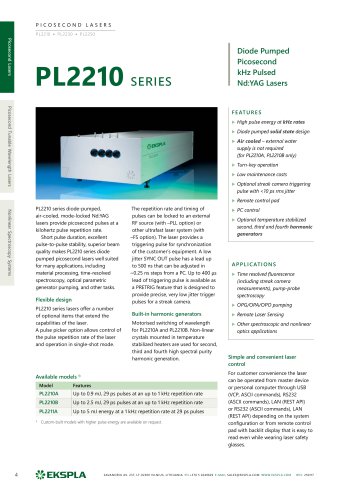 PL2210 series
3 Pages
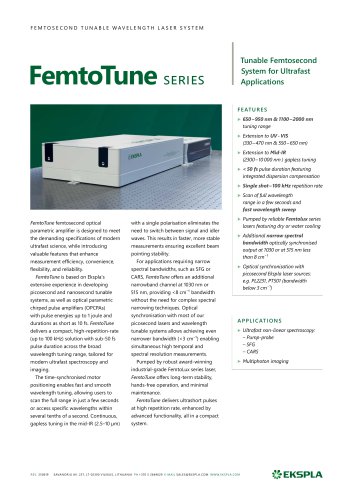 FemtoTune series
4 Pages
 Material processing examples
16 Pages
- Kiln
- Chamber kiln
- Electric furnace
- Spectrometer
- Signal amplifying integrated circuit
- Generator
- High-temperature oven
- Automatic kiln
- Digital oven
- Benchtop spectrometer
- Custom-made oven
- Benchtop oven
- High-resolution spectrometer
- High-sensitivity spectrometer
- Laser module
- Digital generator
- Laser source
- Analysis oven
- Spectrometer for scientific applications
- Laboratory generator