


FemtoLux 3
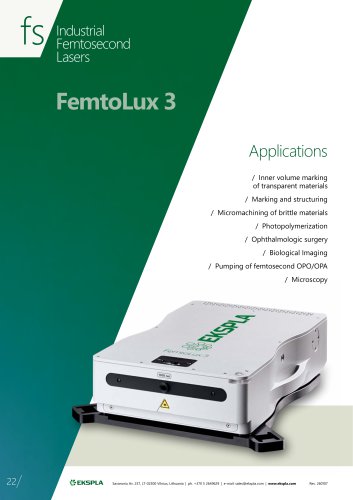
FemtoLux 3
- Output power: 3 W at 1030 nm and 1.2 W at 515 nm.
- Pulse energy: Up to 3 μJ per pulse and 10 μJ per burst at 1030 nm; up to 1.2 μJ per pulse and 5 μJ per burst at 515 nm.
- Tunable pulse duration from less than 300 fs to 5 ps.
- Versatile control and synchronization capabilities with up to 10 MHz pulse repetition rate.
- Smart triggering for synchronous operation with polygon scanners and PSO.
- Passive air cooling for 24/7 operation.
- Central wavelength: 1030 nm (fundamental), 515 nm (with second harmonic option).
- Maximal average output power: >3 W at 1030 nm, >1.2 W at 515 nm.
- Power stability: ≤ 0.5% standard deviation.
- Pulse energy stability: <2% standard deviation.
- Beam quality: M² < 1.2, beam divergence <1.0 mrad, beam ellipticity >0.85.
- Operating conditions: 15-30°C ambient temperature, 10-80% relative humidity (non-condensing).
- Power consumption: <500 W.
Catalog excerpts

Industrial Femtosecond Lasers FemtoLux 3 Applications / Inner volume marking of transparent materials / Marking and structuring / Micromachining of brittle materials / Photopolymerization / Ophthalmologic surgery / Biological Imaging / Pumping of femtosecond OPO/OPA / Microscopy Savanoriu Av. 237, LT-02300 Vilnius, Lithuania | ph. +370 5 2649629 | e-mail: [email protected] | www.ekspla.com
Open the catalog to page 1
Microjoule Class Femtosecond Industrial Lasers Features Output power 3 W at 1030 nm, 1.2 W at 515 nm Up to 3 μJ/pulse and 10 μJ/burst (at 1030 nm) Up to 1.2 µJ/pulse and 5 µJ/burst (at 515 nm) FemtoLux 3 is a modern femtosecond fiber laser aimed for both R&D use and industrial integration. Tunable pulse duration in a range of 300 fs – 5 ps, adjustable pulse repetition rate up to 10 MHz and adjustable pulse energy up to 3 μJ allows optimization of laser parameters for the desired application. These include marking and volume structuring of transparent materials, photopolymerization, biological...
Open the catalog to page 2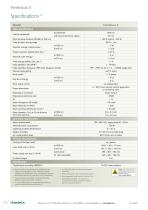
Specifications Model FemtoLux 3 Main specifications Cooling of the laser head Laser head size (LxWxH) Power supply unit size (LxWxH) Umbilical length 1 Due to continuous improvement, all specifications are subject to change without notice. Parameters marked typical are not specifications. They are indications of typical performance and will vary with each unit we manufacture. 2 See typical power and energy curves for other pulse repetition rates at Fig 1., Fig 2. and Fig 4. 3) At 1 MHz PRR during 24 h of operation after warm-up under constant environmental conditions. 4 At 1 MHz PRR under constant...
Open the catalog to page 3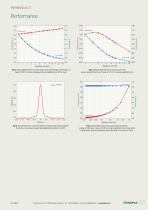
Fig 1. Typical dependence of output power and pulse energy of FemtoLux 3 laser at 1030 nm when changing internal repetition rate of the laser Fig 3. Typical FemtoLux 3 laser (at 1030 nm) output pulse autocorrelation function at 3 μJ pulse energy. Calculated pulse duration is 230 fs Fig 2. Typical dependence of output power and pulse energy of FemtoLux 3 laser at 515 nm on pulse repetition rate Fig 4. Typical dependence of output power and pulse energy of FemtoLux 3 laser at 1030 nm when repetition rate is reduced by pulse picker. Internal repetition rate of the laser in this case is 1 MHz Savanoriu...
Open the catalog to page 4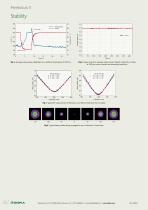
5. Average output power dependance on ambient temperature at 1030 nm Fig 6. Typical long term average output power stability of FemtoLux 3 laser at 1030 nm under constant environmental conditions Fig 7. Typical M2 measurement of FemtoLux 3 at 1030 nm (left) and 515 nm (right) Fig 8. Typical beam profiles along propagation axis of FemtoLux 3 series laser Savanoriu Av. 237, LT-02300 Vilnius, Lithuania | ph. +370 5 2649629 | e-mail: [email protected] | www.ekspla.com
Open the catalog to page 5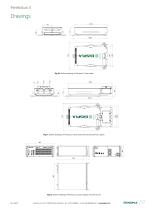
Drawings Fig 10. Outline drawings of FemtoLux 3 laser head Fig 11. Outline drawings of FemtoLux 3 laser head with second harmonic option Fig 12. Outline drawings of FemtoLux 3 power supply and control unit Savanoriu Av. 237, LT-02300 Vilnius, Lithuania | ph. +370 5 2649629 | e-mail: [email protected] | www.ekspla.com
Open the catalog to page 6All EKSPLA catalogs and technical brochures
 Scanning SFG Spectrometer
14 Pages
 Broadband SFG Spectrometer
14 Pages
 NanoFlux AWG series
4 Pages
 NanoFlux HP series
4 Pages
 NanoFLux MM series
4 Pages
 NanoFlux SLM series
4 Pages
 UltraFlux Custom
4 Pages
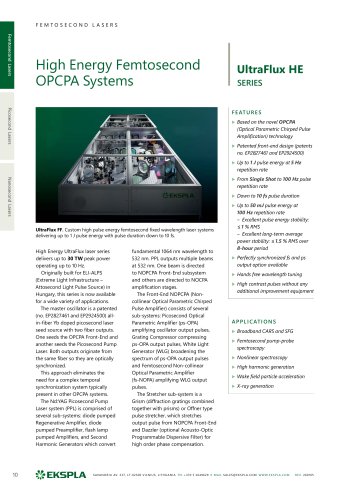 UltraFlux HE series
6 Pages
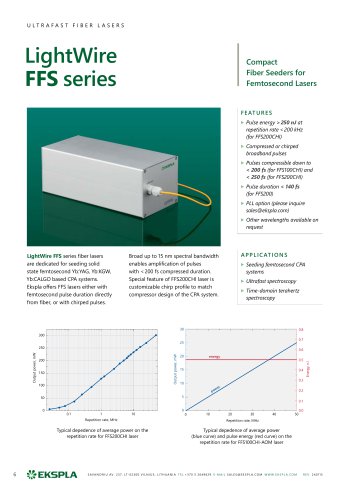 LightWire FFS series
4 Pages
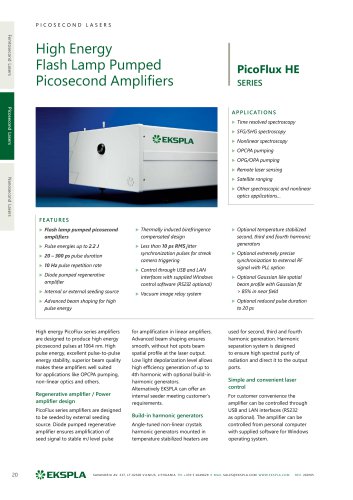 PicoFlux HE series
4 Pages
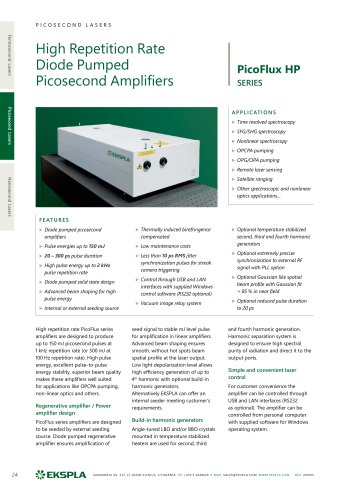 PicoFlux HP series
4 Pages
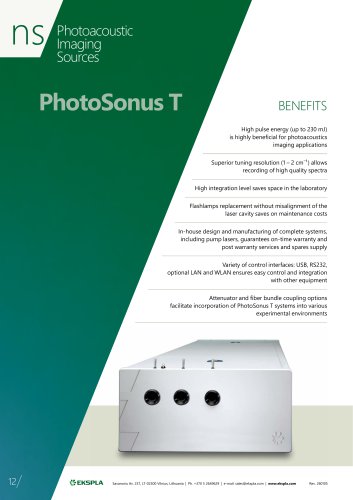 PhotoSonus T
4 Pages
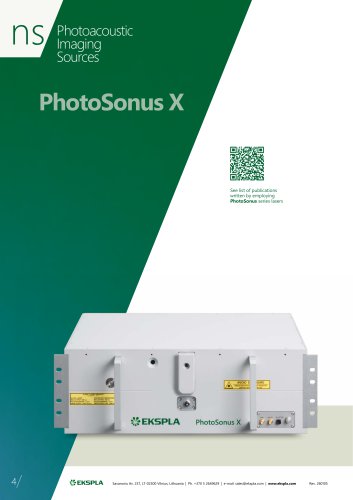 PhotoSonus X
4 Pages
 FemtoLux
20 Pages
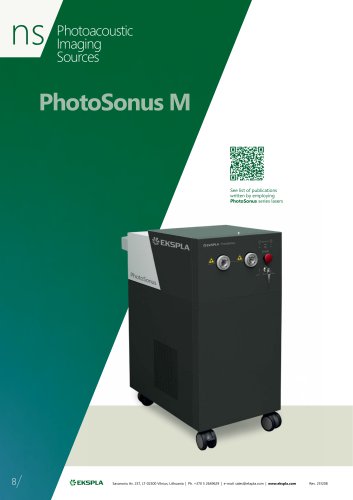 PhotoSonus M
4 Pages
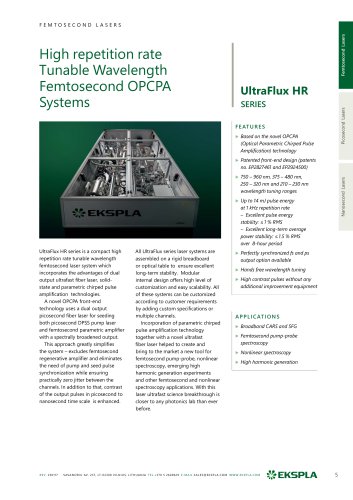 UltraFlux HR SERIES
5 Pages
 PL2210 series
3 Pages
 FemtoTune series
4 Pages
 Material processing examples
16 Pages
- Kiln
- Chamber kiln
- Electric furnace
- Spectrometer
- Signal amplifying integrated circuit
- Generator
- High-temperature oven
- Automatic kiln
- Digital oven
- Benchtop spectrometer
- Custom-made oven
- Benchtop oven
- High-resolution spectrometer
- High-sensitivity spectrometer
- Laser module
- Digital generator
- Laser source
- Analysis oven
- Spectrometer for scientific applications
- Laboratory generator