

EJOT-FDS-AUDI-R8

EJOT-FDS-AUDI-R8
The document discusses the use of EJOT FDS® screws in modern space frame structures, specifically in the Audi R8, highlighting the elimination of pre-punching in the assembly process.
Specifications and Adjustments
For the Audi R8, pre-punching was omitted, requiring adjustments to fastening parameters and optimization of the screw geometry below the head. This change allows the displaced material to be absorbed by the increased space below the screw head.
Material Arrangement
When fastening without a pilot hole, the material arrangement should be 'thin in thick' or 'soft in hard' to achieve higher tightening torques and minimize gaps between components.
Advantages
The screws can be loosened without damage, beneficial for repairs and recycling. In the Audi R8, 310 screws are fastened without pilot holes in a fully automated process.
Fastening Process
The FDS® screw is automatically fed into the robot-guided fastening equipment. The retainer minimizes cracking, and the spindle speed increases with axial load application. The screw pierces components, forming a metric female thread without chips, and clamps the components for a stronger joint.
Robot-Guided Fastening System
The system, supplied by Weber Schraubautomaten, uses high rotational speeds (up to 5000 1/min) and clamping forces (up to 1.8 kN) to facilitate frictional heat for flow drilling.
Process Steps
1. Heating
2. Penetrating
3. Through draught forming
4. Thread forming
5. Engagement of full threads
6. Tightening
Contact Information
For more information, contact Dipl.-Ing. D. Runkel at +49 2752 109-187 or [email protected].
Catalog excerpts
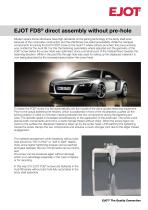
EJOT FDS® direct assembly without pre-hole Modern space frame structures have high demands on the joining technology in the body shell work because of the composite construction and the oftentimes one-sided accessibility. While the clamped components for joining the EJOT FDS® screw to the Audi TT where still pre-punched, this pre-punching was omitted for the Audi R8. For this the fastening parameters where adjusted and the geometry of the FDS® screw below the screw head was optimised, since a small amount of the material flows towards the fastening direction. While in the past this through hole was used for taking up the displaced material it is now being absorbed by the increased space below the screw head. To fasten the FDS® screw it is fed automatically into the nozzle of the robot guided fastening equipment. Prior to the actual fastening the retainer, which is positioned in front of the mouthpiece, pushes on the joining location in order to minimise cracking between the two components during the fastening process. The spindle speed is increased simultaneously to the application of the axial load. The screw point pierces both components and forms a metric female thread without chips. When the screw head connects to the surface the displaced material is taken up by the screw head. Until reaching the tightening torque the screw clamps the two components and ensures a much stronger joint due to the larger thread engagement. The material arrangement when fastening without pilot hole should be "thin in thick" or "soft in hard" respectively, since higher tightening torques can be reached and gaps between the two components can be minimised. The screw can be loosened again without damage, which is an advantage especially in the case of repairs or for recycling. In this way 310 EJOT FDS® screws are fastened in the Audi R8 series without pilot hole fully automated in the body shell assembl
Open the catalog to page 1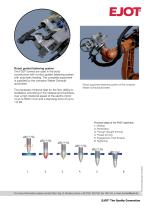
Robot guided fastening system The FDS® screws are used in the body construction with a robot-guided fastening system with automatic feeding. The complete equipment is supplied by the company Weber Schraub-automaten. The necessary frictional heat for the flow drilling is facilitated, according to the material and thickness, over a high rotational speed of the electro motor of up to 5000 1/min and a clamping force of up to 1,8 kN. Process steps of the FDS® assembly 1. Heating 2. Penetrating 3. Through draught forming 4. Thread forming 5. Engagement of full threads 6. Tightening For more information...
Open the catalog to page 2All EJOT catalogs and technical brochures
 Flat Roofing
40 Pages
 Highlights 2019
28 Pages
 Fasteners for timber construction
114 Pages
 Catalogue Building Fasteners
416 Pages
 EJOT EPPsys DR
1 Page
 EJOT DELTAsert
2 Pages
 EJOT-EVO-PT
2 Pages
 EJOT-DELTA-PT
2 Pages
 EJOT_DELTA_PT_DS
2 Pages
