
- Catalogs
- EHD imaging
- EHDView Image Analysing Software

EHDView Image Analysing Software

EHDView Image Analysing Software
The EHDView Manual Version 3.7 offers detailed instructions for using the EHDView software by EHD imaging GmbH, focusing on setup, operation, and features for managing imaging data.
Guides users on initiating the software and connecting to imaging devices with step-by-step instructions.
Explains the graphical user interface for video and image windows, including navigation and closure.
Describes functionalities of the UI toolbar and camera sidebar, covering camera settings like exposure and frame rate.
Covers file operations such as opening, saving, and batch processing images and videos in various formats.
Details editing functionalities like cut, copy, paste, and selection tools for managing image and video files.
Discusses viewing options including browsing, measurement sheets, and full-screen modes.
Provides instructions for setting up video overlays, watermarks, and calibration, and explains image capture and video recording.
Covers techniques like color adjustments, rotation, cropping, and advanced features like HDR and segmentation.
Details layer functionalities for non-destructive editing and measurement, including organization and export.
Concludes with tools for object selection and angle measurement for precise image analysis.
Instructions for enabling Dark Field Correction by capturing a dark field image first.
Explains the Negative option for reversing pixel values.
Details saving and managing camera control parameters.
Includes commands for opening, saving, and managing images and videos in various formats.
Describes techniques for capturing video images using Twain and DirectShow, with steps for Twain Acquire.
Instructions for configuring printer settings and previewing print effects.
Tracks recent files and explains the exit process, including saving modifications.
Details commands like cut, copy, paste, and delete for file and object management.
Explains file management tasks and additional options via the right-click context menu.
Provides details about objects and allows export to HTML, with options for modifying visibility and order.
Describes the functions of five sidebars for camera control, folder navigation, and more.
Allows configuration of grid settings overlaid on images or videos.
Offers commands for adjusting image and video display.
Allows sorting of image files and refreshing directories.
Includes options for video playback and overlay settings.
Details procedures like binarization, inversion, and color quantization.
Instructions for overlaying and adjusting video watermarks.
Adjusts image brightness for desired gray value.
Explains capturing images during video preview and time-lapse capture.
Details starting and configuring video recording.
Instructions for starting network broadcasting.
Includes color quantization, gray scale conversion, and contrast preservation.
Details adjustments for brightness, contrast, and color.
Explains using the Curve dialog for brightness and contrast adjustments.
Describes commands for removing or retaining specific color channels.
Includes commands for inverting, smoothing, and enhancing image details.
Options for rotating and flipping images.
Details cropping and scaling options for images.
Provides a graphical representation of pixel distribution for tonal corrections.
Sets image resolution affecting spatial measurements.
Combines multiple images into a composite image.
Outlines the process and parameters for stitching images.
Describes fusing multi-exposure images into HDR images.
Details methods for generating clear images from multi-focus images.
Describes capturing images for EDF processing using a video window.
Outlines capturing and fusing images using EHDView.
Explains creating color composites from black and white images.
Describes segmentation methods and counting statistics.
Explains methods for segmenting dark and bright objects.
Details segmentation based on RGB values.
Similar to RGB, allows segmentation based on HSV values.
Uses a pipette to select pixels within a color range.
Allows separation of incorrectly counted objects.
Displays statistical results and allows export to Excel.
Offers three denoising methods with varying speed and quality.
Includes denoising filters, sharpening techniques, and color toning.
Describes various filters for image enhancement and noise removal.
Details filters like Close, Tophat, and Gradient for image enhancement.
Provides various kernel configurations for different filters.
Aligns and averages images to improve quality.
Graphs pixel distribution along a selected line.
Creates a 3-D representation of image intensity.
Applies color to monochromatic images to highlight features.
Sets intensity levels to enhance contrast.
Converts images to binary based on a threshold.
Details organizing layers and non-destructive editing techniques.
Includes object selection, angle measurement, and line drawing methods.
Describes creating shapes and text, and adjusting object layering.
Details settings for quick save, file formats, and UI preferences.
Includes settings for calculation accuracy and label display.
Allows selection of length units for measurements.
Options for selecting angle units like Radian or Degree.
Allows modification of item order in the Measurement Sheet.
Lists objects and allows modification of their characteristics.
Manages calibrated magnifications and settings.
Provides steps for camera calibration and resolution calculation.
Allows management of dyes for color composite operations.
Sets ranges for auto level and contrast adjustments.
Includes options for closing and managing open windows.
Provides access to help files and application information.
Catalog excerpts
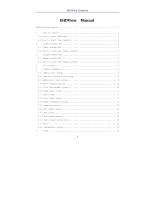
EHDView Contents
Open the catalog to page 2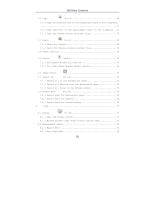
EHDView Contents 7.2 Copy
Open the catalog to page 4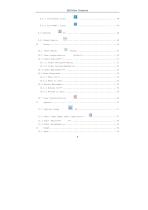
EHDView Contents 9.2.1 Icon>Large Icons 11.2 Start Time-lapse (Auto Capture)••• 11.3 Start Record•••
Open the catalog to page 6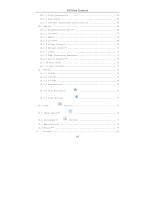
12.3.6 Flip Vertical 12.4 Crop 12.5 Image Scale••• 12.6 Histogram•••
Open the catalog to page 7
EHDView Contents 13.1 Stitch•••
Open the catalog to page 8
EHDView Contents 14.10 Rename••• 14.12 Export to Microsoft Excel 15 15.1 Object Select 15.2 Angle 15.4.2 Line> Horizontal Line 15.4.3 Line> Vertical Line 15.5 Parallel
Open the catalog to page 10
EHDView Contents 15.8 Rectangle 15.10.3 Circle>Three Points 15.11 Annulus
Open the catalog to page 11
EHDView Contents 16.1 Preferences•••
Open the catalog to page 12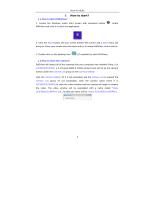
1.1 How to Start EHDView? 1. Invoke the Windows metro start screen with keyboard button EHDView and click it to start the application. 2. Click the Start button (At your screen bottom left corner) and a Start menu will bring up. Move your mouse over the menu and try to locate EHDView, click to start it. 1. Double click on the desktop icon “ ” (If installed) to start EHDView; 1.2 How to start the camera? EHDView will detect all of the cameras that your computer has installed (Here, it is U3CMOS03100KPA, a 3.1M pixel USB3.0 CMOS camera) and will list all the camera names under the Camera List group...
Open the catalog to page 13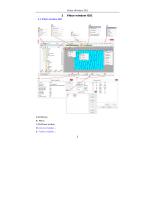
A:EHDView; B: Menu; C:EHDView toolbar D:Camera Sidebar ; E: Folders Sidebar ;
Open the catalog to page 14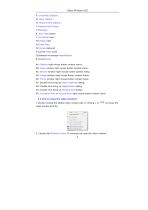
F: Undo/Redo Sidebar ; G: Layer Sidebar ; H: Measurement Sidebar ; I: Measurement Sheet; J:Statusbar; K: Auto Hide button L: Horizontal ruler; M:Vertical ruler N:Frame Rate O:Frames captured P:Current Video sizes Q:Selected microscope Magnification R:Current Unit; AA: Sidebar right mouse button context menu; AB: Video window right mouse button context menu; AC: Browse window right mouse button context menu; AD: Image window right mouse button context menu; AE: Frame window right mouse button context menu; AF: Double-click bring up Video Properties dialog; AG: Double-click bring up Magnification...
Open the catalog to page 15
Video Window GUI 3. Click the right mouse button on the video window title to invoke the context menu and choose Close to the video window. 4. Press Ctrl+W.
Open the catalog to page 16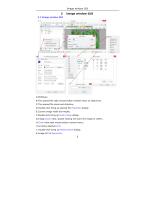
A:EHDView; B:The opened file right mouse button context menu on status bar; C:The opened file name and directory; D:Double-click bring up opened file Properties dialog; E:Current image width and height; F:Double-click bring up Scale Image dialog; G:Image Zoom ratio, double-clicking will zoom the image to 100%; H:Zoom ratio right mouse button context menu; I:Currently selected Unit; J: Double-click bring up Measurement dialog; K:Image BPP & Resolution;
Open the catalog to page 17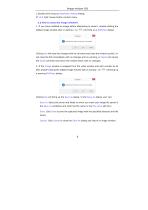
Image window GUI L:Double-click bring up Resolution Setting dialog; M: Unit right mouse button context menu. 3.2 How to close the image window? 1. If you have modified an image before attempting to close it, double-clicking the tabbed image window title or clicking x on will bring up a EHDView dialog: Clicking Yes will save the changes with its old name and close the window quickly, No will close the file immediately with no changes and no warning, or Cancel will cancel the Close command and leave the window there with no changes; 2. If the Image window is snapped from the video window and with...
Open the catalog to page 18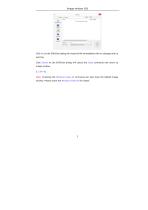
Click No on the EHDView dialog will close the file immediately with no changes and no warning Click Cancel on the EHDView dialog will cancel the Close command and return to image window. 3. Ctrl+W; Note: Choosing the Window>Close All command can also close the tabbed image window. Please check the Window>Close All for detail.
Open the catalog to page 19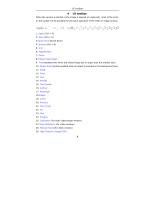
4 UI toolbar When the camera is started or the image is opened (or captured), most of the icons on the toolbar will be available for the quick operation of the video or image window. 1 3 H 7 q ti A J/ \ Pixel v NA I - 100* * 1 n|f) 1 1: Open (Ctrl + O) 2: Save (Ctrl + S) 3:Quick Save (Quick Save) 4: Browse (Ctrl + B) 5: Unit 6: Magnification 7: Zoom 8:Video/Image Select 9: Track(enabled only when the video/image size is larger than the window size) 10: Object Select(will be enabled when an object is overlaid on the background layer 11: Angle 12: Point 13: Line 14: Parallel 15:...
Open the catalog to page 20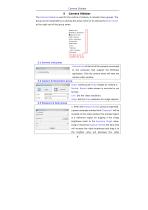
5 Camera Sidebar The Camera Sidebar is used for the control of camera, it includes many groups. The group can be expanded by a) clicking the group name or b) clicking the Down Arrow at the right end of the group name. 0Caaera List ■Capture t Resolution ^Imosure I Cain Ikfhlln Balance w Col or Adjustaent - Fraac Rate •Color/Cray A flip ’ SaapI lfix Power Frequency DUtagru The down arrow to expanded the group Camera List will list all of the cameras connected to the computer that support the EHDView application. Click the camera name will start the camera video window. Snap: Continuously Snap images...
Open the catalog to page 21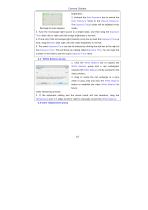
Camera Sidebar brightness; 2. Uncheck the Auto Exposure box to switch the Auto Exposure mode to the Manual Exposure. The Exposure Target slider will be disabled in this Rectangle for Auto Exposure 3. Tune the microscope light source to a bright state, and then drag the Exposure Time slider left or right until the image brightness is normal; 4. If and only if the microscope light intensity is too low to meet the Exposure Time up limit, drag the Gain slide right until the video brightness is normal; 5. The exact Exposure Time can also be entered by clicking the edit box at the right of the Exposure...
Open the catalog to page 22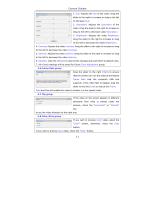
Camera Sidebar 1. Hue: Adjusts the Hue of the video. Drag the slider to the right to increase or drag to the left to decrease Hue; 2. Saturation: Adjusts the Saturation of the video. Drag the slider to the right to increase or drag to the left to decrease video Saturation; 3. Brightness: Adjusts the video Brightness. Drag the slider to the right to increase or drag to the left to decrease the video Brightness; 4. Contrast: Adjusts the video Contrast. Drag the slider to the right to increase or drag to the left to decrease the video Contrast; 5. Gamma: Adjusts the video Gamma. Drag the slider...
Open the catalog to page 23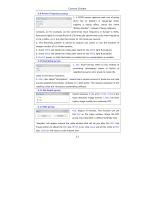
Camera Sidebar 5.9 Power Frequency group 1. A CMOS sensor captures each row of pixels (from top to bottom) in sequential order, creating a rolling effect, hence the name "Rolling Shutter". Instead of being relatively constant, so for example, as the commercial main frequency in Europe is 50Hz, fluorescent lights in Europe flicker at 100 times per second and as the main frequency in US is 60Hz, so in the USA they flicker at 120 times per second; 2. This flickering problem is solved by capture row pixels in over the duration of integer number of (n) flicker periods; 3. check 50HZ will delete the...
Open the catalog to page 24All EHD imaging catalogs and technical brochures
 UV‐Camera SCM2020‐UV
2 Pages
 EHD-0016SWIR
2 Pages
 IK1523
2 Pages
 IK1513-2.2µm
2 Pages
 IK1513
2 Pages
 INGAAS USB2.0 CAMERA
1 Page
 EHD Brochure
21 Pages
 EHD F0.85 Lenses 2020
5 Pages
 Computar
7 Pages
 MERCURY SERIES
4 Pages
 Zoom Lens Series
11 Pages
 MPZ Series
2 Pages
 NIR-Camera
2 Pages
 SIGNA Series
2 Pages
 High Speed Filter wheels
2 Pages
 MERCURY Camera Series
18 Pages
 12MP Camera
2 Pages
 Industrial Lighting 2018-19
43 Pages
 Color Filter Wheels
2 Pages
 EHD-UK39266
1 Page
 KL400
KL4005 Pages
 EHD720p/1080i
9 Pages
 EHD 2/3" SWIR Lenses
2 Pages
 EHD 1" SWIR Zoom-Lenses
1 Page
 EHD 1" SWIR Lenses
2 Pages
 Sled-1-VA
43 Pages
 SLED-2-TU-W Light tunnel series
43 Pages
 EHD UV Lens
2 Pages
 EHD SCM2020-UV
2 Pages
 EHD-704UV
2 Pages
 EHD-Zoom6.5 / 8.0 / 12.5
14 Pages
 SCM305-C
2 Pages
 Alta F Series
7 Pages
 EHD SCM-Series
9 Pages
 EHD SciCam-Series
14 Pages
 EHD Kepler-Series
4 Pages
 EHD_Ricoh_FAlenses
47 Pages
 1.1" 12 MP CBC lenses
4 Pages
 EHD FA lens overview
4 Pages
 Hummingbird USB 3.0
2 Pages
 EHD_Zoom_lenses
14 Pages
 12.5X Macro Zoom Lens system
7 Pages


- Digital imager
- Visible imager
- Industrial camera module
- Automation software solution
- Infrared imager
- Full-color camera system
- Real-time software
- Windows software
- USB camera module
- Detection camera system
- Monitoring software solution
- Monochrome camera module
- Image processing camera module
- Industrial software
- GigE Vision camera
- Inspection imager
- HD camera module
- Automated software
- Temperature-controlled camera