
- Catalogs
- EHC Teknik
- Catalytic Converter

Catalytic Converter

Catalytic Converter
The document discusses the use of catalytic converters in various machinery such as forklift trucks, power generators, and construction equipment. These converters transform harmful exhaust gases like unburned hydrocarbons, carbon monoxide, and aldehydes into non-toxic carbon dioxide and water through catalysis using noble metals like platinum, palladium, and rhodium supported on a metallic honeycomb structure.
- Reduced back pressure due to thinner metallic honeycomb walls (0.04mm) compared to ceramic (0.15mm).
- Smaller size due to reduced internal structure and catalytic mass.
- Greater robustness and resistance to fractures compared to ceramic honeycomb.
- Faster temperature reach and higher efficiency due to metal's conductivity, beneficial for intermittent use.
The catalyst is installed near the exhaust manifold to maximize efficiency at high temperatures. It becomes operational at 180/200°C, achieving 90% pollutant elimination at 250°C. It does not replace the original silencer.
No planned maintenance is required due to high operating temperatures. However, cleaning every 500 hours is recommended by soaking the catalyst in hot soapy water for 5 hours, followed by thorough drying before reinstallation.
Theoretically unlimited due to catalytic reaction, but practical life is around 10,000 hours due to factors like engine tuning, vibration, and abrasive fumes.
Catalog excerpts
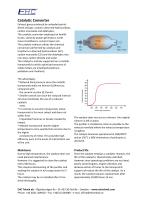
Catalytic Converter Exhaust gases produced by unleaded petrol, diesel and gas, contain unburned hydrocarbons, carbon monoxide and aldehydes. The catalytic converter employed on forklift trucks, stand‐by power generators, earth movers bulldozers, cement mixers etc. The catalytic exhaust utilizes the chemical conversion performed by catalysis and transforms unburned hydrocarbons (HC), carbon monoxide (CO) and the aldehydes into non‐toxic carbon dioxide and water. The catalyst is entirely supported on a metallic honeycomb to which optimized amounts of noble metals are employed (platinum, palladium and rhodium). The advantages: * Reduced back pressure since the metallic honeycomb walls are thinner (0,04mm) as compared with the ceramic version (0,15mm). * Smaller overall size since the reduced internal structure facilitates the use of a reduced catalytic mass. * In contrast to ceramic honeycomb, metal honeycomb is far more robust and does not suffer from irreparable fractures or breaks created by impact. * Metallic honeycomb reaches higher temperatures more quickly than ceramic due to the higher conductivity of metal. This provides high efficiency even in the event of intermittent use of the unit. The catalyst does not act as a silencer the original silencer is left in place. The purifier is installed as close as possible to the exhaust manifold where the exhaust temperature is highest. The catalyst becomes operational at 180/200°C and at 250°C a 90% elimination of pollutants is achieved. Product life Due to high temperature, the catalyst does not need planned maintenance. However it is suggested to clean the catalyst every 500 hours. This requires dismounting of the purifier and soaking the catalyst in hot soapy water for 5 hours. The catalyst may be re‐installed after it has dried thoroughly. Since the catalyst employs a catalytic reaction, the life of the catalyst is theoretically unlimited. However since operating conditions are not ideal; poorly tuned engines, engine vibration and abrasive action of fumes to the honeycomb support all reduce the life of the catalyst. As a result, the catalyst requires replacement after approximately 10,000 hours of use. EHC Teknik ab – Ögärdesvägen 8a – SE‐433 30 Partille – Sweden – www.ehcteknik.com Phone. +46 (0)31 449020 – Fax. +46(31) 444980 ‐ e‐mail. [email protected]
Open the catalog to page 1All EHC Teknik catalogs and technical brochures
 EHC Particle Filter - UK
2 Pages
 EHC Particle Filter
12 Pages
Archived catalogs
 EHC Abgasfilter
12 Pages
 EHC PF
5 Pages


