

Corrosion in stainless steel

Corrosion in stainless steel
Effect of Passivation Film on Stainless Steel Surface Potential
The document presents data on the influence of a passivation film on the surface potential of stainless steel. A graph shows surface potential (in millivolts) over time (minutes), comparing stainless steel exposed with a passivation film versus a reference line of cement-coated steel. The presence of chromium (Cr), iron (Fe), and oxygen (O) is noted, indicating the chemical composition of the passivation layer. The data highlight the immediate changes in surface potential following the removal of the chromium-oxide layer, emphasizing the protective role of the passivation film in maintaining surface stability.
Resistance to Crevice Corrosion
A second section details the resistance of various stainless steel grades to crevice corrosion under different chloride ion concentrations (Cl- ppm) and temperatures (°C). The steels evaluated include 316L, 17-14-4LN, 2205, 904L, 625, and 254 SMO. The temperature range spans from 0°C to 100°C, while chloride concentrations vary from 200 ppm up to 50,000 ppm.
The corrosion behavior is categorized into three stages: primary corrosion, initial pit formation, and secondary corrosion. The data imply that higher alloy grades such as 254 SMO and 625 exhibit superior resistance to crevice corrosion, especially at elevated chloride levels and temperatures, compared to lower grades like 316L.
Key Insights and Recommendations
- Passivation films significantly enhance the surface potential stability of stainless steel, reducing susceptibility to corrosion.
- Removal of the chromium-oxide layer leads to immediate changes in surface potential, underscoring the importance of maintaining this protective layer.
- Selection of stainless steel grade should consider operating temperature and chloride concentration to mitigate crevice corrosion risks.
- Higher alloyed stainless steels (e.g., 254 SMO, 625) are recommended for environments with high chloride content and elevated temperatures due to their superior corrosion resistance.
Catalog excerpts
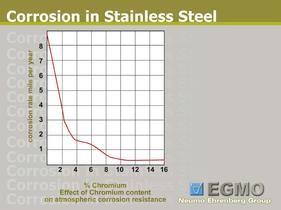
Corrosion in Stainless Steel Effect of Chromium content jjj J7J <^J on a.mospneric corrosion r^tonce KM Sfc^ ^
Open the catalog to page 2
Corrosion in Stainless Steel Immediately after Cr-Oxide layer removal surface potential of stainless steel
Open the catalog to page 3
Corrosion in Stainless Steel * EROSION / CORROSION * PITTING (halide ions, mainly CI")
Open the catalog to page 4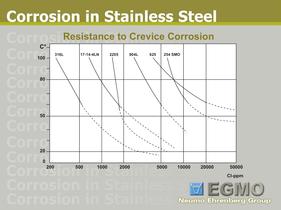
Corrosion in Stainless Steel Resistance to Crevice Corrosion
Open the catalog to page 5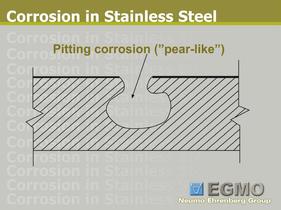
orrosion in Stainless Steel Pitting corrosion ("pear-like")
Open the catalog to page 7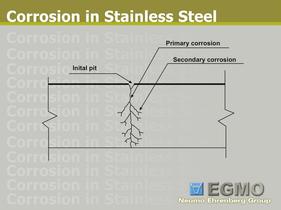
Primary corrosion Secondary corrosion Inital pit
Open the catalog to page 8All EGMO LTD. catalogs and technical brochures
 TMX Control Head
2 Pages
 ESV CATALOG
4 Pages
 MAXCLEAN
2 Pages
 PVE LEAFLET
2 Pages
 TWISTMAX CATALOG
17 Pages
 SOLAR CATALOG
2 Pages
 SCIMAX CATALOG
36 Pages
 MAXPURE CATALOG
52 Pages
 EGMO GENERAL LEAFLET
2 Pages
 Mobile CIP
8 Pages
 Butterfly valve
12 Pages
 Sanitary Equipment Line
51 Pages
 CF Flanges
36 Pages
 ASA Fanges
16 Pages
 ISO Fanges
16 Pages
 Weld Fittings
16 Pages
 Surface characterizations
12 Pages
 Semi-Conductor industry
23 Pages
 stainless steel
13 Pages
 Orbital Welding
23 Pages
 AL-6XN
2 Pages
 880 Elbow
2 Pages
 ASME BPE
11 Pages
 Flanges
20 Pages
 Vessels & Reactors
6 Pages
 Sampling Valves
4 Pages
 Single Seat
2 Pages
 Butterfly & Ball - Midi
3 Pages
 Butterfly & Ball - Mini
4 Pages

- Fitting
- Vessel
- Pneumatic fitting
- Stainless fitting
- Stainless steel vessel
- Cylindrical cap
- T-shaped fitting
- Vertical tank
- Weld-on fitting
- Y fitting
- Stainless steel flange
- Cross fitting
- Process tank
- Pharmaceutical industry fitting
- Metal cap
- Mounting plate
- Through-hole flange
- Ferrule
- Stainless steel adapter
- Stainless steel cap