
- Catalogs
- EGE-Elektronik Spezial-Sensoren GmbH
- Flow Sensors

- Products
- Catalogs
- News & Trends
- Exhibitions
Flow Sensors

Flow Sensors
- SDN 552/554 Series: Based on the thermal principle, these sensors measure flow rates from 0.05 to 100 l/min and display the results digitally.
- SDV 652 Series: Utilizes the vortex principle for applications requiring high linearity and precision.
- SDI 852/853 Series: Employs a magnetic-inductive principle, suitable for precise flow measurements in automation processes.
- LDV 1025 and LDV 1040: These sensors are installed inline in pipes and do not require special measures for dehumidification or filtering of compressed air. They operate optimally within specified pressure ranges, with diagrams indicating their working range.
- LDS 1000: An immersion sensor used in compressed air lines from DN 40. It calculates flow rate based on internal pipe diameter and provides data via an IO-Link interface. The sensor accounts for pressure and temperature variations in its measurements.
- Sensors require straight inlet and outlet sections without steps to achieve specified deviations.
- Installation involves cutting ring fittings, and the required run-in and run-out distances depend on pipe routes and upstream controls.
- These series include probes with various thread designs (G1/2, G1/4, M18x1.5) and are made from materials like stainless steel and PTFE. They are suitable for different temperature ranges and pressures, with specific models designed for high temperatures up to 160°C.
- Probes are available in standard, short, extra-long, and high-temperature designs, with detection ranges specified for water and oil.
- Compact models with robust stainless steel housing, designed for DC-PNP output and screw-in or plug-in installation. They feature LED-array displays for flow indication and are protected to IP 67 standards.
- These models offer AC/DC compatibility with PNP and relay outputs, suitable for universal use with adapters.
- Sensors are equipped with M12 connectors and require specific amplifiers (SKM, SKZ) for operation.
- Accessories include connecting cables and screw-in adapters, enhancing installation flexibility.
- Supply Voltage: Options include 24 DC ±20%, 115 AC ±15%, and 230 AC ±15%.
- Current Consumption: Varies by model, generally less than 100 mA.
- Switching Voltage and Current: Maximum switching voltage is 250 AC / 60 DC, with a maximum switching current of 4 A AC / 4 A DC.
- Switching Power: Up to 1000 VA / 60 W for most models.
- Temperature Range: Ambient temperature from -20 to +70°C, medium temperature from -20 to +80°C.
- Compressive Strength: Rated at 100 bar.
- Material: Sensor material is AISI 316 Ti, housing material is PBT.
- Protection: IP 67 or IP 65 depending on the model.
- Models are available with G1/2 and M18x1.5 threads, with sensor lengths ranging from 31 mm to 120 mm.
- Detection range for water is 1 to 150 cm/s and for oil is 3 to 300 cm/s.
- PNP and relay outputs are available, with some models offering dual PNP outputs or analog outputs (4...20 mA).
- Some models include temperature control capabilities, with temperature detection ranges from 0 to +80°C.
- Accessories include connecting cables and screw-in adapters.
- Material: Housing made of PBT, sensors made of AISI 316 Ti or AISI 316 L.
- Protection: IP 67 or IP 68 as per EN 60529.
- Connection: M12 connector, with various cable types available as accessories.
- Supply Voltage: Typically 24 DC ±10% or ±20%.
- Compressive Strength: Ranges from 10 to 100 bar depending on the model.
- Series SD 5000: Inline probes with detection ranges from 0.001 to 6 l/min, suitable for ambient temperatures from -20 to +70°C and medium temperatures from 0 to +80°C.
- Series SDN 500: Compact sensors with PNP, relay, and analog outputs, designed for flow rates up to 40 l/min and temperatures up to +80°C.
- Series SDNC 503: Inline-Compact sensors with IO-Link capabilities, offering adjustable detection ranges and parameters for various liquid media.
- Series SCB/STB/STC: Designed for food and pharmaceutical applications, featuring triclamp connections and high compressive strength up to 100 bar.
- Series SDB 500: Inline-Compact probes for food and pharma, with triclamp connections and detection ranges from 0.01 to 6 l/min.
- Fast reaction times and high sensitivity for precise flow monitoring.
- Configurable via IO-Link for enhanced control and data management.
- Designed for easy integration into existing systems with minimal setup required.
- Series SDB 510: Includes models SDB 510 GSP, SDB 510 GR, and SDB 510 GA. These models operate at a supply voltage of 24 DC ±10% and have a current consumption of less than 50 mA. They feature a PNP relay output and a non-linear 4...20 mA output. The ambient temperature range is 0...+60°C, with a medium temperature range of -20...+80°C. The protection rating is IP 67.
- Series SDN 500: Models include SDN 506 GSP-CER, SDN 506 GR-CER, and SDN 506 GA-CER. These sensors are designed for a detection range of 0.005...3 l/min and a working range of 0.02...3 l/min. They also operate at 24 DC ±10% with a current consumption of less than 50 mA. The protection rating is IP 67.
- Series SNS 552: The SNS 552 GAPL model supports a flow water range of 0.05...3.00 m/s and is configurable via IO-Link. It operates at a supply voltage of 18...30 DC with a current consumption of less than 120 mA. The protection rating is IP 67.
- Series SDN 550: This series includes models like SDN 552/1 GPP and SDN 552/2 GAPP, designed for water and water-glycol mixtures. They feature programmable functions and a protection rating of IP 65.
- Series SDV 600: The SDV 652/1 GAPP model is a vortex-measuring device with a working range of 2...20 l/min and a precision of less than 2% at 15...50°C. It features programmable functions and a protection rating of IP 65.
- Series SDI 850: Magnetic flowmeters like SDI 852/1 GAPP and SDI 853/1 GAPP offer a working range of 0...40 l/min with a measurement error of less than 2%. They include programmable functions and a protection rating of IP 65.
- All models feature an M12 connector for easy integration.
- Most models offer programmable functions such as switching point, hysteresis, and time on/off delay.
- Protection ratings vary between IP 65 and IP 67, ensuring durability in various environments.
- Materials used include PBT for housing and various sensor materials like AISI 316 L, AL2O3, and PVDF.
- These sensors are suitable for flow and temperature monitoring of water and water-based liquids.
- They are designed for use in inline-compact systems with digital displays.
- Some models are specifically designed for chemical applications and are metal-free in contact with media.
- Various connecting cables and mounting plates are available for different models.
- Optional adapters and IO-Link-USB-Master-Set are also provided for enhanced functionality.
- Materials: Sensors are made from materials like AISI 316 Ti, AISI 303, and PBT, with options for different materials upon request.
- Protection: The sensors comply with protection standards such as IP 65, IP 67, and IP 68 according to EN 60529.
- Connection: Most sensors use M12 connectors or PVC cables for connectivity.
- LTZ Series: Features include a detection range of 0.5 to 30 m/s, IP 67/68 protection, and a start-up time of 10 to 90 seconds.
- LN 500 / LG 500 Series: Compact models with a detection range of 0.5 to 15 m/s, PNP output, and LED display.
- LNZ 450 Series: Offers screw-in mounting, detection range of 0.5 to 30 m/s, and options for PNP or relay outputs.
- LDN 1000 Series: Inline-compact models with IO-Link for mass flow measurement, configurable parameters, and a detection range of 0.2 to 60 m/s.
- LDV 1000 Series: Utilizes the Venturi principle for pressure and temperature monitoring, with a detection range of 3 to 750 Nm3/h.
- LDS 1000 Series: Designed for large pipes, using dynamic pressure principles, with a detection range dependent on pipe diameter.
- Detection Range: Varies across models, from 0.5 m/s to 60 m/s.
- Temperature Range: Typically from -20°C to +80°C for medium temperature.
- Compressive Strength: Up to 30 bar for certain models.
- Output Options: Include PNP, relay, and analog (4...20 mA) outputs.
- Design and Dimensions: The sensors are available in different designs such as G1/2 and DN25/PN40, with sensor lengths ranging from 48 mm to 140 mm.
- Detection Range: The sensors can detect flow rates of 1-100 cm/s for water and 3-200 cm/s for oil. Air flow sensors detect 2-25 m/s.
- Ex Area of Use: The sensors are certified for use in Gas Zones 0, 1, and Partition wall Zone 0/1, and Dust Zones 20 and 21.
- Certificates and Markings: The sensors have ATEX certifications such as TÜV 98 ATEX 1298 X and TÜV 97 ATEX 1218, with Ex markings indicating their suitability for hazardous environments.
- Temperature and Pressure Ratings: Ambient and medium temperature ranges vary by sensor type, with maximum compressive strength up to 60 bar.
- Electrical Specifications: Maximum values include Ui = 13.65 V, Ii = 200 mA, Pi = 0.69 W, Ci = 0.27 nF, and Li = 1.30 μH.
- Materials and Protection: Housing material is AISI 316 Ti, with IP 67 protection rating.
- Connection Types: Sensors are available with fixed cables or M12 connectors, with cable lengths typically 2 m, extendable on request.
- Installation Zones: Specific installation zones are defined for each device category, such as Zone 0 for gas and Zone 20 for dust.
- Amplifier Connection: Instructions for connecting to amplifier SZAb are provided, with additional conditions for use detailed in the "Technique and application" section.
- Extended temperature ranges are available for certain models, up to 120 °C.
- Different housing materials and cable lengths are available upon request.
- Series STS 215 KH: Designed for gas and dust environments, with installation in Zone 0, Zone 1, and Zone 20. It features a detection range of 2-25 m/s, a sensor length of 48 mm, and operates with a fixed cable connection. The ambient temperature range varies from -20°C to +120°C depending on the gas group.
- Series SZAb 400 EX: Available in different models with relay and analog outputs. Suitable for gas and dust environments with specific Ex markings. The ambient temperature range is -20°C to +60°C.
- Series LC 518 and LC 521: Compact models for gaseous media with a detection range of 0.5-20 m/s. They are designed for installation in Zone 2 (gas) and Zone 22 (dust) with PNP and analog outputs.
- Series GK: Designed for connecting supply and signal lines in explosion-hazardous areas of Zone 1 and Zone 21. Available in various models with different dimensions and clamp numbers. They offer increased safety and intrinsic safety for gas and dust environments.
- Used for parametrization of IO-Link devices and monitoring process data. It supports multiple communication protocols and includes accessories like USB and M12 connecting cables.
- Maximum voltage and current values for each device are specified, ensuring safe operation within hazardous areas.
- Protection ratings (IP 20, IP 65, IP 67) indicate the level of protection against dust and water ingress.
- Specific conditions for use are outlined, including the requirement for Ex-amplifiers to be mounted outside hazardous areas.
- Additional housings and terminals are available upon request for junction boxes.
- Cable Plug Housings: Available in straight and angular designs with varying cable lengths and wire specifications. Protection level is IP 67, with a temperature range of -25 to +80°C.
- Preferred Cables: PVC and PUR cables with different wire specifications and color coding. Shielded options are available for specific applications.
- Accessories: Includes flanges, thread sleeves, and adapters for different sensor types, made from materials like AISI 316 Ti and brass.
- Temperature Sensors: Suitable for monitoring in pipes and containers, with a temperature range of -40 to +120°C and pressure up to 100 bar.
- Pressure Sensors: Designed for monitoring pressure up to 16 bar and level up to 10 meters.
- Ultrasonic Sensors: Feature a switching distance up to 6000 mm and watertight housing.
- Metal Detectors: Capable of detecting metal parts in harsh environments with a sensing range up to 400 mm.
- Level Sensors: Suitable for extreme temperatures and chemically aggressive media.
- Infrared Detectors: Used for temperature measurement and monitoring of hot media.
Catalog excerpts

Flow Sensors
Open the catalog to page 1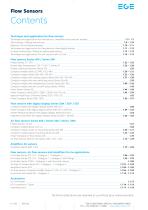
Flow Sensors Contents Technique and application for flow sensors Technique and application for flow sensors, amplifiers and compact models Terminology / Setting instructions Detection of microflow impulses Technique and application for flow sensors inline-digital display Ex area certification / Notes on safety applications Technique and application IO-Link, sensors with IO-Link Flow sensors Series 400 / Series 500 Probes Series ST / STK Probes high temperature 120 °C/160 °C Series ST Probes chemical resistant Series STA Compact models Series SC 440 / SCS 440 Compact models Series SNS 450 / SN...
Open the catalog to page 2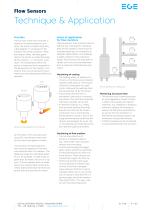
Flow Sensors Technique & Application Function The function of the flow controller is based on the thermodynamic principle. The sensor is heated internally a few degrees °C compared to the medium into which it projects. When the medium flows, the heat generated in the sensor is conducted away by the medium, i. e. the sensor cools down. The temperature within the sensor is measured and compared to the temperature of the medium. The state of flow can be derived for each medium by the temperature difference attained. Areas of application for flow monitors Thermodynamic flow monitors function without...
Open the catalog to page 3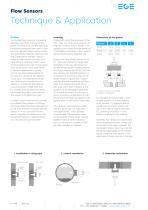
Flow Sensors Technique & Application Probes The temperature-sensitive measuring elements are fitted in the tip of the probe. The probe tip and the adjoining thread/mounting part are made in one piece of stainless steel in many probes. This guarantees absolute tightness and high compressive strength. Special materials are used in corrosive, and particularly in oxidizing media, since stainless steel shows only limited resistance to corrosion in this application. In standard applications, probes can be mounted independently of the direction of flow of the medium. In any case, it is important to...
Open the catalog to page 4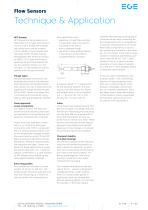
Flow Sensors Technique & Application NPT threads Flange types NPT threads can be provided as an alternative for all types which have a G1/2 or a G3/4 thread. NPT threads are conical and must be screwed into an equally conical counter-part. Two types of NPT threads must be distinguished. NPT thread according to ANSI B 1.20.1 does not ensure a good seal by itself and requires the use of a sealing medium, e.g. Teflon tape. It is not possible to use flat gaskets with this type of thread. Main applications are: • detection of small flow velocities in pipes with large cross section • mounting of the...
Open the catalog to page 5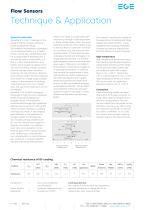
Flow Sensors Technique & Application Special materials Hastelloy B-2 (2.4617) belongs to the group of highly corrosion-resistant nickel-molybdenum alloys. This material has excellent characteristics in reducing media, e.g. in hydrochloric acid of any concentration and for a large range of temperatures. It can also be used in hydrochloric, sulphuric, acetic and phosphoric acid media. Good resistance against corrosion such as pitting, crevice corrosion, chlorine induced stress, corrosion cracking, hair-line corrosion, abrasion and corrosion within the heat influence zone allows for a large range...
Open the catalog to page 6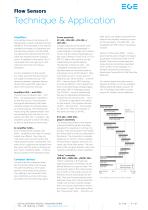
Flow Sensors Technique & Application Amplifiers All amplifiers have a multicolour LED display which visually indicates the flow tendency. If the LED light is red, the preinstalled limit value is not reached and the switching output is not activated. The yellow LED indicates that the limit value was reached and the output is active. In addition to the yellow LED, 4 more green LEDs can light up to indicate how much the limit value is exceeded. For the installation of the amplifiers, make sure that the devices are not subject to heat build-up. The distance between adjacent devices should not exceed...
Open the catalog to page 7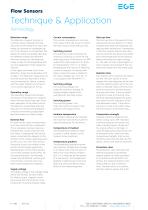
Flow Sensors Technique & Application Terminology Detection range Current consumption Start-up time The detection range of a probe or compact device indicates the flow velocities of the medium for which the probe can provide an analysable signal. If the medium is not specified, the details for water are applied. Because the different media have different thermal conductivity, the detection range as well as the temperature drift are also dependent of the respective medium. At the upper and lower limit of the detection range, the temperature drift is higher. The detection range does not limit the...
Open the catalog to page 8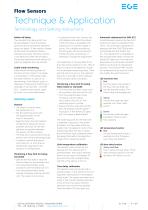
Flow Sensors Technique & Application Terminology and Setting instructions Switch-off delay The variable time delay which can be set between 0 and 25 seconds becomes active during flow standstill (drop-out delay). If the medium ceases to flow and the amplifier display indicates this state, the relay contact is actuated only after the set delay. During the delay period the yellow LED lights up together with the red LED. Cable break monitoring Cable break monitoring shuts off the flow monitor output if no probe is connected or if the probe cable has been severed. In case of cable severing, "flow...
Open the catalog to page 9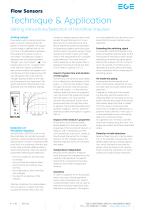
Flow Sensors Technique & Application Setting instructions/Detection of microflow impulses Analog output Flow sensors with analog output supplies a current intensity which depends on the flow speed. The output current range is defined from 4 mA to 20 mA. The dependence between flow speed and output current is non-linear. The detection range is adjusted over two potentiometers: "Range" ( ) and "Adjust" ( ). The lowest value (>4 mA, 1st green LED) is set with the "Adjust" potentiometer at the smallest flow speed to be monitoring and the highest value (20 mA, 5th green LED) is set with the "Range"...
Open the catalog to page 10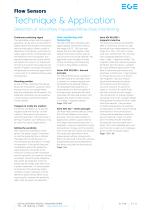
Flow Sensors Technique & Application Detection of microflow impulses/Inline-Flow monitoring Continuous switching signal The adjustable output switching signal extension can be set to a time which is slightly above the duration of the pulse and the interruption. When a pulse is detected in this setting it will cause an output signal which is maintained until the extension time has elapsed. Any new pulse detected during this period will restart the interval. For the period of time during which the pulses are detected in regular succession the device will generate a continuous signal which is only...
Open the catalog to page 11All EGE-Elektronik Spezial-Sensoren GmbH catalogs and technical brochures
 About EGE - Overview
6 Pages
 Accessories M12 Connector
10 Pages
 SDNC 500
2 Pages
 LDS 1000
2 Pages
 LDV 1000
2 Pages
 AGVU
AGVU1 Page
 SDN 550
1 Page
 SCS 440
1 Page
 KBM
KBM1 Page
 Serie cfc
1 Page
 series DN 752
1 Page
 series DGC 075
1 Page
 MFP
MFP1 Page
 TGBA
TGBA1 Page
 Serie AGVU
1 Page
 Serie HGVH
1 Page
 TGM 050 FW T1/T2
1 Page
 GK
GK104 Pages
 Serie IGEXHa
1 Page
 Dust / Gas Series IGEXHa
1 Page
 SDNC500
2 Pages
 SNS 552
2 Pages
 LDN 1000
2 Pages
 SDN 500
2 Pages
 Brochure Pressure-level
8 Pages
 Capacitive Sensors
29 Pages
 Opto high capacity systems
12 Pages
 Series MFP
1 Page
 Series LDN 1000
2 Pages
 Metal detectors
8 Pages
 Ultrasonic Sensors
9 Pages
 Infrared detectors
12 Pages
 Pressure/Level
8 Pages
 demanding environment
16 Pages



Archived catalogs
 Temperature Sensors
12 Pages
 Level Sensors
40 Pages
 Inductive Sensors
72 Pages

- Flowmeter
- Volume flow monitor
- Liquid flow monitor
- EGE proximity sensor
- Level limit switch
- Pressure limiter
- Liquid level detector
- Stainless steel flow monitor
- Single-stage pressure regulator
- EGE liquid level sensor
- Industrial pressure limiter
- EGE cylindrical proximity sensor
- Industrial flow monitor
- EGE inductive proximity sensor
- In-line flow meter
- Membrane regulator
- Water flow monitor
- EGE IP67 proximity sensor