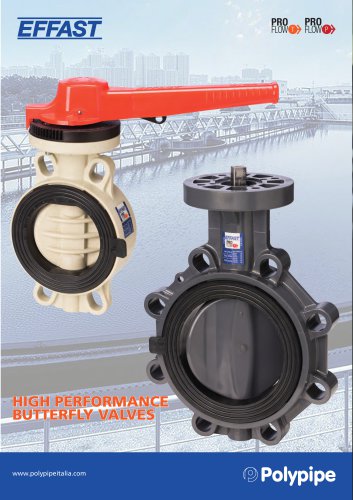
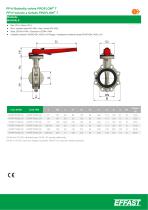
PROFLOW T - PP-H Butterfly valves

PROFLOW T - PP-H Butterfly valves
Overview
This document contains two main technical sections: one on butterfly valves compliant with standard 352)/2:7, and another on EPDM rubber components used in sealing applications. Both sections provide detailed specifications, standards references, dimensional data, installation guidelines, and best practices to ensure optimal performance and compliance in industrial settings.
1. Butterfly Valve Specifications and Performance
- Valve Type and Function: Butterfly valves designed for flow regulation and shut-off, offering smooth operation and positive flow control.
- Pressure and Flow Ratings: Suitable for pressures up to 16 bar; includes tabulated flow coefficients (Kv) and pressure loss coefficients (ζ) for nominal diameters DN 65 to DN 200.
- Leakage and Tightness: Valves meet EN/ISO/DIN and ANSI standards ensuring tight shut-off and minimal leakage.
2. Materials and Construction
- Body Materials: Options include ductile iron, cast iron, and other materials tailored for specific applications.
- Seals and Seats: EPDM or FKM elastomers selected based on fluid compatibility and temperature range.
- Internal Components: Stainless or coated steel shafts and parts for corrosion resistance and durability.
- Standards Compliance: Materials and mounting conform to ISO 5211 and flange standards (ISO/DIN/ANSI/JIS).
3. Installation and Operation
- Mounting: Standardized flange connections and ISO 5211 mounting pads facilitate easy installation.
- Actuation: Compatible with manual, pneumatic, or electric actuators; suitable for integration with control systems.
- Operational Guidelines: Recommendations on maximum pressure, temperature limits, and flow direction to ensure valve longevity.
- Maintenance: Procedures for inspection, lubrication, and replacement of wear parts to maintain valve integrity.
4. Testing and Quality Assurance
- Pressure and Leakage Testing: Conducted per EN/ISO standards to verify tightness and mechanical resistance.
- Certification: Valves comply with official industrial valve certifications ensuring reliability and safety.
5. Technical Data and Tables
- Comprehensive tables provide valve dimensions, weights, flow coefficients, and pressure loss data for various sizes.
- Material composition tables ensure traceability and quality control.
6. Standards and Norms Referenced
- EN/ISO/DIN standards for design and testing.
- ANSI and JIS standards for flange compatibility.
- ISO 5211 for actuator mounting.
- Industry-aligned pressure and temperature ratings.
7. Recommendations and Best Practices
- Correct valve orientation and flow direction during installation.
- Use actuators compatible with valve specifications.
- Regular inspection and timely replacement of seals and seats.
- Adherence to pressure and temperature limits to prevent premature failure.
- Maintain documentation of specifications and test results for quality assurance.
8. EPDM Rubber Components Specifications
- Product Codes and Types: Defines EPDM components with codes such as )+3(3)7-, )+3(3)7<, and )+333)7 representing fully and partially cured bodies and dimensional variants.
- Dimensional Data: Detailed tables list parameters including diameters (1, d, DN), heights (Z, H1, H2, H3), clearances (C1 to C4), additional dimensions (B, Q), and weights in grams.
- Installation Guidelines: Emphasizes compatibility with EN 1629/161 and ANSI flange standards, proper sealing surface maintenance, and correct use of fully or partially cured bodies.
- Standards Compliance: Adheres to EN and ANSI standards for flange compatibility and sealing performance.
9. Legal and Usage Notes
- All descriptions and illustrations are for guidance only; dimensions are nominal and subject to change without notice.
- Information is provided "as is" at the revision date; no automatic updates.
- Users must verify rights and comply with legal requirements; reproduction without consent is prohibited.
10. Critical Information and Best Practices for EPDM Components
- Select correct EPDM code based on application needs (fully or partially cured).
- Verify dimensional compatibility with flange standards before installation.
- Follow installation instructions carefully to maintain sealing integrity and avoid damage.
- Use dimensional tables for precise measurements and weight references.
- Respect legal and copyright notices when using the document.
Summary
This comprehensive technical document provides essential specifications, standards, and guidelines for butterfly valves and EPDM rubber components used in industrial fluid control systems. It ensures high performance, material quality, and compliance with international norms, supporting engineers, installers, and maintenance personnel in achieving reliable and safe operation.
All Effast catalogs and technical brochures
 ABS Solvent welded BS fittings
14 Pages
 TITE & PREMIUM LARGE TITE
4 Pages
 BK1-BX-BV - PVCu Ball valves
8 Pages
 PVCu Accessories & spare parts
39 Pages
 PE100 Fittings
8 Pages
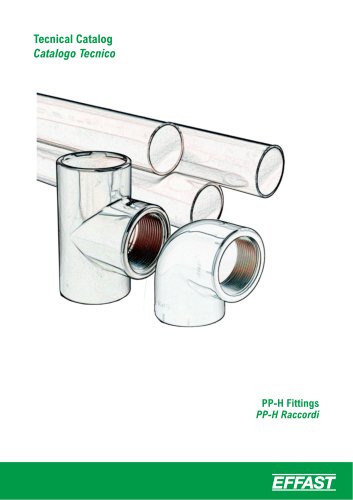 PP-H Raccordi e tubi
13 Pages
 PVCu BSPP fittings
22 Pages
 PVCu Solvent welded BS fittings
13 Pages
 PP-H Fittings
13 Pages
 MV - PP-H Diaphragm valves
12 Pages
 MV - PVC-u Diaphragm valves
15 Pages
 BG - PVC-u Gate valves
3 Pages
 HV - PVC-u Foot valves
7 Pages
 AV - ABS Air release valves
4 Pages
 CB - PVC-u Ball check valves
7 Pages
 CV - ABS Spring check valves
5 Pages
 CV - PVC-u Spring check valve
11 Pages
 CK - PVC-u Wafer check valve
6 Pages
 BT - PVC-u 3 way ball valve
9 Pages