

- Products
- Catalogs
- News & Trends
- Exhibitions
VPLED

VPLED
- Optimized for MCS with 14 pre-set pulse widths from 50 ns to 1 ms.
- External trigger capability for adjusting pulse width and repetition rate.
- Operation in CW mode with spectrally purified output.
- Compact plug-and-play design with extremely low RF radiation.
- Available wavelengths range from 255 nm to 1300 nm with a typical spectral width (FWHM) of 10 ± 4 to 50 ± 5 nm.
- Typical average power in CW mode is 0.1 – 2.0 mW, with peak power at minimum pulse width ranging from 0.4 – 5.0 mW.
- Laser classification is Class 3R for 410 nm – 770 nm and Class 3B for other wavelengths.
- Pulse widths available in ns and μs, with a maximum duty cycle of 50%.
- Bias supply requirements are 15 Vdc +/- 5%, 15W.
- Physical dimensions are 168 mm length x 64 mm x 64 mm, with a weight of 750 g.
Catalog excerpts

VPLED SERIES Adjustable Pulse Width UV & VIS LEDs The VPLED series of LEDs provide variable width pulses from ns to ms, as well as CW operation with powers in the mW range. They are optimised for long photoluminescence lifetime measurements using the Multi-Channel Scaling (MCS) detection method. The width of the excitation pulses is easily controlled from the VPLED allowing quick optimisation of the measurement conditions. The VPLED diodes are compact, maintenance free, and user-friendly. Although they are designed to match Edinburgh Instruments spectrometers, they can be incorporated into any experiment thanks to their external trigger capability. KEY FEATURES Optimised for MCS 14 Pre-set pulse widths from 50 ns to 1 ms External trigger capability Adjust pulse width and repetition rate with input trigger pulse Operation in CW mode Spectrally purified output Compact plug-and-play design Extremely low RF radiation
Open the catalog to page 1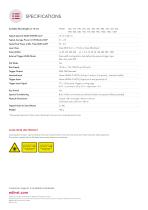
SPECIFICATIONS Available Wavelengths (± 10 nm) Typical Spectral Width (FWHM) (nm)* Typical Average Power in CW Mode (mW)* Typical Peak Power at Min. Pulse Width (mW)* Laser Class Class 3R (410 nm – 770 nm) or Class 3B (others) Pulse Widths External Trigger Width Mode Pulse width and repetition rate defined by external trigger input Max. duty cycle 50% CW Mode Yes Bias Supply Trigger Output Interlock Input Hirose HR10A-7P-4P(73), (Link pin 1 and pin 2 to ground – interlock healthy) Trigger Input Hirose HR10A-7P-4P(73), (Signal pin 4 and ground pin 3) Trigger Input Signal TTL > 50 ns pulse. Trigger...
Open the catalog to page 2All Edinburgh Instruments catalogs and technical brochures
 MicroPL
4 Pages
 VPL
VPL2 Pages
 HPL
HPL2 Pages
 AGILE
AGILE2 Pages
 RM5
RM57 Pages
 EPLED Series
2 Pages
 The Mini- (Mini-tau)
2 Pages
 FLS1000
24 Pages
 LifeSpec II
4 Pages
 DS5
DS54 Pages
 TCC2 Electronics Module
2 Pages
 The FS5 Spectrofluorometer
2 Pages
 SPECTROFLUOROMETER F5
16 Pages
 RMS1000
16 Pages
 295-FIR
2 Pages
 395-FIR
2 Pages
 MTL-5 Mini TEA CO2 Laser
2 Pages
 LP980 Spectrometer Brochure
20 Pages
 PL Series
4 Pages
 FIRL Series Flyer
2 Pages

- Microscope
- Laboratory microscope
- Spectrophotometer
- Laboratory spectrometer
- Pulsed laser
- Solid-state laser
- Visible laser
- Compact spectrometer
- Compact laser
- Precision laser
- Benchtop spectrophotometer
- Process spectrometer
- Automated microscope
- UV spectrophotometer
- Continuous wave laser
- High-resolution spectrometer
- Compact microscope
- High-sensitivity spectrometer
- Continuous laser