
- Catalogs
- Edinburgh Instruments
- EPL Picosecond Pulsed Diode Laser

- Products
- Catalogs
- News & Trends
- Exhibitions
EPL Picosecond Pulsed Diode Laser

EPL Picosecond Pulsed Diode Laser
- 15 pre-set repetition frequencies ranging from 2.5 KHz to 20 MHz.
- External trigger capability and spectrally purified output.
- Compact design with extremely low RF radiation and optimized collimated beam.
- Drive electronics included.
- Laser Class: Class 3R or Class 3B depending on the model.
- Repetition Rate: Options from 2.5 KHz to 20 MHz.
- Bias Supply: 15 Vdc +/- 5%, 15W.
- Trigger Output: SMA, NIM Standard.
- Beam Quality: Near field dimensions and divergence specifications provided.
- Spectral Conditioning: Built-in filter to minimize out-of-band emission.
- Physical Dimensions: 168 mm length x 64 mm x 64 mm, weight 800 g.
Catalog excerpts
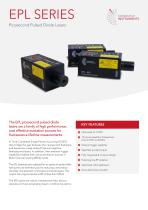
EPL SERIES Picosecond Pulsed Diode Lasers The EPL picosecond pulsed diode lasers are a family of high performance, cost effective excitation sources for fluorescence lifetime measurements. In Time-Correlated Single Photon Counting (TCSPC) they bridge the gap between the nanosecond flashlamp and expensive mode-locked Titanium sapphire femtosecond lasers. In addition, their external trigger capability enables their use as excitation sources in Multi-Channel Scaling (MCS) mode. The EPL lasers are pre-adjusted for an optimum pulse width, with particular attention paid to reducing a secondary shoulder characteristic of picosecond diode lasers. The output has a typical pulse width of less than 100 ps. KEY FEATURES Optimised for TCSPC 15 pre-set repetition frequencies from 2.5 KHz to 20 MHz External trigger capability Spectrally purified output Fully integrated & compact design Extremely low RF radiation Optimised collimated beam Drive electronics included The EPL lasers are robust, maintenance free, easy to operate and have proprietary beam conditioning optics.
Open the catalog to page 1
Typical Pulse Width @10 MHz (ps) Typical Average Power @20 MHz (mW) Typical Peak Power @10 MHz (mW) Laser Class Repetition Rate Bias Supply Trigger Output Interlock Input Hirose HR10A-7P-4P(73), (Link pin 1 and pin 2 to ground – interlock healthy) Trigger Input Hirose HR10A-7P-4P(73), (Signal pin 4 and ground pin 3) Trigger Input Signal TTL > 50 ns pulse. Trigger on rising edge. 0.0 V < Low level < 0.5 V, 2.5 V < High level < 5 V Beam Quality Near field dimensions: ≤4.75 mm (fast axis), ≤1.75 mm (slow axis) Divergence: ≤1.5 mrad (fast axis), ≤0.75 mrad (slow axis) Spectral Conditioning Built-in...
Open the catalog to page 2All Edinburgh Instruments catalogs and technical brochures
 MicroPL
4 Pages
 VPLED
VPLED2 Pages
 VPL
VPL2 Pages
 HPL
HPL2 Pages
 AGILE
AGILE2 Pages
 RM5
RM57 Pages
 EPLED Series
2 Pages
 The Mini- (Mini-tau)
2 Pages
 FLS1000
24 Pages
 LifeSpec II
4 Pages
 DS5
DS54 Pages
 TCC2 Electronics Module
2 Pages
 The FS5 Spectrofluorometer
2 Pages
 SPECTROFLUOROMETER F5
16 Pages
 RMS1000
16 Pages
 295-FIR
2 Pages
 395-FIR
2 Pages
 MTL-5 Mini TEA CO2 Laser
2 Pages
 LP980 Spectrometer Brochure
20 Pages
 PL Series
4 Pages
 FIRL Series Flyer
2 Pages
- Microscope
- Spectrometer
- Laboratory microscope
- Spectrophotometer
- Laboratory spectrometer
- Pulsed laser
- Solid-state laser
- Visible laser
- Compact spectrometer
- Compact laser
- Precision laser
- Benchtop spectrophotometer
- Process spectrometer
- Automated microscope
- UV spectrophotometer
- Continuous wave laser
- High-resolution spectrometer
- Compact microscope
- High-sensitivity spectrometer
- Continuous laser